

Transcribed from handwritten notes and edited by Martin Life 13 Feb 2025
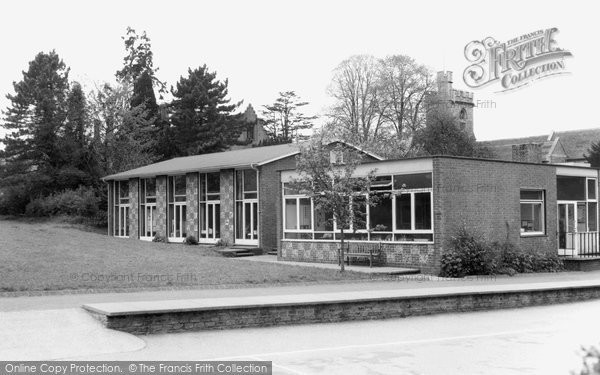
Chenies school, built in 1846, overlooks the lovely green at Chenies and comprised four classrooms – two large and two small. One large room was used for lessons, the other as a hall for drill and dancing – the smaller rooms for dining and a stockroom office, respectively. There was no electric light! When I was appointed, there were only sixteen children on the roll, ages ranging from four to eleven and over. The older children in the village were taken by bus to Chesham. I believe I make a correct statement when I say this was the first school in the county to be ‘decapitated’.
I took up my post with some trepidation, as I had a small son of just five, and I did not know how he would fit into this new scheme of education! I decided that taking him into school with me might prove to be a case of Mary and her little lamb. Accordingly, I made arrangements for Andrew to be taught in the mornings by a retired teacher (Miss Palmer). However, before the end of the term, quite frequently after the 2:30 playtime break, I saw I had another pupil in the back, listening to the story. The schoolhouse, where we now lived, adjoined the playground, and this small person just joined himself onto the end of the line and made his way in with the others! Before the end of a year, Andrew was on the roll. The amusing thing is, without any instruction from me, he always addressed me as Mrs. Life in school.
By this addition, the family atmosphere was strengthened. I must say, though, he made my life much more strenuous. He was full of bright ideas. “Wouldn’t I give a prize to the one who could collect the most wildflowers? Couldn’t we collect butterflies? Would it not be nice to have a bird chart as well as the weather one?” and so on ad lib. The others caught the enthusiasm, and my nature course was more or less drawn up for me.
Bird study was great fun. First of all, we built a bird table, which we could watch from the classroom. Gradually, we brought it nearer and nearer to the window. Finally, we attached a string across almost touching the glass. On this, we fixed pieces of fat, nuts, etc. At one period, we had visiting it at the same moment four varieties of tits: blue, great, coal, and marsh. They would swing and literally play there while we sang or recited or did our usual lessons. The extraordinary thing was, if we had a visit from an official or a manager, the birds seemed to know and would not come near. Directly the visitor departed, they returned. It needed to be seen to be believed! The nuthatch, usually a very shy bird, came to the table and brought her family of three, which she fed with nuts.
We collected moths and butterflies and spent the whole of one afternoon watching an elephant hawk moth sweeping back and forth spinning his cocoon in a match box. The children too collected cocoons, which they put in tins and placed on the top of a cupboard to await spring and learn what lay within. I remember one morning in an arithmetic lesson, a child lifting out a book and exclaiming, “Here’s a tiger moth Governess!” In a few moments, another child found one. They kept producing these like conjurers. There were butterflies on the walls, books, and windows. From whence came they. Suddenly, one child remembered the tins! Yes! Only the husks remained. They had hatched out in the night. How joyous we all were – what a lovely resurrection, and we had played a part in it!
Another of our crazes was mounting orange wrapping papers. We drew maps and put in the places from which the fruit came. Once we could not track down a location of origin. We consulted larger and better maps. No success. My young son, who was becoming a geography fan, would give me no peace until we found the place. At that time, our Rector was a professor at King’s College, and we enlisted his willing aid – but no, his maps were no more helpful than ours! Finally, he asked the professor of Spanish, who was able to give us the required information. It was, he said, but a small village and not usually marked, but it was so many miles southeast of so-and-so. I drew a big sigh of relief when that dot was placed on the map of Spain.
At this point in our history, the number on the roll had dropped to ten, and we were the smallest school in Buckinghamshire. The question arose as to whether a neighbouring village school should be closed. As ours happened to be the better building, we were given another lease of life, with twenty-four pupils from Latimer.
You will probably wish to know if the curriculum varied much from that in town schools. It was very similar with, as you may have gathered, a strong accent on nature study. We had visits from HMIs [His Majesty’s Inspectors] to see if we were up to the educational standard required of us. They were always sympathetic and helpful, but I recall an occasion which gave me some uneasy moments.
One day, Sir Roger Curtis [?- surname indistinct] was questioning the class during a history lesson. My son, who was then seven, seemed to get the lion’s share of the answering. Said Sir R turning to me, “That child should be shut up in a glass case so that the others can get a chance.” To my shame, be it said, I did not claim him as mine! However, I had not drunk to the dregs of my cup of woe: “Who has heard of Alexander the Great?” asked Sir R. Andrew’s hand shot up. As his was the only one, Sir Roger looked at him with a more kindly eye and said, “Yes?” Imagine my horror when my offspring replied quite calmly, “I have heard of him, but I have forgotten what I have heard.” Take heed, ye who listen – do not admit your child as a pupil in your class!
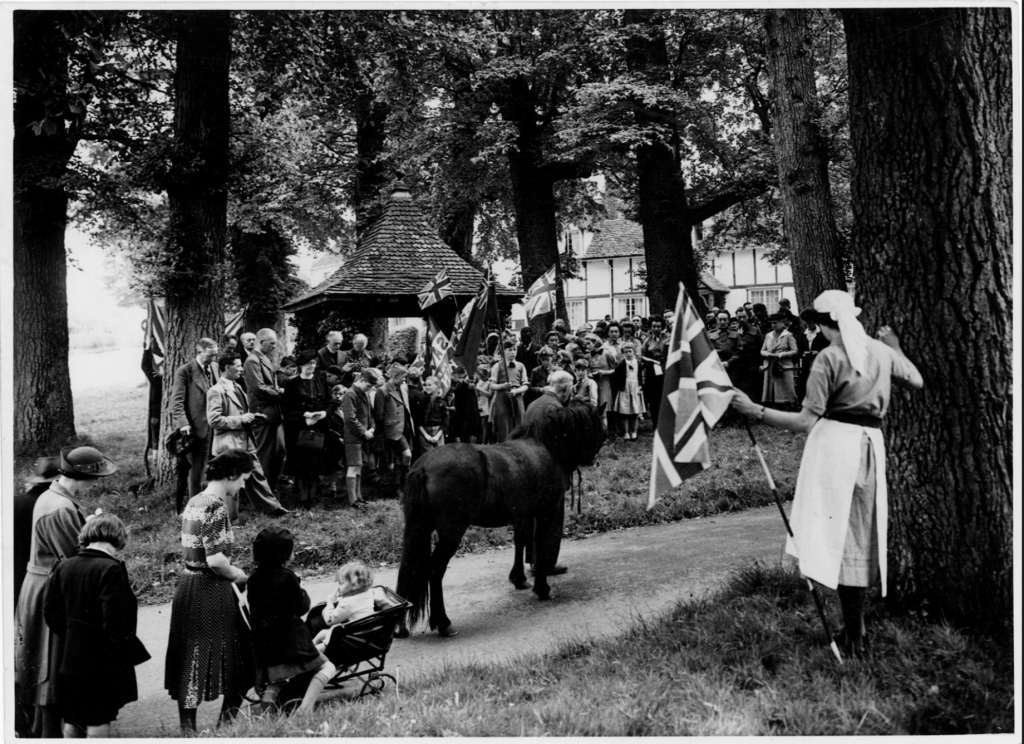
Years passed and our school grew larger till we reached the giddy height of 50 on the roll and we were given a teacher for the infants class. That made life much easier for me, as up till now I had been in sole charge. Then came the war and evacuees and London (LCC) teachers. In one week, our numbers rose to 175 and the staff to six. In a room for 40 we packed 120 children, three in a desk, with two of us to instruct same. From September till May we struggled under those conditions. Perforce we had to take many combined lessons. Heretofore, the singing of my children had been rather weak and colourless. What a change when the LCC children joined in! Believe me everyone in Bucks could have known what we did to the drunken sailor!! No longer did any mistake in my accompaniment sound to high heaven.
I think, though, the spelling lesson was my greatest nightmare. That was taken by an LCC teacher – a man. From some obscure corner he unearthed a long lath. He gave the children a word to spell ten times and beat out the number with a sharp smack of the lath on his desk. The noise was overpowering! The great advantage of the method was that every child in the school could, should he so desire, learn the word at the same time!
The evacuee children were very lovable and brought a breath of fresh air into our lives. They were, too, very amusing. One day some of the children had been teasing a red head calling him ‘ginger’ and ‘carrots’. I, trying to comfort him, said never mind Jimmy, your hair is lovely: I wish mine was that colour. “Oh Governess”, exclaimed six-year-old Joan, “You would look horrid. I like yours best silver”. She it was who gave me one of the greatest compliments in my career. A visitor was examining her handwork and said: “Who thought of doing this?”. “Oh, Governess” she answered, “She’s magic and wonderful”. – I had small hope that the HMI shared her opinion!!
Re my title of “Governess”. One child who had newly joined our company informed her parents she must do so and so – government said so. I was somewhat dismayed though when I heard one class devoutly praying “That all our doings may be ordered by my Governess”! I thought the time had come to substitute another morning prayer.
I would say if you wish to be happy in a village school you need to be a person like Kipling’s sailor – a person of infinite resource and sagacity. You have to fill the post of parent, teacher, doctor, nurse and be ready to meet any emergency. The children trust you to take up any of these roles when circumstances demand it. When they are hurt, they come to you confident you can help. When the damage is too great for you to deal with, they bravely wait and bear the pain uncomplainingly till the Dr. arrives – grateful for your presence and sympathy. When in distress, they come to you for comfort. They give you their trust and affection and tell you their most treasured secrets.
In return, they take the greatest interest in your affairs and take pride in your achievements: wearing a new jumper one morning, a small boy passing me in line paused, looked up, and said “That’s a nice piece of knitting you’re wearing – I didn’t see you doing it.” That child must have been particularly fond of the craft. Thinking about this, I had knitted, in the days of coupons, a pair of silk stockings of which I was rather proud. The time came when they were worn out, so I took them into school and said to him. “You can use these for your rug Stanley…” His response: “Thank you Governess – that’s a good thing, for I ’ates ‘em!”
You will ask perhaps – “With this family atmosphere, did you have discipline?” I reply “Definitely”, and not free discipline at that. We aim at self-discipline – some of the fondest moments in my career were when I had unexpected examples of this.
On the occasion of my mother’s death, I was sent for in the middle of the night. In the morning my husband, on his way to inform the school of my absence, met one of my 11-year-olds. He said “Governess won’t be at school today. She has had to go away. You’ll have to manage on your own.” At 9.30 Mr Owen arrived saw no children, heard no sound. Thought he: “They’ve all gone home.” But no! On opening the door, they were all there doing arithmetic. Betty had rung the bell, taken prayers and set them to work.
Another time the Inspector, Mr. Blockridge, was with me discussing school business in another room. At 11 o’clock, in filed the class. Said Mr B. “What are they doing? You have not rung the bell.” “No”, I said, “but it is 11 o’clock.” “You sit there”, he went on, “I am going to see what they are doing.” On his return he remarked: “Writing – as on the time table” That is my idea of discipline.
In my experience country children are much easier to manage than their town counterparts. They have a sense of humour and respond well to correction given in that spirit. For example, three of my boys were several times caught playing in the girls’ playground. I was afraid lest an infant might be accidentally injured. I mentioned the matter in school and gave the reason why I wished them to remain in their own area. A few days later, I again saw them in the same spot, so I called them over and remarked, “I asked you not to play round the hut. Why are you here?” “We forgot, Governess,” was the reply. “Of course,” I proceeded, “if you were not boys, you could play there. The only thing is to turn you into girls. Come with me.” We went into the house, and I dressed them up in knitted skirts and cardigans – a rust [?], a blue and a grey. They put on the garments without protest – just a shy grin as they viewed one another. When the bell rang, I conducted them to the lines and said, “Here, children, are three new girls—Pansy, Penelope, and Poppy. They will, of course, play in the girls’ playground.” They sat in their strange garb for the rest of the afternoon. Need I say they did not avail themselves of the privileges of their new status. Neither I discovered, did they tell their parents of their experience until years afterwards!
There are, if I am to be perfectly honest, some drawbacks to teaching in a village school. To begin with, the buildings are often not so up to date as those in towns. The classrooms are less convenient, and the furniture old-fashioned and heavy. The cloakroom accommodation is frequently poor. There is probably no staff room, and there is not a full-time caretaker. The teachers have often to cope with his duties. This in itself can be amusing.
One dull winter morning, the electric light bulb in the second infants’ classroom just faded out. The holder was high up, and we had no steps that would reach. Accordingly, the head assistant (who was the same build as myself) placed a box on the teacher’s high chair, which in turn was balanced precariously upon one of the highly polished slippery infants’ [?] tables. One held the chair while the other climbed up on it and inserted the new bulb. While this was going on, from nearby I heard a boy remark in a quiet, half-admiring tone, “The Daring Dexters!” [A BBC radio serial of the early 1950s about circus life] It would have been difficult to imagine anyone less like acrobats than we were!
As regards the staff, I think the country teacher often spends more hours in her classroom than do the town counterparts. There is not such a good bus service, and so one is sometimes obliged to arrive early and stay later. In addition, the pupils remain the whole day, and all take the canteen lunch together—it means there is only a brief break at midday. But it is then that one is told all about the new baby, the party frock mother is making, and the flowers daddy has planted in the garden. One is made a member of their family – a kind of extra auntie.
There is much more I could tell you of the amusing answers we received in class, of our little termly ‘highlights’: A May Queen at Easter, party at Christmas, prize-giving, and sports in the summer. But to do so would be to overrun my time. So, in conclusion, to you who contemplate making teaching your career, I would say that it is a vocation rather than just a profession. It offers you limitless scope for exerting an uplifting influence in the lives of your pupils. It is such a worthwhile occupation. And if you put into it all you have to give, when the day comes to retire, and you have locked up the register for the last time and look round the empty classroom, you too will say, “The lot has fallen to me in pleasant places – Yea -I have a goodly heritage.” (after Psalm 16:5-8 KJV)
content source: Various family archive materials contributor: Martin Life date published: 01/11/2025