

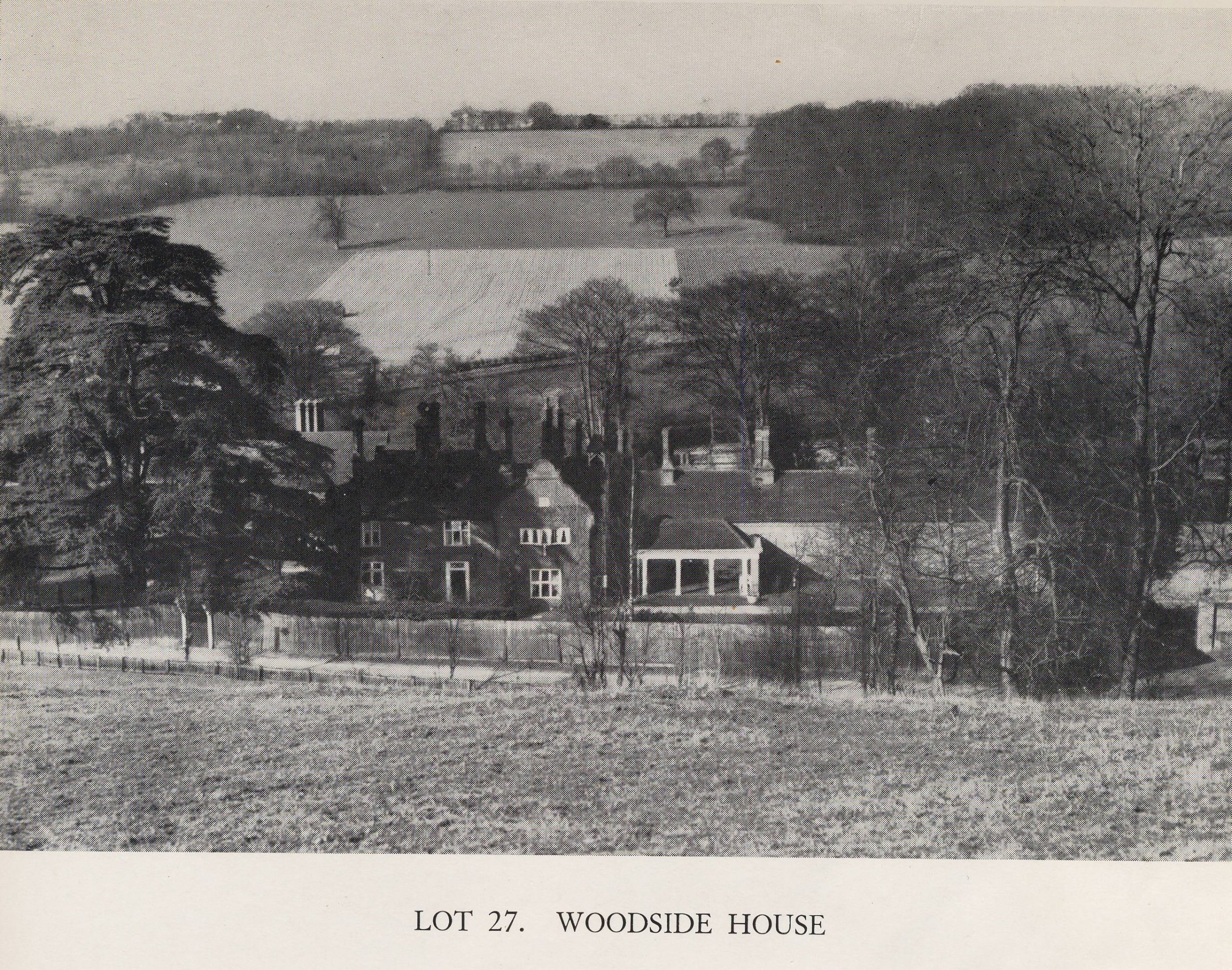
Chenies Place was once a part of Woodside House, started life as a boarding school for ‘young ladies’, where between 1860 – 1887 it educated the daughters of the nobility. The Misses Forbes, sisters Louisa and Evaline, worked there as schoolmistresses along with a language teacher, cook and a variety of domestic servants from the surrounding area. In 1871 there were 12 scholars listed as present for the census, and in 1881 there were 10. Louisa and Evaline were both born at the Russell’s Woburn seat, where their father worked as gardeners.
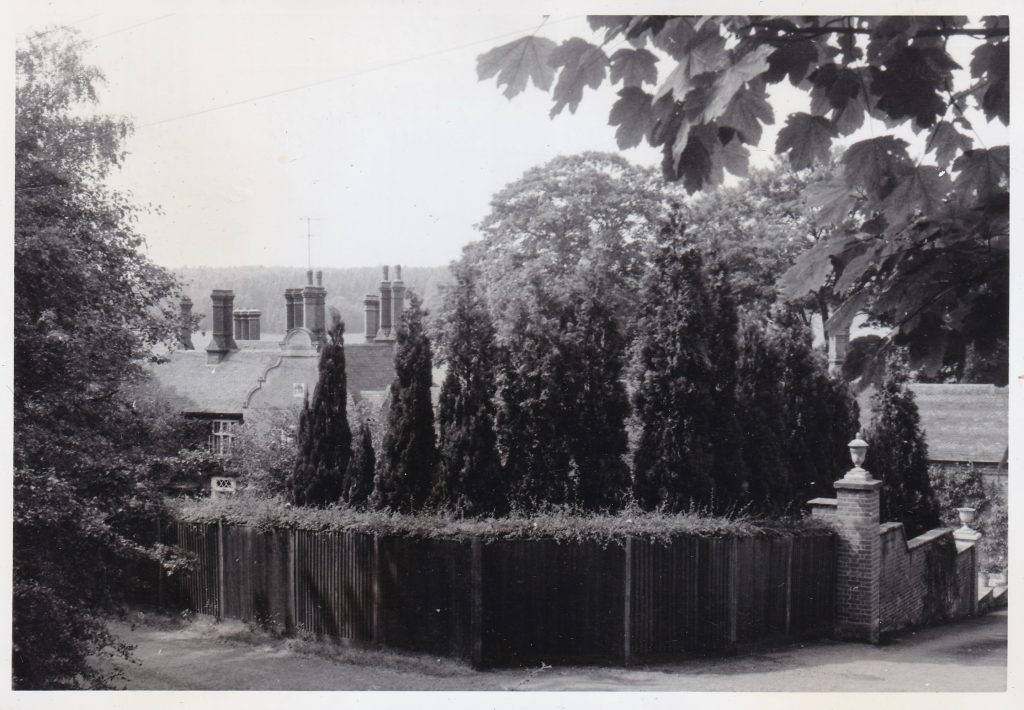
In 1893, on the death of the 10th Duke of Bedford, his widow the Dowager Duchess Adeline Russell bought Woodside House and turned it into a residence. Rose remembers of the Duchess, ‘The Dowager Duchess Adeline of Bedford lived at Woodside House and each year she presented the children of the village with something at Christmas. One year it was a red riding hood cloak for the girls and a red jersey for the boys. Another year it was boots for each child. One year I had a doll but I cannot recall if every girl had one’.
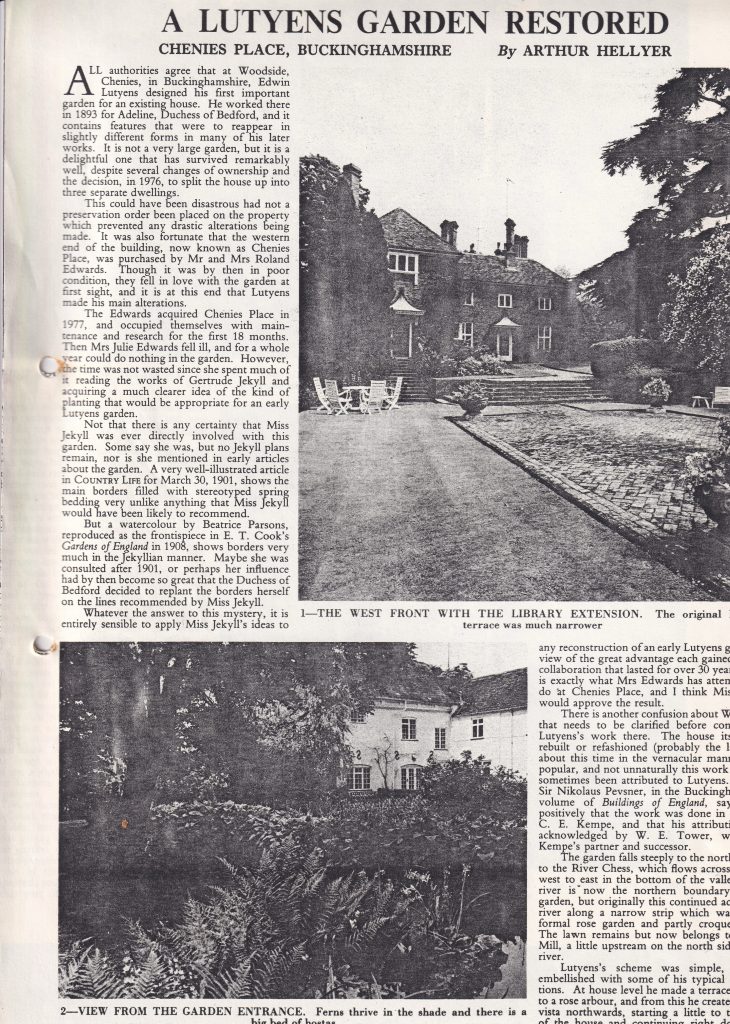
The Duchess built an extension as a chapel (now the dining-room and main bedroom), used the cottage as kitchens and in 1894 she built a stable block and carriage house (now the Court House), but the gardens which now grace Chenies Place were created by Edwin Lutyens, his ‘first important garden for an existing house‘. This 23 year old, unknown and unqualified architect had a sister, Mary Constance Elphinstone Lutyens (1868-1951) who was a scholar at Woodside House between 1884-1885, so Woodside House may have been a personal project for him. Lutyens has since been desribed as the greatest English architect since Wren, and with him he brought his much older friend, Gertrude Jekyll to arrange the planting, who went on to establish herself as the leading plantswoman of her era, who changed the face of English gardening during her lifetime.
Originally the gardens measured 12 acres and took in a wide section across the river Chess. Fourteen gardeners were employed for the upkeep, the herbaceous borders being replanted two or three times a year.
Mr & Mrs R Stafford Charles lived here sometime after the Duchess died in 1920. They had previously lost their son Captain Leslie Stafford Charles during World War 1. Mrs R Stafford Charles started the WI with Miss Wishart at No. 19 in the 20s. In 1946 the house was leased by Air Commodore Benson, and then purchased in 1954 when the Duke’s Estate was sold. It is likely Benson who planted various unusual trees at Woodside, due to his family links with the Westonbirt Arboretum which was owned by his grandfather, Sir George Holford.
In 1976 the property and gardens of Woodside House were divided into six separate dwellings. Chenies Place was bought in 1977 by Roland and Julia Edwards, and they kept the major features of the garden designed by Lutyens and the Jekyll tradition of planting.
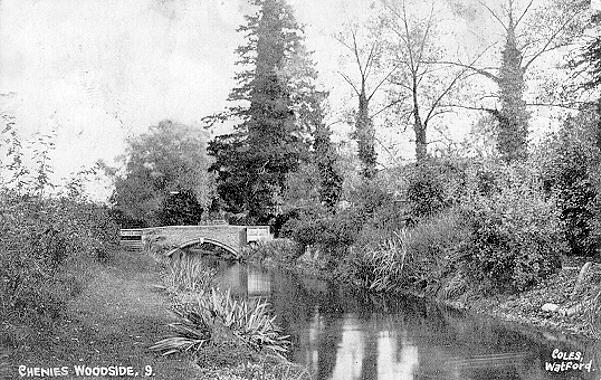
The present gardens fall steeply down to the River Chess, which forms the northern boundary of the garden, though originally it spanned the river to a formal rose garden and croquet lawn. The lawn remains but now belongs to the Mill, a little upstream on the north side of the river.
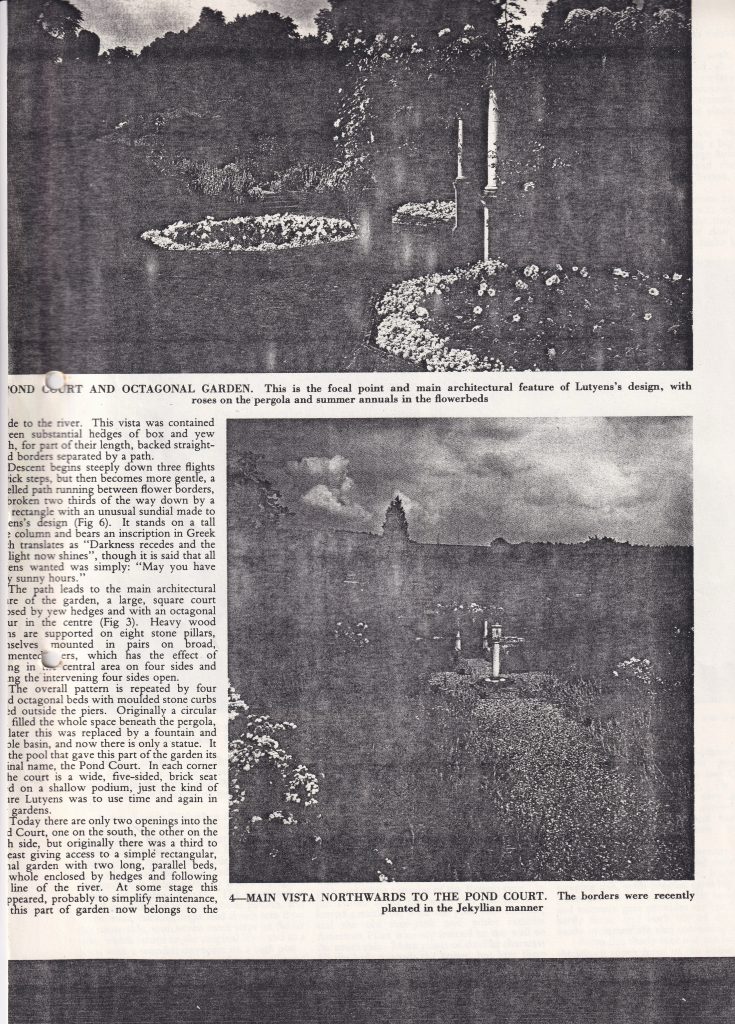
At the house, Lutyens terrace remains, leading to a rose arbour from which the vista northwards to the river is visible, contained between hedges of box and yew. Descent begins steeply from a huge Atlas cedar, over 200 years old, down three flights of steps, becoming a gentle path between flower borders, broken two thirds of the way down by an unusual sundial made to Lutyens’s design. It bears an inscription in Greek which translates as “Darkness recedes and the light now shines“, though it is said that all Lutyens wanted was simply: “May you have many sunny hours”.
The path continues on to the main architectural structure of the garden, a courtyard enclosed by yew hedges, and an octagonal pergola in the centre. Octagonal beds with moulded stone curbs repeat the pattern. Originally a circular pool filled the whole space beneath the pergola, giving this part of the garden its original name, the Pond Court. Now it holds a statue. In each corner of the court is a wide, five-sided, brick seat, in the style that Lutyens favoured.
Today there are only two openings into the Court, one on the south, the other on the north side, but originally there was a third to the east giving access to a simple rectangular garden with two long, parallel beds, the whole enclosed by hedges and following the line of the river. At some stage this disappeared, probably to simplify maintenance. This part of garden now belongs to the middle section of the house, which retains the name Woodside.
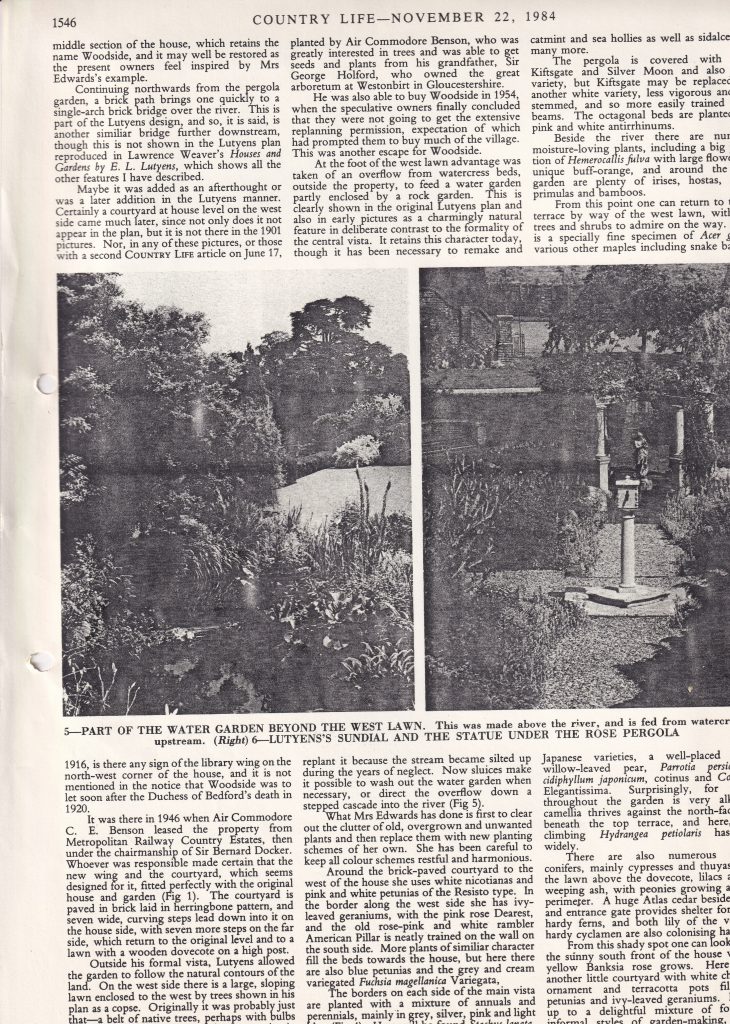
Continuing northwards, a brick path brings one quickly to a single arch brick bridge over the river. This is part of the Lutyen design, though the other bridge may have come later, as did a courtyard on the west side and the library wing on the north west corner of the house. The courtyard is paved in brick laid in herringbone, and has seven wide curving steps lead down into it on the house side, and seven more on the far side leading to the lawn and a wooden dovecote.
At the foot of the west lawn, advantage was taken of an overflow from watercress beds, outside the property, to feed a water garden partly enclosed by a rock garden. Sluices allow it to continue to operate today. A gravel path leads from the bridge to the garden and courtyard of Woodside House.
The garden is listed which prevents alteration to the architectural features without the consent of English Heritage. Planting is at the discretion of the owner, whose efforts to continue the Jekyll tradition are restricted by the lack of fourteen gardeners!
sources:
Chorleywood, Chenies, Loudwater and Heronsgate, a Social History by Ian Foster
Country Life, November 1984 (see above)
contributor: Rachel Bishop, Sandy Homewood
date published: 18/04/26