

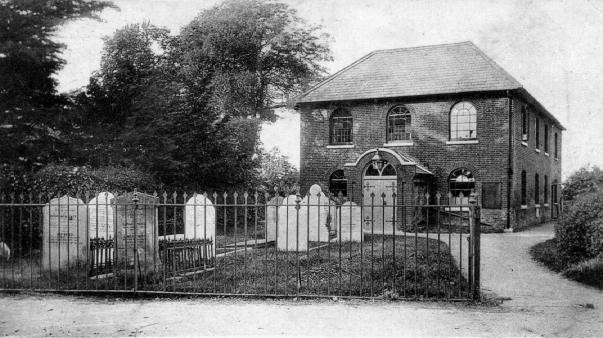
Chenies Baptist Church has been a place of Christian worship for over 250 years and its history cannot be told without first understanding the political and religious shifts that occurred in the preceding years both in the country as a whole, and here in Chenies, and precipitated the building of the chapel in 1778.
Non-conformity had been a latent force in the Chilterns since the turmoil of the Wycliffe era. In a document written about the Chapel’s history in 1978 Christopher Stell tells us that four hundred years before the Baptist Church was formed in Chenies, John Wycliffe’s itinerant preachers were spreading his message amongst the peoples of the Chiltern Hills. Known as Lollardy, this movement took a firm hold, and the subsequent persecution it triggered affected both members of the powerful Cheyne family as well as others from Chenies.
In 1553 John Knox paid a notable visit to the county preaching a most outspoken sermon at Amersham on the eve of the succession of Queen Mary, and the national archives hold a record of this effort in Chenies in the book ‘The Lollards of the Chiltern Hills’,
“Two leading members of the Council at this time, the Earl of Bedford and Sir Thomas Cheyne, were intimately associated with South Bucks. Cheyne belonged to the old Lollard stock already more than once referred to. It is noticeable that Knox seems to have begun his labours near Bed-ford’s seat of Chenies. He may very likely have been entertained at the old manor-house, still standing, which was built a few years before his visit, and perhaps at Lord Windsor’s seat at Bradenham. The Lord Russell to whom he was commended was probably Lord Francis, afterwards the second Earl, a man who not only staunchly supported the cause of Protestantism, but also cherished the traditions of the older reforming movement. At his death in 1585, when he left sums of money for “godly sermons” to be preached in Chenies Church and elsewhere he bequeathed his MSS. of Wycliffe’s works, as a valued possession, to his friend Lord Burleigh; and in the Countess Cowper’s library at Wrest Park is a vellum folio of Wycliffe’s sermons, copied about 1400, bearing the autograph ” Francis Russell ” and the date 1556.”
The Lollards of the Chiltern Hills by W. H Summers
In the following century non conformity began to take hold.
In fact, Christopher notes that in 1662 the Presbyterian rector in Chenies was among the 2000 ministers ejected under the Act of Uniformity, and his name can be read in the internet archives here.
However, it was not until the turn of the seventeenth century that non-conformity became more visible and widespread. Between 1700 and 1724 three non-conformist chapels were built in Chesham, and in 1705 James Newton became a Licensed Dissenting Minister and two cottages in Green Street, outside the Bedford holding, were licensed as meeting houses. James Cannon also became a Licensed Dissenting Minister at Cheynes Lodge in 1708. In 1741 the Newton family of Chenies acquired a licence to use their home as a Baptist meeting house, and from that time the number of people in Chenies becoming Baptists grew rapidly.
By 1760 this group had grown to twenty one and the steward at the Manor House, Mr John Davis, had identified himself with it.
Christopher tells us that the first entry in the Church Book is undated, comprising a carefully written Confession of Faith of 24 articles, and a Church Covenant in five parts. The first dated entry, 20 December 1760, is an agreement concluded on the advice of the Rev. Dr. John Gill, Of Carter Lane, Southwark, whose nephew had succeeded Bennet at St. Albans. From this it appears that some Independents and Presbyterians had assisted in fitting up the meeting place but their inclusion in the Church was causing difficulties for others in the transfer of Church membership. The conclusion reached was to restrict membership so far as possible to Baptists, although in 1764 these conditions were modified to admit Independents ‘upon an impartial confession that they are not ignorant of Believer’s Baptism for want of searching’.
Bennet’s successor was a Mr. Stone whose regular quarterly salary of 16 appears in the accounts from 1761 to 1764; he was transferred to Dr.Gill’s Church in 1765. The first official pastor was Thomas Cromwell from Limehouse whose brief records of Church discipline and membership give a misleading picture of tranquility.
The first meeting-house which till then had sheltered the Church at that time was on ‘Green Street, Chenies, in Bucks’. Green Street was at that time a small hamlet on the main road from Rickmansworth to Amersham, now comprising only Great and Little Green Street Farms, but formerly including the almshouses built in 1605 by the Countess of Warwick and no doubt a few cottages and outbuildings, one of which was converted for use as a meeting-house. No trace of any such building now remains nor has any licence been found for it, but it is quite clear from a reference in the 1760 agreement to persons ‘who contributed to the Expence of fitting up the said Meeting House’ that it was the conversion of an existing building. It was not merely a small room since the accounts, which survive from 1761 to 1774, refer to the existence of a gallery as well as a pulpit with its bible and cushion, a clock, candlesticks, and various charges for minor repairs and regular cleaning. No records appear of any rent paid for the building which most likely would have been lent to the Church by one of its members without further formality.
By 1774 however, a serious disagreement had developed leading to the secession of two deacons and other members. The origins of the quarrel are not clear but deficiency in pastoral visitation is suggested with the possibility of more serious doctrinal differences. Cromwell resigned in 1775, with Hugh Giles his successor, and in addition John Davis, the steward at the Manor House had begun to grow weary of the rector at the church there.
It is known that the Rector of Chenies, who lived within the Anglican church grounds only a few yards from the manor house and had a very comfortable living, yet was continually absent from his parish, and it is very likely that his apathy towards his fellow parishioners greatly influenced John Davis in his opinion of the Church of England. In addition, the Rector had refused to recognise John’s daughter Elizabeth’s marriage to John Lamb. He said that her five children were born out of wedlock, and therefore were registered in baptismal records as being ‘in sin’.
An obvious dilemma had arisen because, being the Duke’s steward, he was expected to follow the Church of England since the Duke was himself an ardent patron and especially as all his ancestors were buried in the Bedford Chapel. Furthermore, the Duke was a great friend of the Rector, Dr Jubb, and so was John Dodd, however not once did the Duke intervene, the reason being that he lived far away at Woburn. The situation came to a climax in 1773 when John Davis resigned his position as steward and became a Baptist.
At the same time as John Davis was growing frustrated with the Anglican church, the Baptists in Green street were starting to be in need of a better meeting place. The first indication that a more, permanent chapel was needed is in a lease of 1 February 1773 of part of the present site in which John Davis grants the Church part of an orchard then occupied by George Cooper subject to six months notice ‘whenever they shall have occasion or think proper to build a Meeting House thereon’.
The following extract from the records of the Baptist Chapel reveals quite clearly the passionate under-currents of the situations:
“In the year 1775, a clergyman officiated at Chenies Church whom the present rector described to me as a wolf in sheep’s clothing. It was a time of great laxity in the discipline in the Church of England, and there were a great laxity of discipline in the Church of England, and there were a great many sporting Parsons whose lives would not bear strict investigation. This man was one of those. My great uncle Mr Davis was at the time steward to the Duke of Bedford and lived at the large house by the Church. He could not stand the goings on of the rector, so he bought two cottages and the field on which the Chapel stands, resigned his office under the Duke, helped to build and gave the land for the chapel, gave the ministers house and the land on which it stands to the cause. The whole was placed in the hands of the trustees, he retaining the cottage and garden lying between the chapel and the minister’s where he ended his days”
As a result of his dissatisfaction with Dr. George Jubb, Mr Davis’s exit from the Anglican communion resulted in a rise in their numbers from 21 to nearly 90. Held in high esteem by the Duke, Mr Davis was able to persuade him to sell him the plot of land on which the chapel was later erected. In addition some cottages were pulled down and the present Manse and adjoining house built. William Davis himself lived in the house next to the chapel, and gave the other (now ‘Kingscote’) for the Manse, but later his house became the Manse instead.
The dramatic resignation of the pastor Cromwell may have delayed the start of this new venture, but by September 1775 Hugh Giles was already active on behalf of the Church representing it at a formative meeting of the Eastern Association. In a letter to the Association of 28 April 1776 the Church reports ‘The Lord is inclining more people to attend upon the word than can be conveniently accommodated with seats in the meeting-house’.
The 1777 letter notes a steady increase in membership. By the time the letter of June 1778 was compiled the new meeting-house had been started, the Church reporting ‘the place we at present occupy for Religious worship far too small to contain the people in a comfortable way and manner which has constrained us to begin building a more commodious and larger house for the worship of God’ and noting that letters asking for assistance had been sent to members of the Association.
On 8 October 1778 the new building was certified to the court of Quarter Sessions as a Place for Religious Worship for Protestant Dissenters and so may be presumed to have been ready for use. The formal vesting of the property was delayed until May 1779 when it was transferred by John Davis to 20 trustees including his son William, sons-in-law Rev.Morgan Jones and John Munn, and the minister Hugh Giles. ‘Kingscote’, then occupied by Giles was included in the deed, but the adjacent cottage, the present manse, remained the property of Davis whose tenant George Cooper was still living there.
One year later John Davis died and was buried with his wife in the Chapel. The stone commemorating them is to be found under the present seating arrangement in the Chapel.
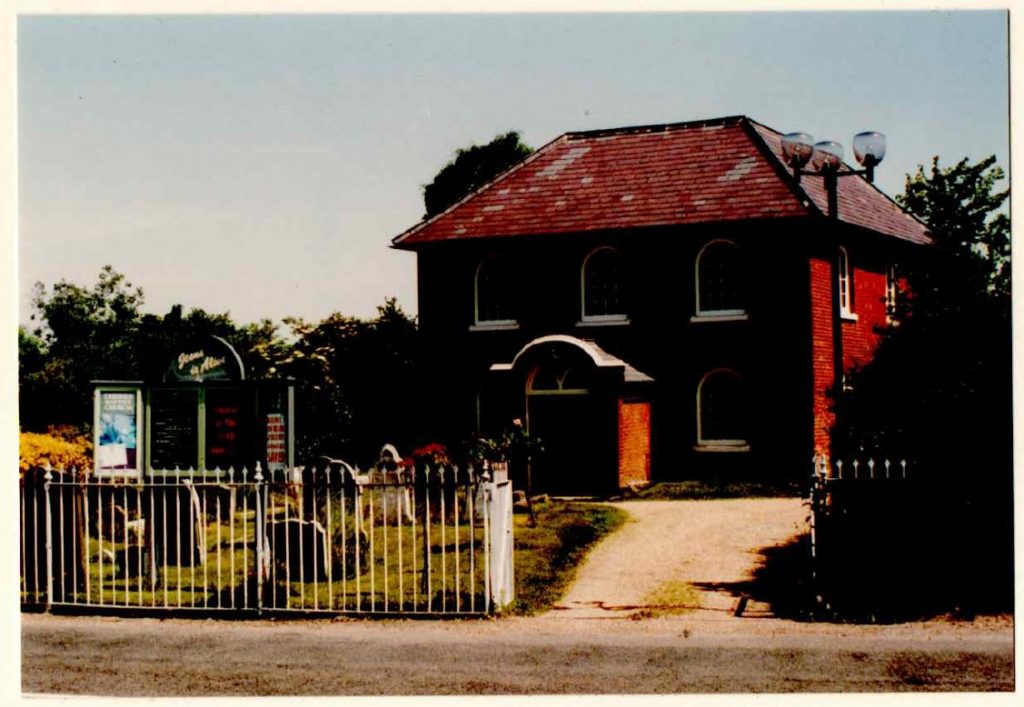
The chapel of 1778 is still clearly recognisable although the front wall was then in line with the panelled front of the rear gallery and the windows each side of the pulpit were longer and came above the low Vestry roof.
Linked initially with Dagnall Street Baptist Church, St. Albans, it was not long before Chenies had become a ‘mother’ church in its own right, and soon after 1791 other Baptist churches had been formed in Chipperfield, Bovingdon, Flaunden, and Mill End, Rickmansworth.
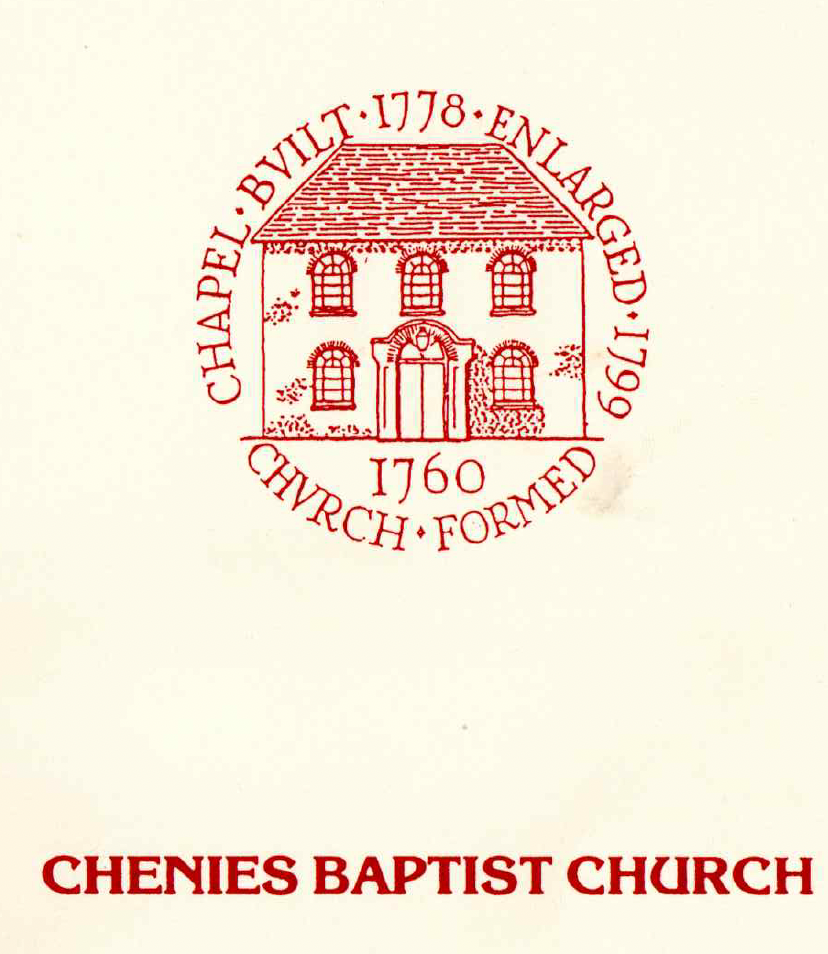
The first major internal addition was in 1794 when the baptistery was dug, avoiding a long journey to Chesham for those who may have regarded John Davis’ pond immediately in front of the Chapel as insufficiently salubrious. In 1799, the front of the meeting house was taken down and the building extended by 12ft to the south-west. A new façade was built, with one round-arched window either side of a central doorway and a row of three similar windows on the first storey, giving light to the gallery.
A major structural problem in 1829 caused the insertion of iron columns to assist in supporting the roof. The Vestry was rebuilt or enlarged in 1833 and in 1838 the porch was added. In 1841-51 the schoolroom was built above it. Various internal repairs in 1840 caused three successive Sunday services to be held lat the back of the Chapel under a ‘large rick cloth’ and at the same period cast-iron gutters were provided and the present front railings set up. The cost of further repairs in 1862 supervised by Mr. Smith, architect, of London, were partly paid for by the sale of engraved portraits of the pastor by ‘Mr Boarder, the artist’.
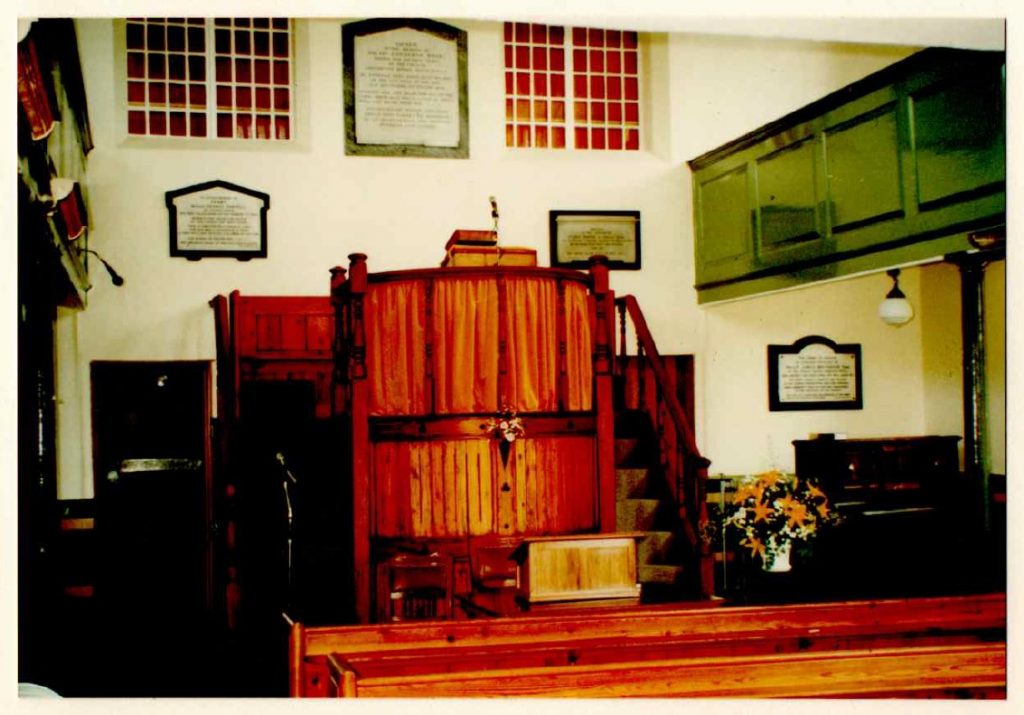
Of the changes which took place in the generation or so following the centenary of the building Christopher states that it can only be said that much worse might have happened. Though the box pews and the benches and the pulpit were all renewed it is still possible to appreciate scenes once familiar to the fathers of the Church two centuries ago and to recall that they built not for their bodily comfort but for the comfort of their immortal souls.
Of the life of the Church following the erection of the new meeting-house much could yet be written, of the sad end ot Hugh Giles’ ministry in a hasty and ill-considered resignation in 1788, and of his successor Nathan Sharman whose notable pastorate of 18 years saw the opening of preaching stations in Mill End, Bovingdon, Chipperfield and Flaunden.
Little is known of his successor William Lewis but the pastorate of Ebenezer West is recalled by the tablet behind the pulpit. In 1821 he started a school “for 4 or 5 young gentlemen under 12 years of age”, together with his two sons, one of whom, Charles, (later Dr Charles West), was the founder of the Great Ormond Street Hospital for Children. His small school which removed to Amersham and later to Caversham took him partly away from the Church in 1829 just when the incumbency of Lord Wriothesley Russell at the Parish church began to have a serious effect on Baptist support, but the assistant pastor, Thomas Davis proved himself a blessing to the Church in time of need.
In 1850, Church members living in Sarratt decided to build their own church, which was completed in 1855. Sadly Sarratt Baptist Church closed for worship in 2007. The cross from Sarratt Baptist was symbolically given to Chenies Baptist Church at the Good Friday service in 2007 as a sign of the historic link between these two churches.
In 1851, an ecclesiastical census reported that Chenies Baptist attracted 120 worshippers for morning worship, 280 attended afternoon worship and Sunday school and 115 attended evening worship.
The Baptist services are recorded as being held at 10 a.m., 2 p.m. and 6 p.m. in 1883, and there was a flourishing Sunday School.
Taking over from the Rev. John Palmer, the Rev. Robert Fursdon and his family came to Chenies in 1906, where he served for 34 years during which time the church thrived despite the difficulties of the war during which two of his children died, one in active service and another of T.B. Fursdon is remembered as a dedicated and well loved pastor, who was a member of the School Board and very much involved in village life. Robert’s wife Elizabeth too, played an active role in both church and village life, running Mothers Meetings among other things. It was during the Fursdon’s pastorate that the Manse moved from Kingscote to its present location at Rose Cottage, likely between 1921-1939. In 1940, after the outbreak of war and the death of his wife, Robert left Chenies to go to New Zealand where his son was the President of the Baptist Union of New Zealand.
More modern changes include the replacement of the outside toilet in 1999 and extension which now provides a modern kitchen, prayer room, two toilets and a further toilet for the disabled, though the pulpit and the benches still date from the late 19th century.
The last addition to the building took place in 2010 when the Sun Room was built to the rear of the church. The beautiful sunny aspect of the room, overlooking the Chess Valley, is greatly appreciated by members and the local community.
Chenies Baptist became a member of Baptist Union of Great Britain in March 2002 and enthusiastically engages in Churches Together in the Chess Valley joining in prayer and worship with Methodists, Anglican and Roman Catholics during the year.
The current building has all the charm of what is considered by some to be the most attractive of the Baptist houses in the county as well as offering modern amenities to the local community.
content sources:
- Dr Roy Bruton ‘A Study in Historical Anthropology’
- Christopher Stell, Some notes on the Chenies Baptists and their Chapel, 1978
- Baptist Church Leaflet (date unknown)
- Chenies Yesterdays (leaflet produced in May 1985)
- A Brief Guide to Chenies Village leaflet produced by St Michael’s, date unknown
- Chorleywood Field Studies Centre research into the parish of Chenies, date unknown.
- St Michael’s Church Leaflet prdouced 2004 (available to buy from St Michael’s Church)
- The Lollards of the Chiltern Hills by W. H Summers
contributor: Rachel Bishop
date published: 21/11/2025