

Agriculture was the main industry of the parish, and most of the trades which grew up in the village were for the maintenance of land, manor and the people. Chenies was, like most villages, largely self-supporting until the 20th century. In the 18th century the following trades are recorded, but this is not a complete list:
| Agricultural Workers | Carpenter | Maltster | Tailor |
| Baker | Collar Maker | Miller | Tanner |
| Blacksmiths | Farmers | Paper Makers | Thatcher |
| Bricklayer | Glazier | Plumbers | Turner |
| Brickmaker | Husbandman | Shoemaker | Weaver |
| Butcher | Innkeepers | Shopkeepers | Wheelwright |
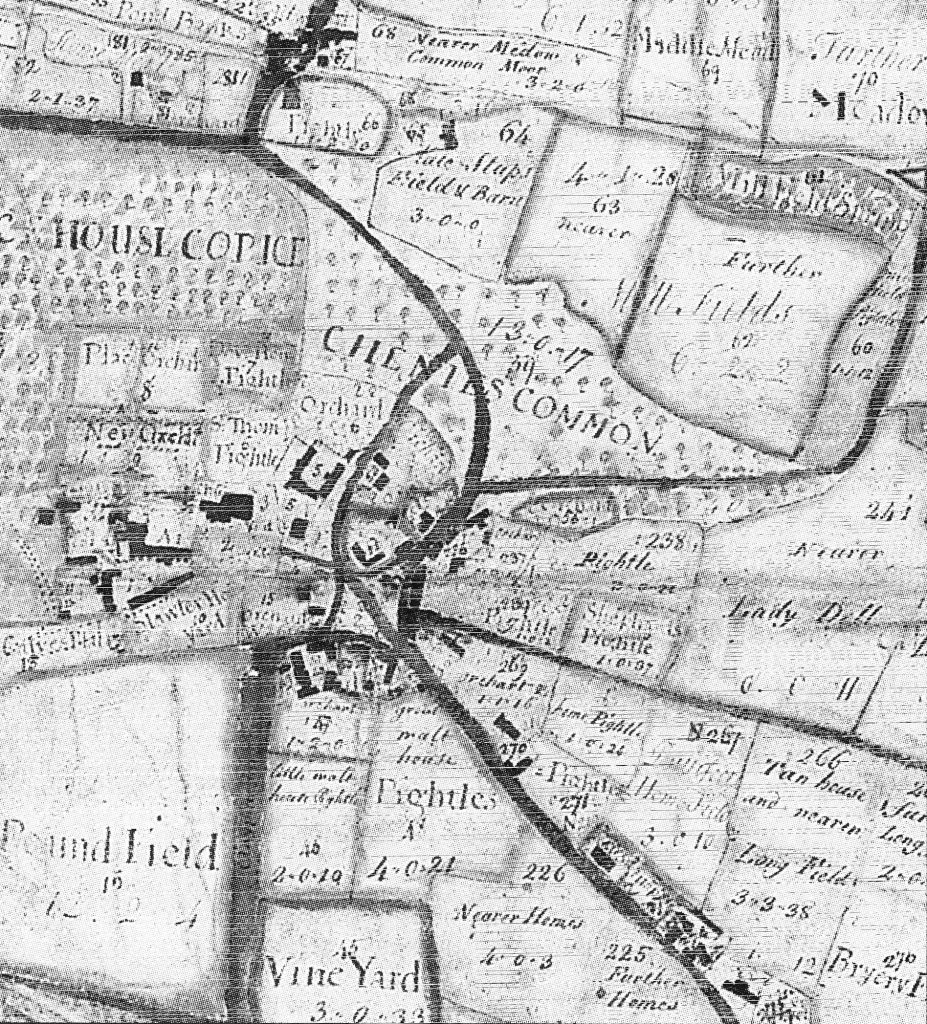
These trades tended to run in families, the Arnold family were tailors, and lived for generations at Whitehill Cottage, so that it became known as “Arnolds”. The Shepherds were carpenters and farmers living on the site of the Bedford Arms. The Grace family were farmers, giving their farm the name of “The House of Grace”. The Reed family were turners and woodworkers. The Dells kept the village shop which was situated on the village green, right down in the north corner, and appears in the 1735 map, but by 1838 it had disappeared. Dodd’s mill was also very important in the life of the village, employing millers, paper makers and cart drivers.
Foster writes in his book, ‘There was a malt house and a small tannery. There were two blacksmiths: Mr Pluckhouse who lived in Claypits Lane and Mr Beeson who lived in Green Street Lane. There was a wheelwright, Mr Clarke, a weaver, Mr Baldwin, a bowl turner, Mr Reed, a shovel maker, Mr Blackwell who worked with Mr Pluckhouse, paper makers Strikes and Lowances, a carpenter and thatcher, Mr Redman and Mr Blake, a shoemaker. Some were leasehold farmers such as Messrs J Border, Newton, Cannon, Reding, Simpson, Goodman, Alderidge, Body, Blyth, Skidmore, Stapp, Grover and Mrs Meller: the rest of the villagers found work as farm labourers – some being expert milkers – or there was work to be found on the turnpike road’
Some idea of prices and wages in the 18th century can be gained from the following extracts from the Duke of Bedford’s account book for 1711 and 1712.
1711
December 15th “Paid Thomas Mayo, carpenter, for sawing and laying bridges in several places, for making a frame for the Well House cistern, and other work as the bill appears” £02.19.00
December 31st “Paid the Haily Glazier for mending the almshouses windows, as the bill appears“ £00.11.00
January 11th “Paid the Hobbs Smith for wedges, staples and nails used at the Well House and other works” £00.02.01
March 24th “ Paid Jacob Dell for Nails, Baskets, Broom and Candles” £00.13.00
March 24th “Paid the rat catcher for one whole year” £00.10.00
1712
August 19th “Paid the Hobbssmith for work done on the Chappell vault and other works” £01.01.08
March 6th “Paid Thomas Mayo, carpenter, for making 4 new styles, a new gate at the Court, and other works as by bill appears” £05.03.08
By the 20th century the shops gradually closed down, and the trades disappeared, only the farmers, innkeepers and agricultural workers remaining. Mr Salmon the baker made bread at ‘Chess Croft’ for 41 years until 1945, and delivered it by pony trap. William Howell was the last Blacksmith, and he retired in 1920; Mr Hughes, a butcher, ran a shop in the single storey building attached to ‘Home Close’ until 1968. Three general stores closed one by one, the last in 1932. The mill ground corn for flour until 1915, then continued grinding for animal feedstuffs until 1933. Rose Maling recalls a draper, wheelwright, carrier, oilman, straw hat maker and basket maker operating at the turn of the century, all of which eventually stopped trading in the following years. The Post Office finally left Chenies in 1975.
content source:
Chorleywood Field Studies Centre:
Property Photos and Descriptions 1960-80,
1711 Page from Duke of Bedford’s Account Book
Chorleywood, Chenies, Loudwater and Heronsgate, a Social History by Ian Foster
contributor: Andy Homewood, Sandy Homewood, Rachel Bishop
date published: 1/11/2025 edited: 18/04/26