

Chenies School – ‘My School Days’ by Rose Jane Maling
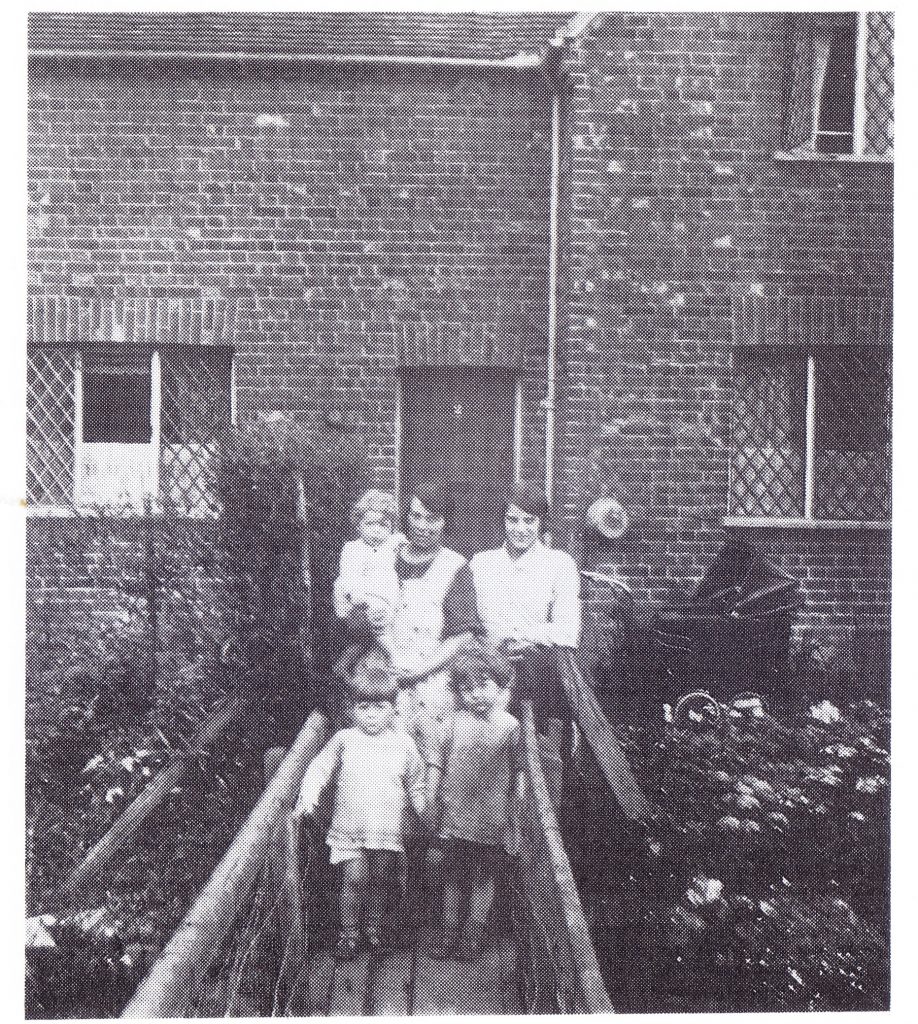
I was born in 1907 in the village of Chenies in Buckinghamshire where I have lived up to the present time. I was the eldest child of a family of twelve. The youngest was born when I was 15½ years old.
At their time of their marriage my mother was a cook housemaid and my father worked in the flour mill on the side of the river chess. Later he became a driver of traction engines going to farms in the district to thresh the corn for the farmers, or sometimes he worked on a steam roller making up the roads. When the engines were moved about a man walked in front with a red flag to give warning, quite laughable these days when we compare the speed of present day traffic; we could always hear a car coming a long way off and often ran to look over the gate to see one go by.
I started to go to school in the village at the age of three. On the first day I had a tray of sand and had to make patterns or maybe it was letters with my fingers. My cousin who took me to school was moved that day to the next room and I cried for her.
There were at one time between forty and fifty children in the school in three classes, infants taught by Miss Turtle, The Middle Class by Miss Haynes and the big ones by the Headmaster Mr. James.
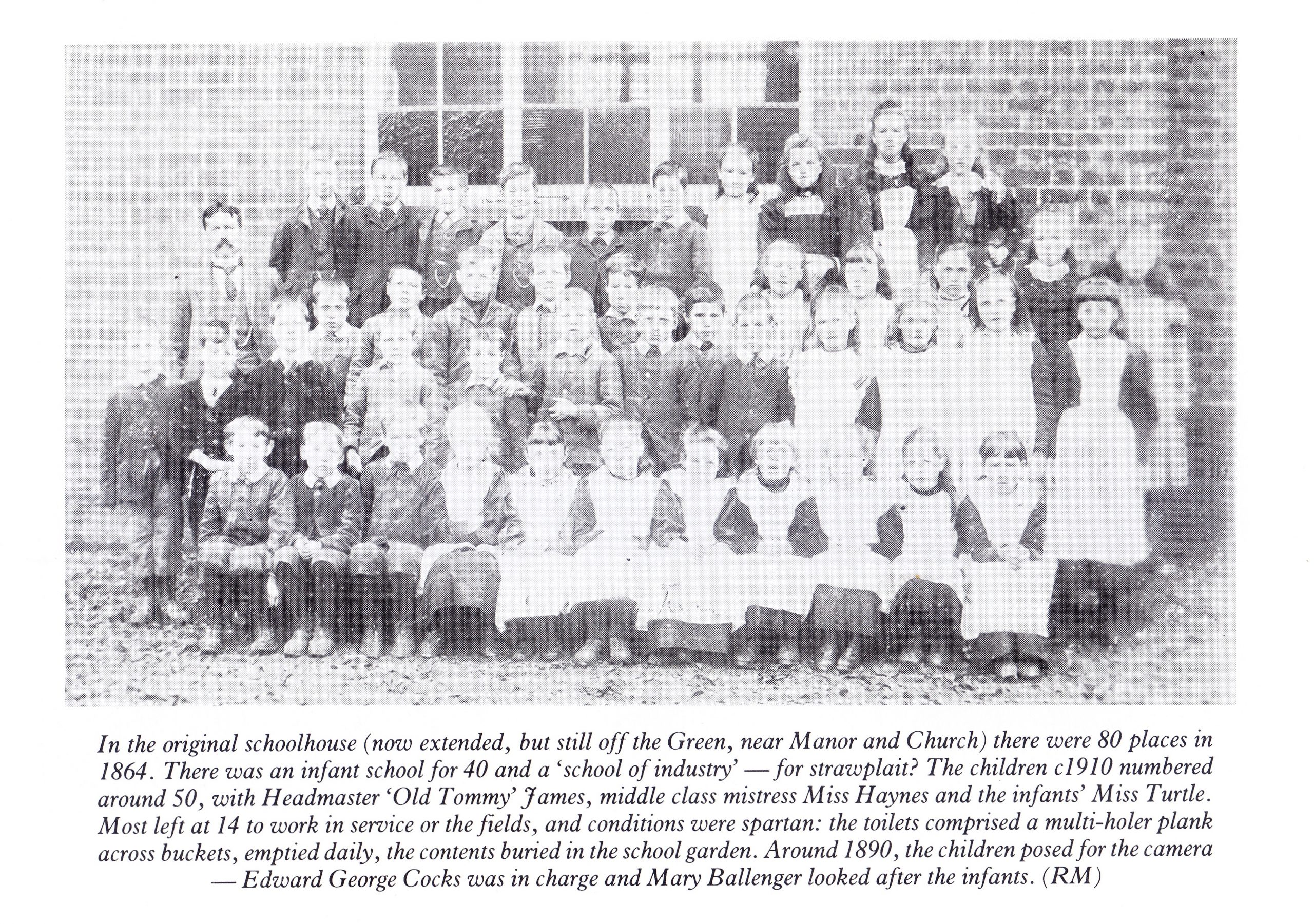
We did not wear uniform but the girls wore white starched pinafores which usually had a frill around the bottom and across the shoulders. I had a change to a coloured one when I got home. Boys wore strong grey serge or corduroy knickerbockers which were buttoned just below the knee and long socks with turnover tops. They had jerseys and stiff white celluloid collars and boots which had buttons up the sides. We had special button hooks to do them up. Boots always had to be shining in the mornings.
A bell hung in a little turret on the roof and it was was rung by a long rope hanging down inside. There was always a bit of competition to get permission to ring it.
We all had to line up outside and march into school. We started by singing a hymn and having a prayer. Sometimes the Rector from the church came to take that and give us short talk. On Sundays we had Sunday school, in the classroom and afterwards went up to the church for the first part of the service – another class in the afternoon too.
Our hair was worn in plaits tied with ribbon. I remember one girl who had fair hair and her plaits came down to her bottom; we were always envious of her – she was one of the children who had to walk from Sarratt bottom, about 1 ½ miles across the moor and fields, others came about the same distance from the Sheep houses at Little Chalfont. They always brought their dinners with them.
We had an hour and a half for dinner and as I lived just across the road I often had to peel the potatoes for the family when I got home, also do other jobs. I liked it best when I had to go up the village to the shops, especially when the sun was shining. We always had to go for milk before breakfast, either to the Bedford Arms or to the Butchers, or if they were short of milk we went to Latimer. We had tin milk cans with lids and at Latimer we got them full of skimmed milk for a penny and there was a lot of froth on top as it was straight from the separater. Very greatly daring we swung the cans round without spilling any, always of course, half afraid that we might.
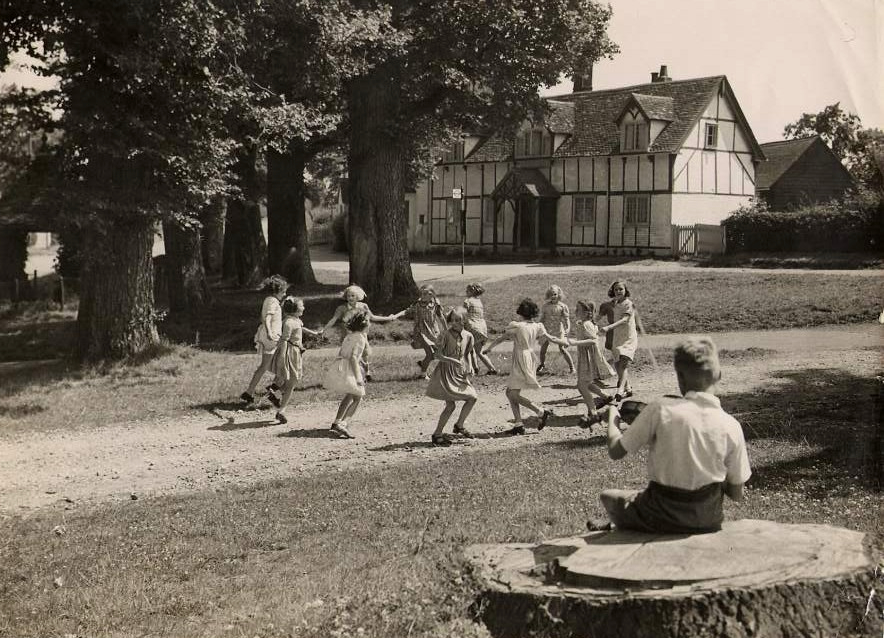
We had drill on Monday mornings, if fine enough in the playground or on the grass. Sometimes in very hot weather we had our lesson on the Green underneath a lovely Lime tree. I can recall now the smell of the blossom and the hum of the bees. For nature lessons we sometimes went out to see the trees or flowers actually growing and had the sepals, petals, stamens ,leaves and the veins explained to us, then when we got back to school we had to draw or paint them – these were my favourite lessons.
The girls had sewing lessons and we had to be very precise and to do very fine stitches and work buttonholes without taking our eyes off the work once. Boys were taught gardening, that was once very essential in the country where most of our vegetables were grown.
The cane was used quite frequently, mostly on the palm of the hands but sometimes if the Master was annoyed it would be across the legs as well. If he saw us making mistakes when he looked over our shoulder he would rap our knuckles with a ruler or box our ears. I say our but I don’t ever remember it happening to me. Another punishment was to stand in the corner of the room with the hands behind the back and sometimes we would see the culprit turn around and grin or wink.
At one stage we had to use slates and slate pencils for writing. I hated the sound they made also the noise of chalk on the blackboard, it seemed to set my teeth on edge. Of course there were no Biro pens then, we used pens with wooden handles and nibs which were always getting crossed and affected our writing. It was always nice to have a clean new book and pen. The inkwells were let into holes in the desks, they had to washed out occasionally, this was a cold job as the tap was outside in the playground, it was also used for water for the Headmasters house, as they did not have taps indoors, nor was there water laid on in the toilets. These were across the playground, and consisted of wooden seats with a step in front and a bucket underneath which a man was paid to empty into a hole dug in the garden. Toilet paper was newspaper cut into squares and hung up on a loop of string.
The classrooms were heated by huge iron stoves, but they never seemed warm enough in winter. They had big iron guards round them and if any children got very wet on the way to school they were allowed to hang their coats on the guards to dry. Chilblains were a real nuisance on fingers and toes.
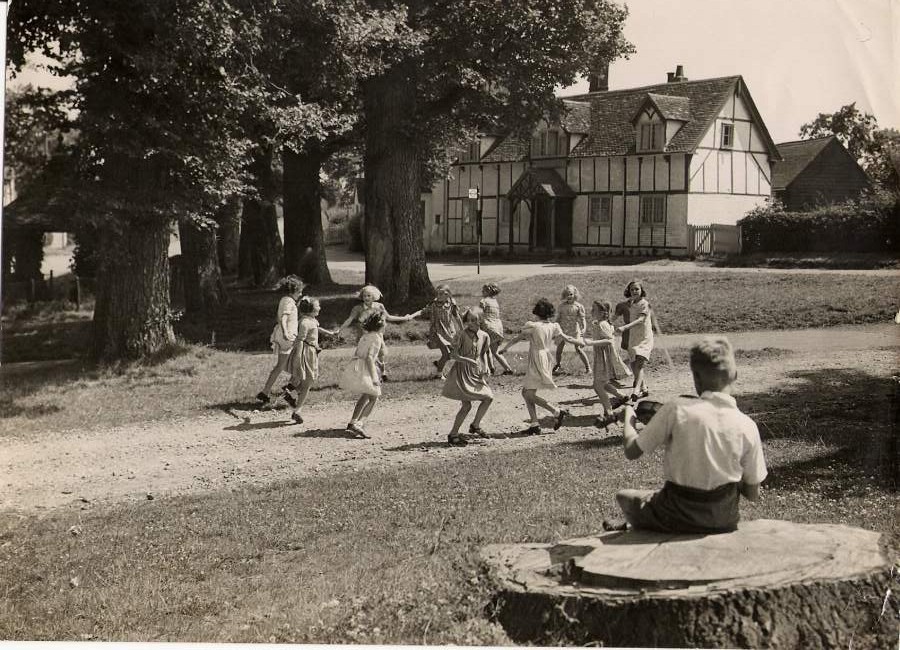
Playtimes were midways through morning and afternoon sessions and we played games like “Ring of Roses”, “Poor Jenny is aweeping”, “Farmers in his Den”, “Wallflowers”, “In and out the Window, “Sheep, sheep come home” and of course games we made up ourselves. Then we had skipping. Marbles which we called “Dabbers” played with five marbles when we turned our coats inside out to sit on the ground. We would throw one marble up while picking one or more up from the ground, then catch the first marble before it reached the ground. The girls had wooden hoops bowled along with a stick and the boys had iron hoops with a skid hook to guide them. We could play on the roads in those days as there were few cars. The boys of course played football, cricket and leap frog and we all played “Hide & Seek”
We didn’t have any home work to do but we often played school in the evenings so that probably helped us to learn.
There was no television or radio, but we had a gramophone and we sang or danced to that, also we had time to play games like “Snakes & Ladders”, “Ludo”, “Draughts”, “Rings”, “Spinning Tops”, “Jigsaws”, etc. There was time too to learn to knit and sew and darn socks and stockings. In the summer we helped to weed and water the garden, also to go to the woods to collect fallen twigs and small branches which had to be broken or chopped up for fire lighting.
On Sunday evenings in the summertime my father would take us for long walks through the fields and woods so that we became familiar with all the footpaths and we came home with hands full of flowers, there were many more about then. Bluebells, Horse Daisies, Buttercups, Campions, Meadowsweet, Primroses, Violets and many others.
We had no electricity, but there was a gas stove and lights downstairs but we had candles to go to bed and my Mother always had a small oil lamp on the landing shelf so that we were not frightened by the dark if we woke in the night.
As there was always a baby and little ones in our family there was scarcely a week that went by that I had a full time at School, as I had to stay and help out my mother.
The special days were when the Inspector came to examine our work and we all had to be there then. The Doctor came sometimes and the nurse to examine our hair; it was nothing unusual for someone to have a note to take home. We got our eyes tested and also our teeth examined, but even so we got toothache a lot.
Another special day was Empire Day when we marched round the flag on a pole in the playground and sang Empire songs and then we had a half-day holiday.
The average number of children at school was around 40 to 50 aged from 3 to 14, when we left school for good. There was an exam which we could enter to pass for the Grammar School; but my parents could not afford to keep us until we were sixteen so we did not go in for it.
‘Memories of Long Ago’ – by Rose J Maling
Having often been asked to write down some of my memories of long ago, I have at last decided to do so.
I was born of working class parents in the village of Chenies in Buckinghamshire. My father at that time worked in the flour mill which stands on the side of the river Chess. But soon after he worked as a driver of an agricultural engine for the firm of T.T. Boughton and travelled to the farms in the district around to thresh the corn from the ricks, where it was stacked when harvested in the fields.
Chenies was considered a model village having mostly rebuilt during the last Century when Lord Wriothesley Russell was the Rector 1870, but that of course was before my time; in fact it was just before my father was born.
The village is surrounded by farms, in my younger days the Manor & Mill Street Farms were run as one unit by Mr. Harry Boughton. The two Green Street Farms by Mr. Woods, The Mount Farm by Mr. Darvell, and Home Close by Mr. Hughes.
The whole estate until 1954, owned by the Duke’s of Bedford, they in turn kept a Bailiff here and about half a dozen men who worked full time keeping edges and grass verges cut and tidy, also the Church Cemetery. In the summer the wells in the yards of the cottages were cleaned out ready for the winter rains to fill them again.
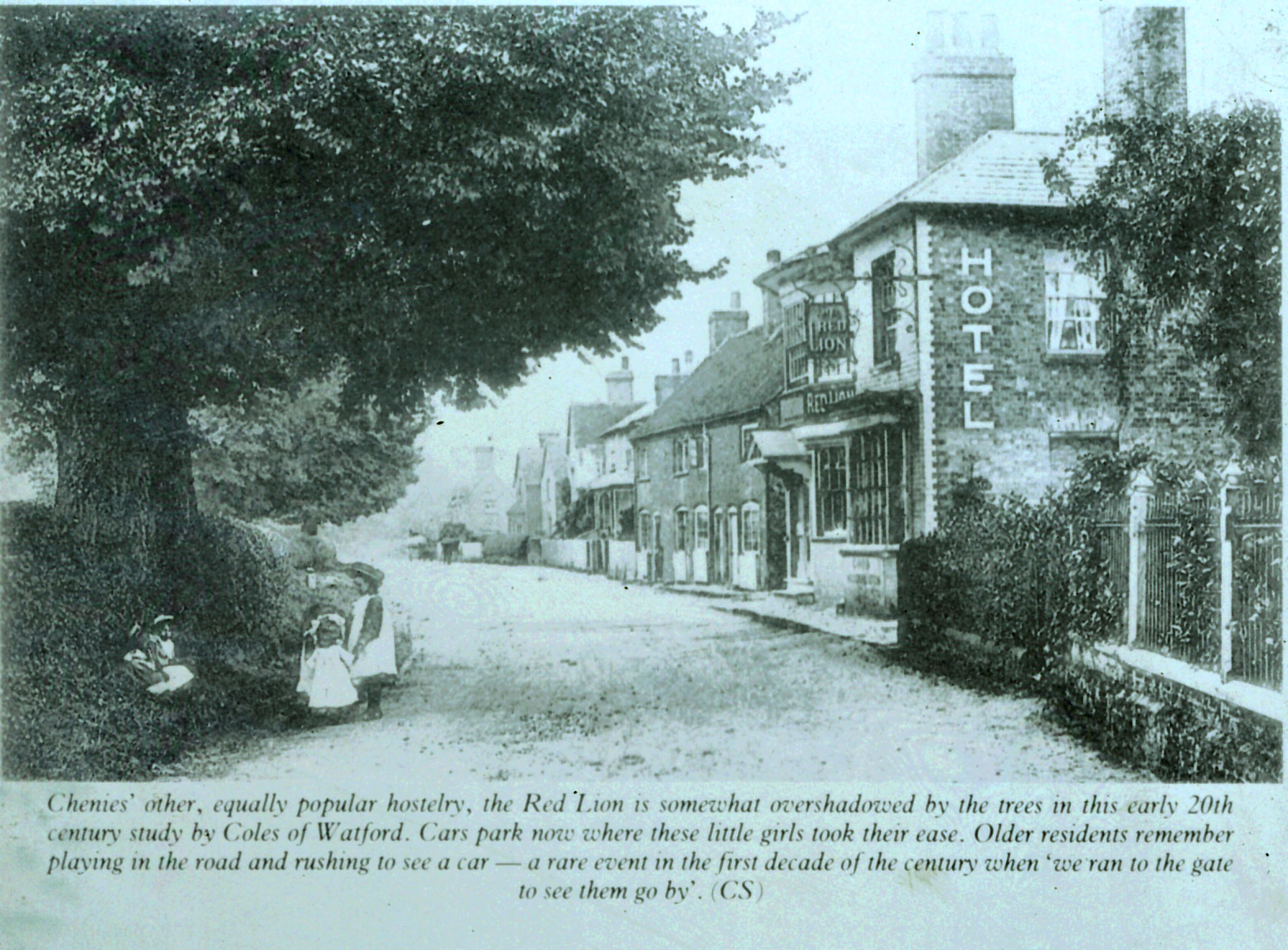
At that time the village was practically self supporting. We had a Post Office and General Store where Nos. 30 and 31 are. Till about 1914 a drapery store that is now the Post Office and Antiques, a General Store at Banner Rest, a Butchers, a Bakery and two Public Houses (the Bedford and the Red lion). Then there was a Blacksmiths Shop in Back Lane now the electricity shed, and a Wheelwrights (now no. 18), and a Carrier who made weekly journeys to London.
Mr. Kilby at No. 41 had a smallholding and kept a pony and trap. The cherry trees were a great attraction at haymaking times when all the children around would help him and collect the hay and pile it into heaps ready to be carted to the rick. We were usually given a handful of cherries as a reward. My eldest brother worked after school for him, cutting the wood ready for lighting the fires and getting in coal, cleaning shoes and helping to clean the stable. For this he was paid the princely sum of eight pence per week.
We were able to buy milk from Mr. Hughes who also kept cows as well as the Butchers Shop. Also from Mr. Goodson at the Bedford Arms we would go along twice a day with tin cans with lids on to buy either fresh milk or skimmed, the latter was a can full for a penny.
The Bedford also kept horse carriages and took people to and from the station, that being the only public transport as the buses only started to run through from Watford to Chesham about 1921.
We had a grocers, a drapers, oilman, a man with straw hats, and the Muffin Man, who came around with a tray of muffins on his head ringing the bell. These came round regularly or spasmodically according to their trades.
Miss Palmer ran a little business at her house on the corner by the green, making and selling baskets. She also employed a younger woman to help her.
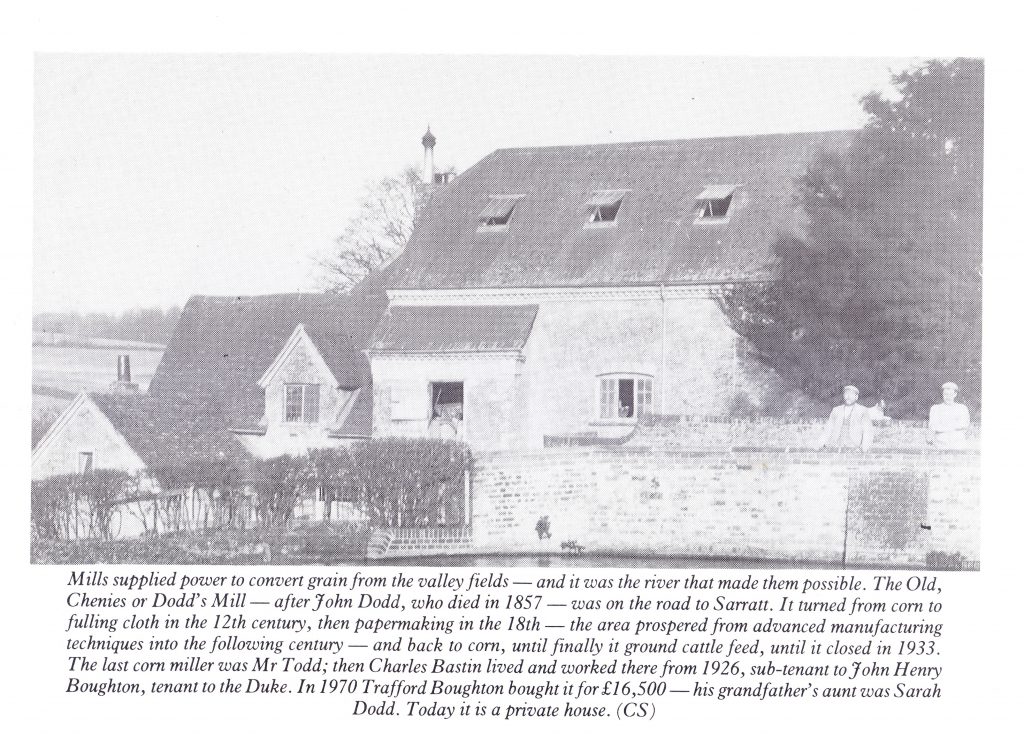
The mill was worked by Mr. Todd, and every day we would see him come up the hill with his white smock and white millers hat on to go for his drink at the Bedford. Mr. Howell the Blacksmith would go also with a jug to bring his drink home. I can picture him now, a large man wearing a leather apron (a large and brawny man he was, just as the poem says). It was a favourite to go round to watch him shoeing the horses and from where I lived on the green, we could hear the ringing of his hammer on the iron.
Chenies House was the home of Miss Russell. She was a small lady usually wearing black. I remember Mr. Kilby, who had been her butler, coming into the school and telling us she had died. After her, lady Blandford lived at Chenies House. She was a very dear lady and much liked by us all, apart from the fact that she used to come visiting just at meal times. She would come while we were having a midday meal and being a large family, it wasn’t always convenient. But if anyone was ill she would send soup or a cake or jelly. Once when it had been a very hot summer I had run around without stockings and didn’t want to wear them when it turned cooler. The dear lady noticed and I was presented with three pairs of black stockings with coloured clocks (embroidery) up the sides, green, red and blue. I’ll never forget those stockings.
The Dowager Duchess Adeline of Bedford lived at Woodside House and each year she presented the children of the village with something at Christmas. One year it was a red riding hood cloak for the girls and a red jersey for the boys. Another year it was boots for each child. One year I had a doll but I cannot recall if every girl had one. We had a party in the Long room where we were given these. My chief memory of the parties was having an orange and a large bun as we came out.
I mustn’t forget the watercress beds kept by Mr. Dollimore, especially as I later married my husband when he had them. When it was packed it was stood in the ditch as near as possible to the spring to wait until the time to take it to market. Our cress always went to Covent Garden. Before the last war it was sent by rail from Chalfont Road station on the first train of the day, this meant that my husband had to be up about 4 am to load the cart, catch the horse and get to the station. During the war a van came down to collect it from Sarratt Bottom and Chenies, the driver often sleeping nearby to escape the bombing.
The River keeper, Mr. King lived in the cottage at the corner of the wood and we would always look carefully to see if he was in sight when we went wooding, not that he would say anything to us, but he and Mr. Macgregor were always regarded with awe by the children.
The houses were very much below today’s standard with no taps indoors. The water was carried in pails from a tap in the road. We had a pump over a stone sink which gave us rain water when there was any in the tanks or wells out in the back yards. No drains from indoors so every drop of water had to be carried out to an outside communal drain.
In the house where I grew up the washing copper was in the corner of the room on the opposite side to the door. Imaging if you can, the steam filling the house when the clothes were boiling. Also the smoke if the fire didn’t draw properly when fed with wood or coal. Then there were the odd times when it all boiled over and flooded the floor with hot soapy water. This also happened if one forgot to watch the bucket under the sink and a bowl full was tipped over.
Bath night meant the copper was lit again and a washing Bath in front of the fire. We had to go across the back yard to the toilet which was inside a wood and coal shed. In the winter time it was quite an expedition as the younger children would not go on their own, so it meant lighting a candle in a glass side lantern and ass the top would get very hot we had to be careful not to touch it.
We had a very large garden and everyone grew their own vegetables and fruit. Also attached to most was a pigsty and we kept pigs. An elderly man from the village Mr. Charley Beeson would come when they were large enough, to kill them. We would hide indoors till the squealing stopped. Pigs always squeal as soon as they are touched. Then would come the straw fire and the carcass was burnt to singe all hairs off. Parts of the pig were sold to neighbours and part kept for home use. Every part was used, even the intestines were cleaned and turned inside out and soaked for several times before using. The fat parts were rendered down to make lard, that was good as butter.
No one seemed to keep chickens (I don’t know if there was a rule against it) so eggs were a real luxury to us. We always had one for Easter Day Breakfast and I had one when I visited my Grandmother in finch Lane, Amersham Common. It was a long walk so I usually stopped the night and sometimes from Friday until Sunday.
Our schoolmaster was Mr. James of ‘Old Tommy’ to us outside school. He and his wife were Welsh so we had plenty of signing. The Rector Mr. Shann came on Monday mornings to give scripture lessons and Miss Grace from the Drapers Shop came to teach us girls how to sew and the boys were taught gardening.
We played games like skipping, farmers-in-the-den, poor Jenny and many games that are still carried on. One I never see now is a marble game called dabbers played with five marbles. We would sit on our spread out coats and each game had a name like, ones, twoers, threes, long and short sprawl and creeps. Hoop, the girls had wooden ones with sticks to bowl them along and the boys had iron ones with a hook if iron to guide them along.
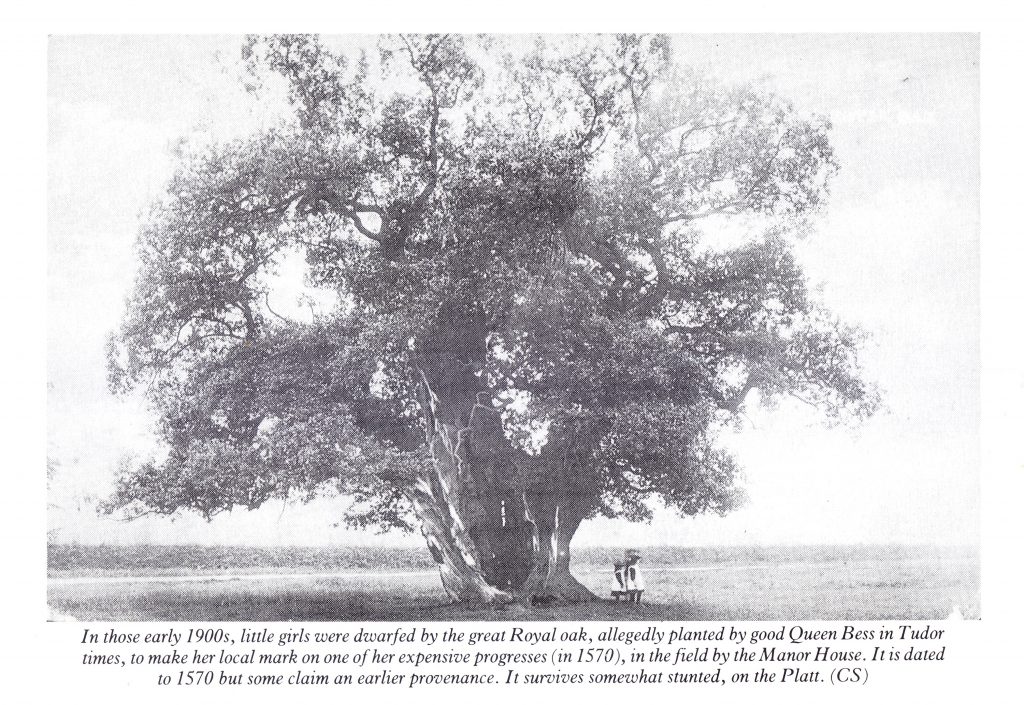
In the summer holiday we would take our picnic teas and go on the Platt or the common or even venture as far as the Walks and amuse ourselves by having races or making daisy chains or hide and seek. The old oak tree on the Platt made a real grand house to play in. According to History books I have read, this tree was set by Queen Elizabeth I in 1570 and a hundred years ago was said to be decayed inside and hollow enough for eight or ten people to shelter in.
At one time we had a resident District Nurse who was a great friend to everyone and as babies arrived very frequently she was kept very busy.
Also there were Special Policeman and later a real Policeman lived here for a time here. We used to see cows and sheep go through as they were driven to Watford Market with the men walking or running with them.
The timber carts would come up the hill in pairs leaving one lot at the bottom, so all the horses were used to pull up the hill, then they were taken back down for the next load.
The coach came through to Wendover twice a week, they changed the horses at the Bedford each way. We always ran to see them, later we would run to watch a car come as we could hear it a long way off.
One of my memories of the beginnings of the First War was seeing some of the farm horses being taken away.
Winter evenings were spent playing games like rings or snakes and ladders. When my uncles called in they and my Dad would get the melodeons out and sing songs. Every year my ad would make a new rug from a sack. We would cut old clothes up into strips about six inches by one and he just pulled them through with a clip hook.
Saturday mornings we had jobs to do like polishing the spoons etc and the tin saucepan lids which were hung flat to the wall. Then we would have to take the rubbish to the pits at claypits. We were told it was bottomless and the amount of things that disappeared in it that could well be.
We would go into the woods to collect fallen bits of branches and twigs for fire lighting. For this we had a truck made from a large wooden box mounted on pram wheels. On summer Sunday evenings my father would take us all for long walks through the woods and fields so we got to know all the footpaths.
In winter after Church, I would go to a friend’s house and join with her family in singing hymns or at home where w all joined in.
The Scouts and Girl Guides were started and were called Adelades Own and each girl had to work the shoulder flash in cross stitch. Then there was the band of Hope held in the upper Long Room, the hand bells ringing the Choir practice and later the club for the lads, with a billiards table which Mr. Stafford Charles had installed and for which they paid a bit each time they had a game until £30 was paid. This table is still there but it is now in the possession of Mr. Mathews who bought the Manor House and the Long Room
During the 1914-1918 War we had concerts in the school. These were run by Mrs. Maclean who lived at Rose Cottage, now the Manse. I remember once we were dressed as geese with feathers stuck all over the costumes. The slicing doors in the school made ideal screens for the stage and the little room at the back for dressing up. Perriot Troup sang all the popular songs, one which always reminds me of them is ‘Let the great big world keep turning’. The school would be packed as everyone looked forward to such events.
The Sunday School was held in the school as well and the parties usually held in Summer time at the Rectory, if fine in the garden, if wet we were allowed in the Parish Room (now a garage) and in lofts over the sheds.
The W.I. was started in no.19 by Mrs. Wishart and Mrs. Stafford Charles who, lived at Woodside House after the Duchess had died. (The Girl Guides formed a guard of honour at her Funeral). My mother was one o f the first members and learnt to do fruit bottling, canework and stools etc. She always made jam and had been a cook before marriage. They had outings and rallies in those days too., I have a photograph to prove it.
Mrs. Maclean gave a few of us some lessons in French speaking and that is the only few words of French I have learnt. She made her telephone available for calls to the Doctor for anyone in the village.
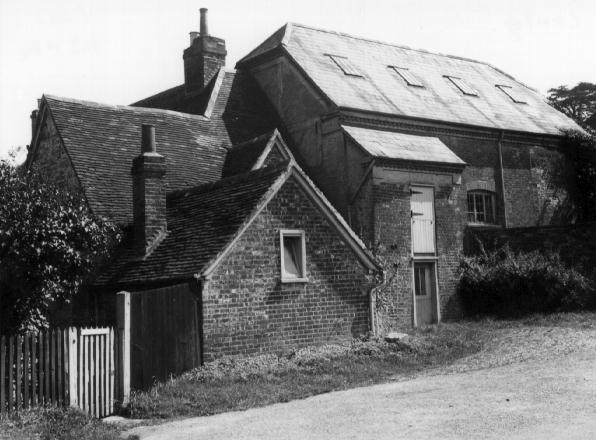
In 1926 my parents and family moved to the Mill House and my father once more worked the Mill in the evenings and on Saturdays. By now it was used only for grinding corn for animal feeding. The house and the garden were very dirty and neglected and a great deal of work was put in by my mother especially, to make it habitable. It was like stepping back in time as we had to use oil lamps once more and all cooking on a kitchen range (no gas). There was however a tap indoors and a drain from the sink. Also the wash house was outside with the copper, in fact there were two large coppers, I have no idea why.
As I said, Dad worked the Mill and sometimes at night it would start up by itself and he would have to get up to stop it again, as it vibrated the house. The grain was brought in very large carts with seats high up in the air, and unloaded to the top part of the mill.
It was a sad day when it finally closed in 1933, he was the last person to run it, and soon after he moved out of Chenies to live for the first time in his life.
During the 1914-1918 War the school children collected horse chestnuts and acorns for pig feed, beechnuts, to be sent to Wooburn for growing into trees, and blackberries for jam making. My pick was just a half a pound for which I received one half a penny. After that my mother said I was more useful at home helping her.
________________________________________