

The Life Family’s Time at the Pightle
Martin Life
May 2025
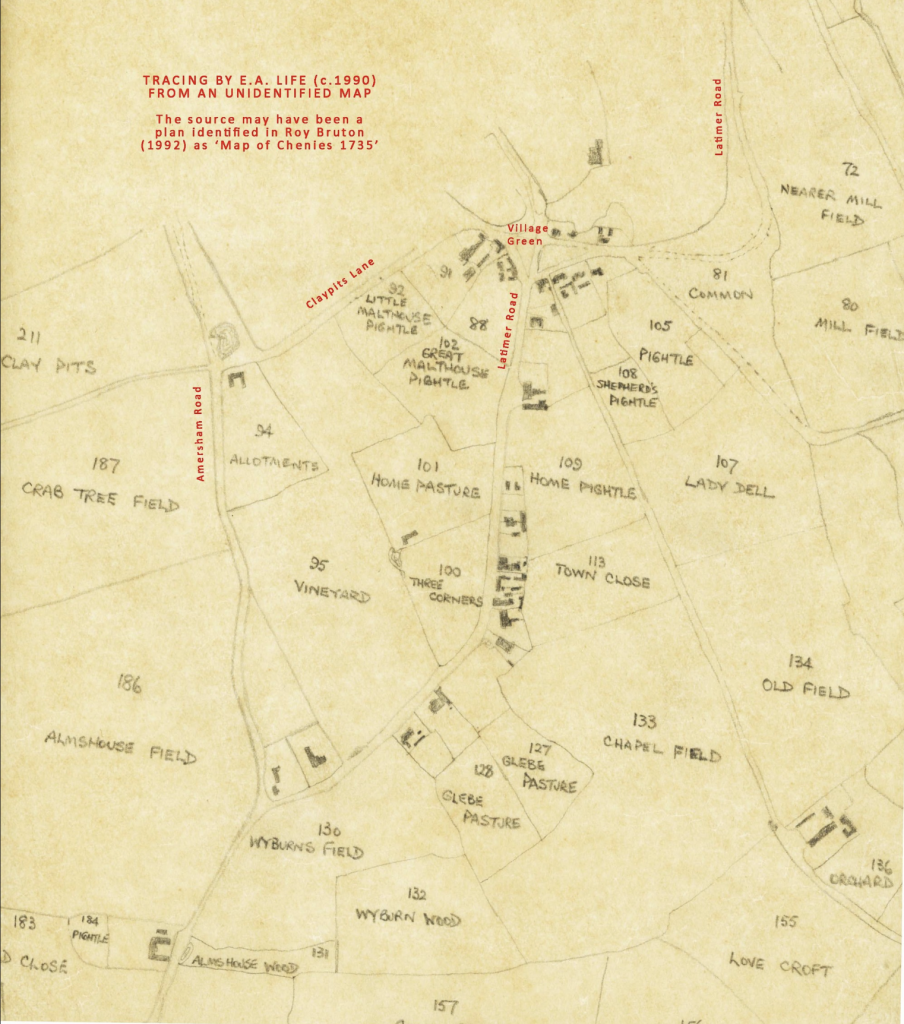
According to the dictionary (OED), a pightle is a Middle English term for a small field or enclosure. A very faded tracing made by Andrew Life from an unnamed map source (speculatively dated around 1735) identifies many of the old enclosure names in and around Chenies, and a number included Pightle in their title. For example, there was Little Malthouse Pightle, Great Malthouse Pightle, Home Pightle and Shepherd’s Pightle, all being clustered around the Village Green. As far as I’ve been able to tell, the land purchased by Ted Life (see Ted Life (1887 – 1971)) was on, or very close to, what was originally Little Malthouse Pightle, and this accounts for the unusual name chosen for his new house – The Pightle.
The land on Claypits Lane was purchased by Ted from the Duke of Bedford in 1950 (date TBC). According to a map of the Bedford Estate dated to around 1807, this, and the surrounding fields had previously been occupied by one William Davis. Before Ted’s acquisition it had been used as an orchard, and in the early 1950s large cherry trees grew next to the lane, two of which were incorporated into the front garden of the Lifes’ new house. Although they were removed in the 1960s, they are very evident in the photograph below, taken soon after completion of the building work. A couple more occupied the plot next door, probably leading to the house built there subsequently being called ‘Cherry Trees’.
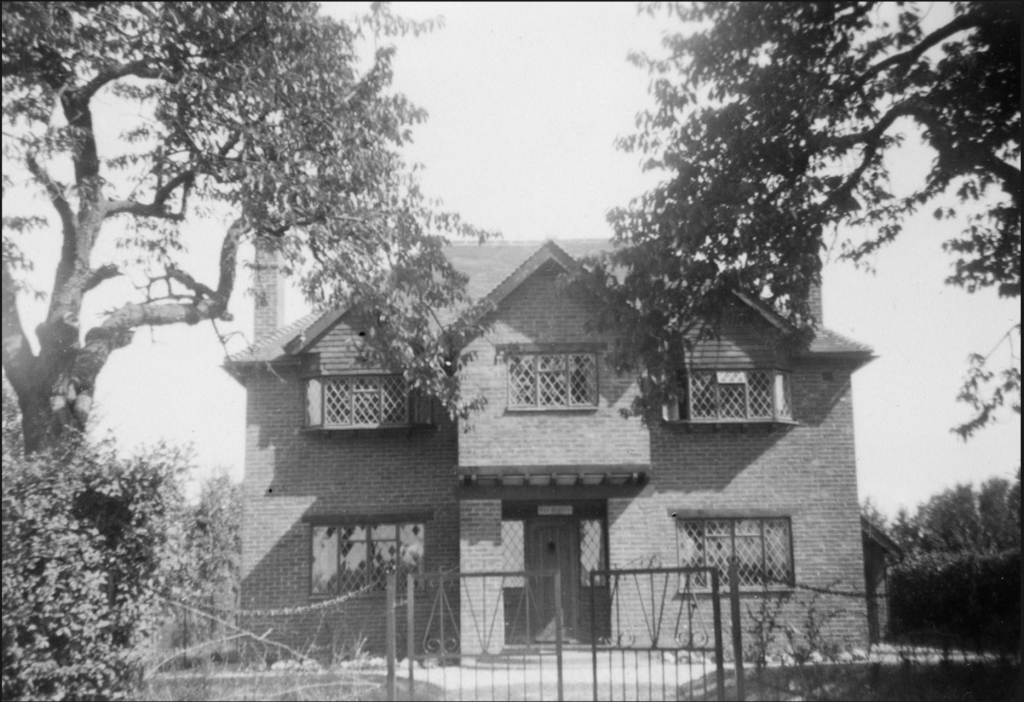
Ted employed C.H. Senecal – a building contractor from Chalfont St. Peter to build the house. I understand that the design was based upon an existing home that the Lifes particularly liked on the Green. It therefore also echoed the Tudor style originally chosen by the Bedfords in the development of their village. The total cost, including a number of extra items added during the build, was £2,972.19s.2d., and works were completed by in late 1951.
Emilie (see Emilie Life (1890 – 1982)) had retired at the end of August that year, and it is uncertain whether they had continued to live at the School House for a few months until The Pightle was fully completed or found some temporary accommodation for the period. It is conceivable (but perhaps rather unlikely) that they moved to the Pightle before it was finished!
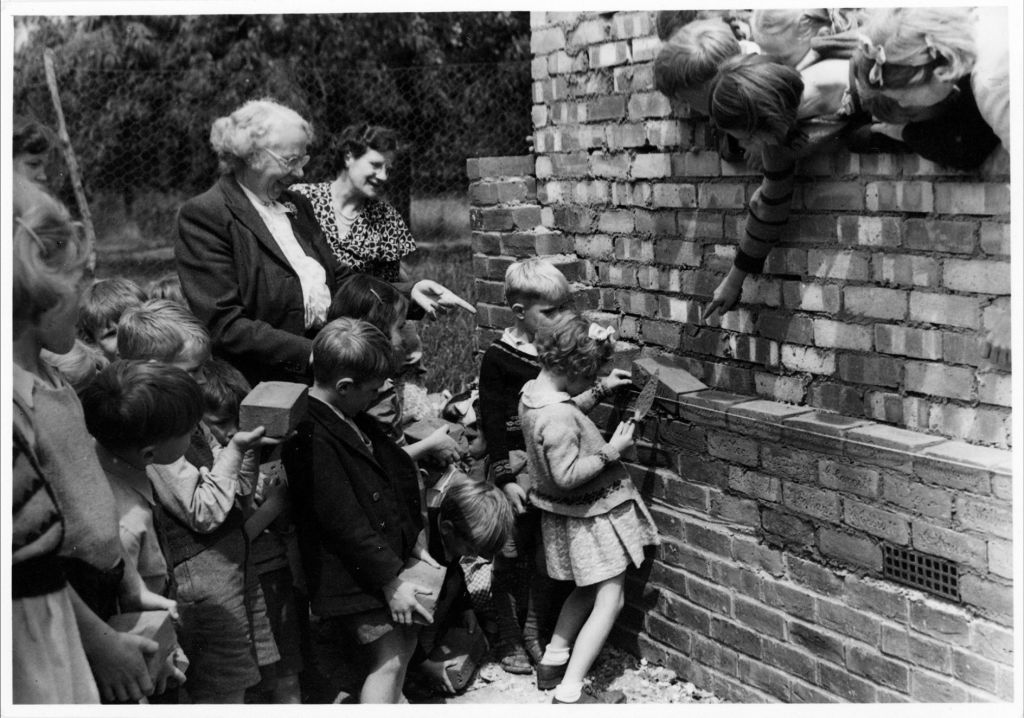
One of the unique features of the Pightle is its commemoration of Emilie’s relationship with the village school. Each pupil personally laid a brick in the front wall of the house bearing their name. After this, the Rector of Chenies Church blessed the house in a short ceremony including the children and school staff. As adults, many of the ‘bricklayers’ would return to the house to show their inscribed brick to their own children, and in later years, their grandchildren!
After they had moved in, Ted and Emilie arranged the back garden with an ornamental section nearest the house, and a vegetable garden in the other half of the plot. In the 1960s, they added a small summer house at the far end, beyond the vegetable patch. Mr. Cant was a gardener who lived in the village and who looked after the garden for them in those early years.
Ted and Emilie lived in the Pightle until their deaths – Ted in 1971 and Emilie in 1982 – after which the house was left to their son Andrew (see Andrew Life (1921 – 2010)) and daughter-in-law Joan. Apart from some minor modernisation, Andrew and Joan made few changes to the house, but the garden was dramatically transformed. Joan in particular was an enthusiastic and skilled gardener; she and Andrew cleared the vegetable area and extended the ornamental planting down to the summer house.
Andrew and Joan’s years living in The Pightle were some of the happiest in their lives. Returning to the village, where they had first met in the early 1930s, must have been part of the pleasure, but they loved the house and its garden deeply. They continued to live there until the death of Andrew in 2010 and, finally, Joan in 2013, leaving the house to their children, Martin and Susan. With much regret the house had to be sold in the division of the estate, and in 2015 it passed to the ownership of a new family.
content source: Various family archive materials contributor: Martin Life date published: 01/11/2025