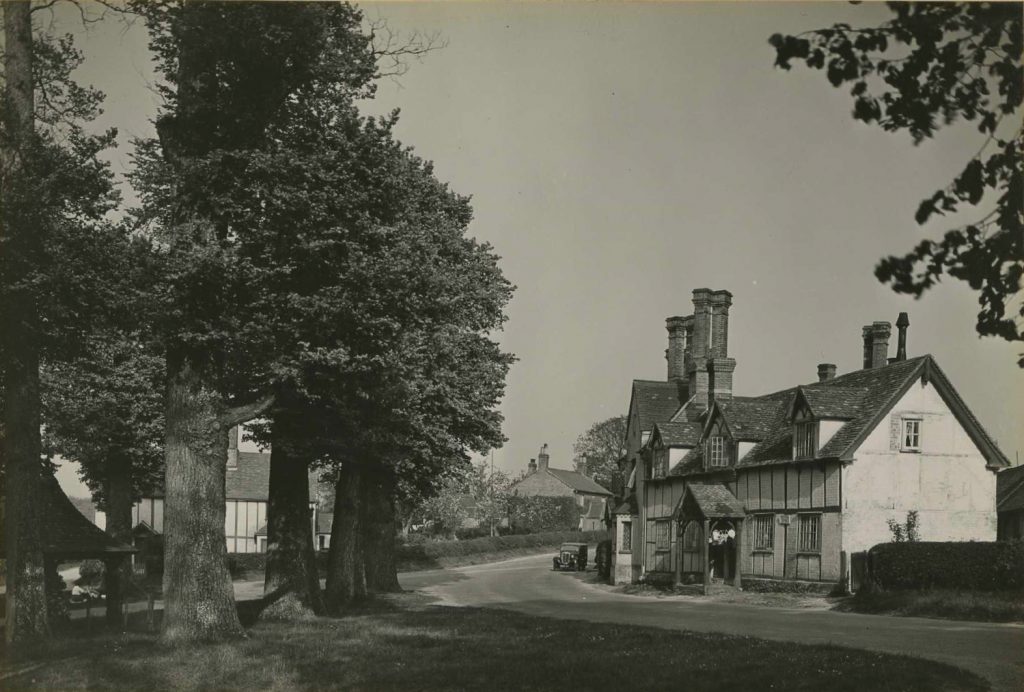
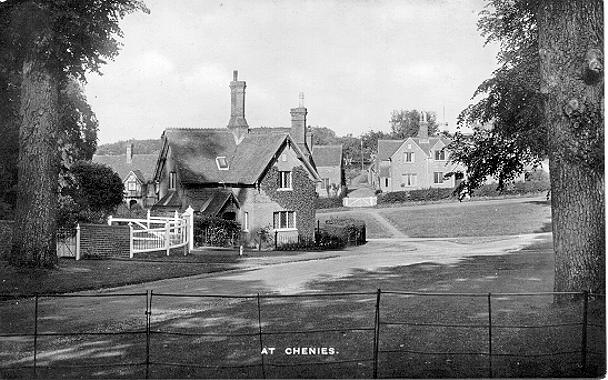
Chenies village lies in the very eastern part of south Buckinghamshire, near the border with Hertfordshire. It is situated to the east of Chesham and the Chalfonts. Chenies is also a civil parish within Chiltern district. Until the 13th century, the village name was Isenhampstead.
There were two villages here, called Isenhampstead Chenies and Isenhampstead Latimers, distinguished by the lords of the manors of those two places. In the 19th century the prefix was dropped. Near the village there was once a royal hunting-box, where both King Edward I and King Edward II were known to have resided.
Several paper mills were once established in Chenies, operated by the River Chess, which flowed here from further west in Buckinghamshire. The parish church of St Michael includes the Bedford Chapel, burial place of many notable members of the Russell family.
Use the timeline below to view the full picture of the history of the village, from Roman Times up to the present day.
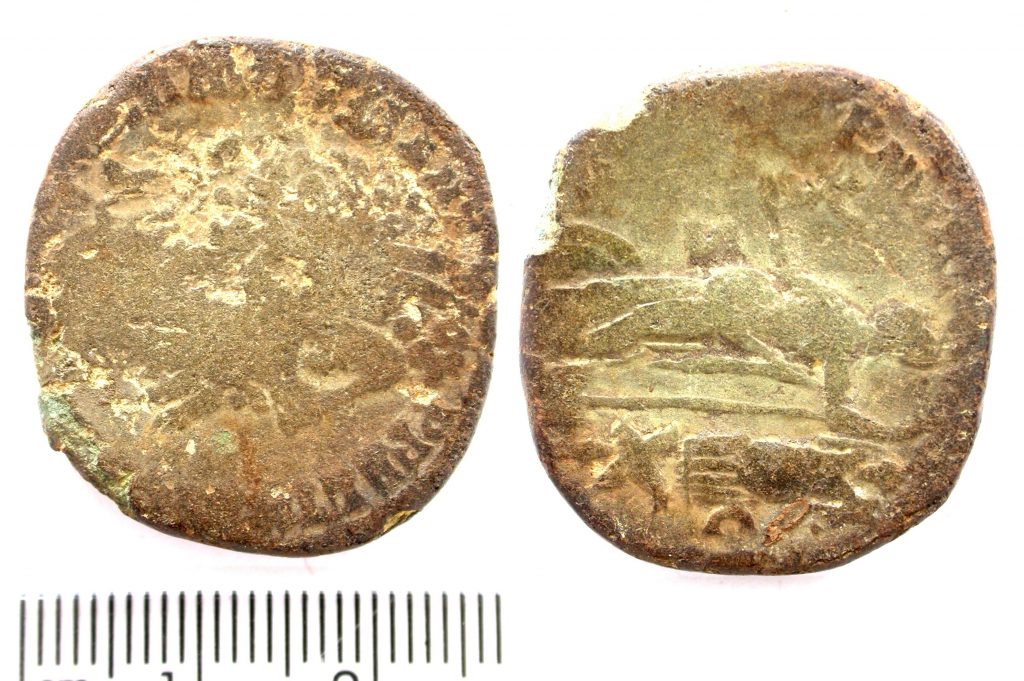
A number of sites of Roman materialhave been recorded in the local area, including several villas. One villa was built at Chenies itself, to the north east of the Church. This was constructed during the last quarter of the 1st century AD, and with the addition of further rooms and a new bathhouse, reached its peak during the 4th century. The presence of late Roman mosaics highlight its sophistication at this time.
Rights Holder: Buckinghamshire County Council CC License:
1st to 4th centuries AD
The Late Saxon settlement at Chenies was known as Isenhamstede, a name which may relate to its position on the river. The name probably derives from the ‘hamstead’ on the River ‘Isen’ – presumably the Saxon name for the Chess. The Domesday Book does not mention the settlement at Isenhamstead itself, which probably lay within the manor at Chesham.
Late Saxon 850–1066 AD
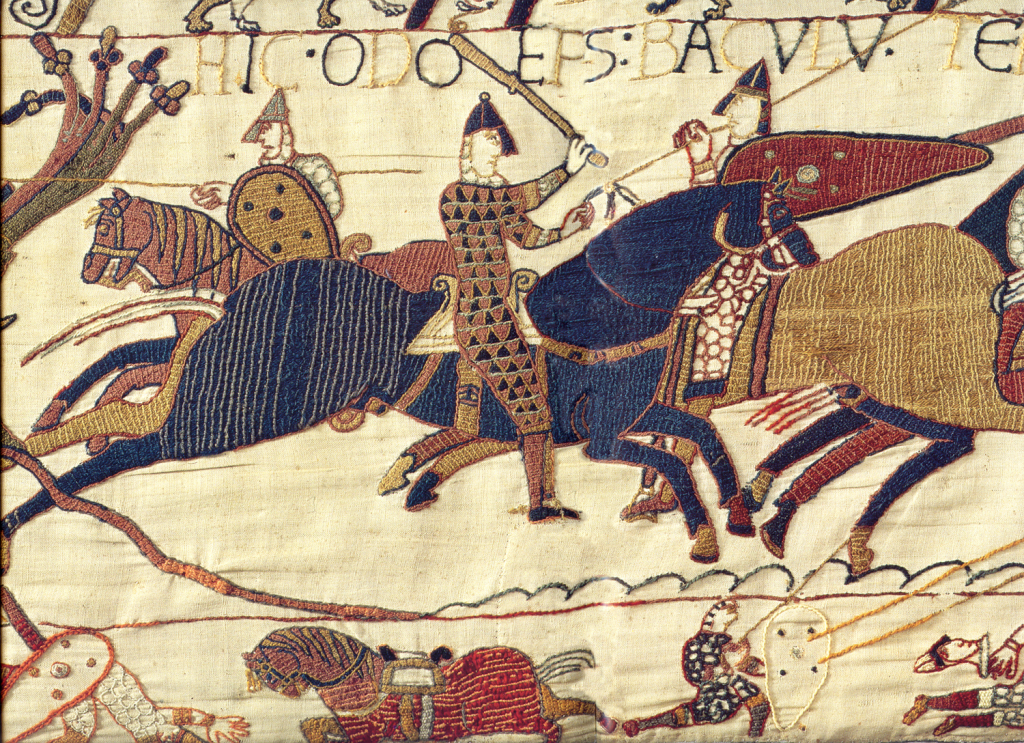
After the Battle of Hastings King William gave the area around Chalfont to Maigno the Breton, a mercenary, who assisted him. It is probable that Chenies was included in this area, although there is no mention of it in the Domesday Survey of 1086.
The Domesday Book entry for Chesham however indicates that at the time of the Domesday Survey, it was held by Alsi, a lady in waiting to Queen Edith:
“Alsi holds 4 hides in Chesham from the King. Land for 9 ploughs; in lordship 1½ hides; 2 ploughs there. 10 villagers with 5 smallholders have 7 ploughs. 6 slaves, meadow for 2 ploughs; woodland, 800 pigs; 1 mill. The value is and was £4; before 1066, 100s. Queen Edith held this manor; she gave it to Alsi after King William’s arrival”
1086
The first official mention of Isenhampstead is in 1165 when it was held by Alexander de Isenhampstead who held the manor for a knight’s fee.
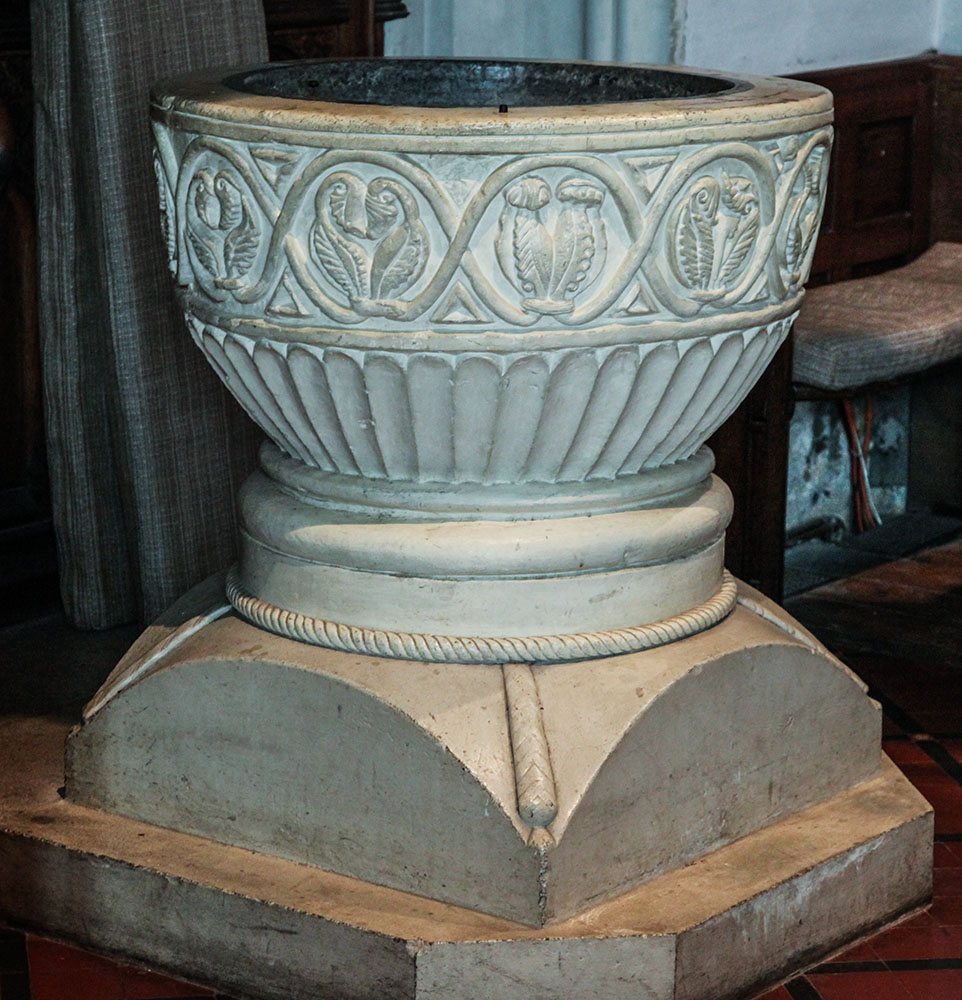
Nothing exists of this first period of settlement, except some relics of a capital and font in the present church, St. Michaels, said to have come from an earlier church on the site.
The village was held by the Cheney family from 1180. The first of the Chenyes to own the manor was Alexander Cheyne. Upon his death, the manor passed to his son John (later Sir John).
1180
A Medieval watermill, first documented in the 12th century, lay to the west north west of the current manor house on the River Chess. Initially it functioned in Chenies as a ‘fulling mill’ for the cleaning of cloth, but over time it began to transition into paper making.
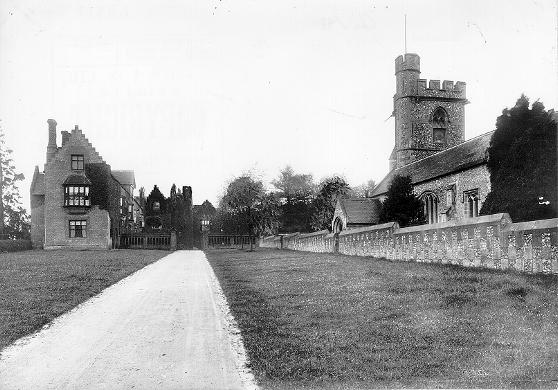
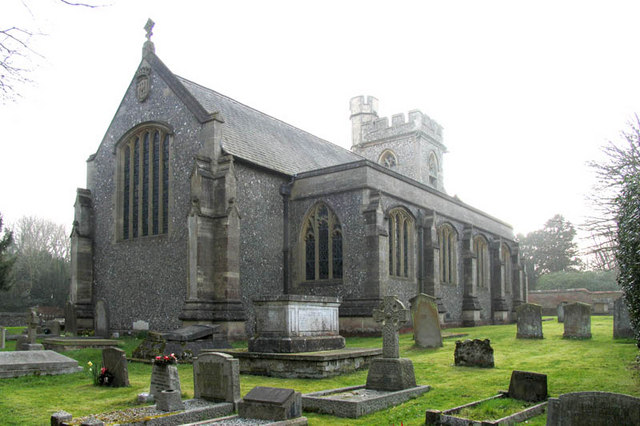
The church at Chenies, dedicated to St Michael, stands to the east of Chenies Manor. It is first mentioned in 1232, although elements of the current building date to the 12th century when John de Chednuit was appointed the first rector.
In 1285, with the death of Sir John Cheyne, who was Sheriff of Buckinghamshire and Bedfordshire in 1278, the manor was taken over by Edward I in lieu of a debt, and he spent time hunting here. At the time he also held a nearby manor of King’s Langley, and Chenies became a ‘Chamber manor’ – a personal rather than an official possession. The manor was valued at £11 4s 3d at the time, and John’s widow Joan was allowed to draw a pension from it.
1285
Some documents survive referring to Edward’s ownership of the manor. The first of these is an order issued to the sheriffs of London to convey two tuns of wine to his royal cellar at Isenhampstead. This points to the presence of a substantial manor house, probably built in stone, with substantial cellarage. A second document refers to a royal visit to Chenies before Easter of 1290. The Royal Court moved to Chenies from King’s Langley on the 15th of March, and accounts survive for the hiring of carts to carry the luggage, which included a cask of ale.
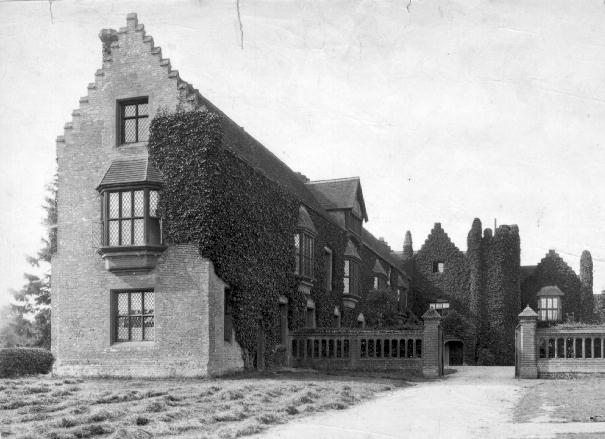
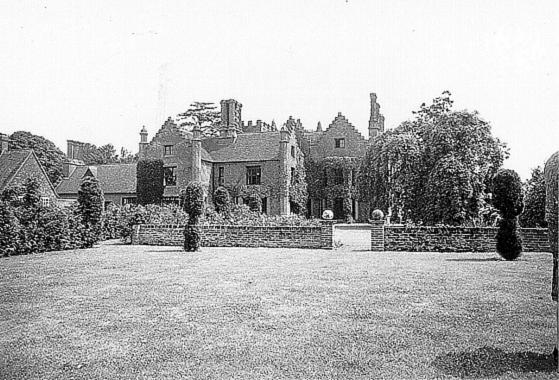
The Manor House (photograph reproduced with permission from the Bucks Archive).
1290
Bartholemew Cheyne became head of the Cheyne family, presenting the rector to St Michael’s in 1296.
1296
The name of Isenhampstead Chenies was first used in 1321, probably to distinguish it from the nearby Isenhamstead Latimer.
1321
In 1348 the manor was returned to Bartholomew’s son Alexander by the crown after a period of 63 years.
1348
Alexander was still holding the manor in 1346, but by 1350 it had passed to his son Sir John Cheyne. In 1371, Sir John, like his previous namesake, was also made a Sheriff of Buckinghamshire and Bedfordshire, and a knight of the shire in 1373. He fell from grace in 1397, when he was condemned to death as a Lollard. His sentence was commuted to life imprisonment. His son John became the next owner.
1346
John and his son Alexander conveyed the estate to one Sir Thomas Cheyne, of another branch of the family and Edward III’s shield bearer.
c. 1400
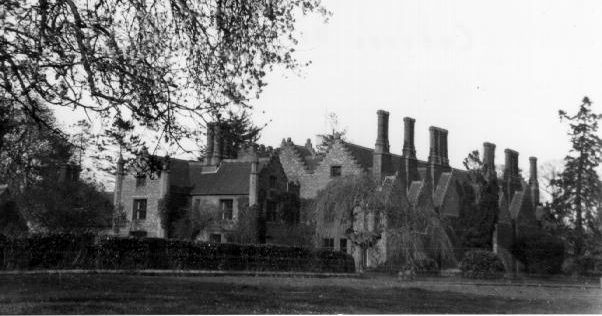
The present Manor Housewas built by Sir Thomas’s brother Sir John Cheyne in 1460. It was also known as Chenies Place.
John died without issue in 1468, leaving the Manor to his widow. She died in 1498, and in her will, she left the manor at Chenies to her niece, Lady Anne Philip who took possession of the manor in 1500.
1460-1500
The original 12th century Church was replaced by the stone and flint building that we have today. It was built at the end of the 15th and the beginning of the 16th Century, probably by Sir David Phelip (elsewhere spelt Phillips), husband of Lady Anne. In his will he left four pounds “To fynyshe my building of the Parish Church of Chenies”.
On the event of Anne Philip’s death in 1510, the manor passed to her granddaughter, Ann Sapcote. Her first husband, John Broughton, died in 1518, and she remarried in 1526 – to one John Russell.
1510
John Russell and Anne chose Chenies as their main residence – it had been recently modernised and lay close to Windsor and London. Much of the surviving south wing of Chenies Manor was probably built around 1530 during his ownership. During this time the village also grew and became considerably bigger than it is today, though there are still several timber-framed cottages dating from this period.
Henry VIII first visited Chenies Manor in 1534. He stayed for a week, during which time the King received an agent sent by the King’s governor at Calais. He was probably at Chenies on the 6th of July when he heard of the execution of Sir Thomas More. The King no doubt took the opportunity whilst at Chenies to hunt in the two parks belonging to the manor. The royal party left Chenies on the 10th of July, accompanied by Sir John Russell.
1534
John Russell was a rising star at the court of Henry VIII. By the time of his marriage to Anne, he had been knighted, fought in the war in France and undertaken diplomatic errands and secret missions on Henry’s behalf. Henry visited the manor again in 1541this time with Kathryn Howard, and the house was cited in her trial for treason as being the location of one of her trysts with Thomas Culpepper.
In March of 1539 he was created Baron Russell of Chenies, and was one of the executors of Henry VIII’s will upon his death in 1547. He continued to serve the crown under Edward VI. In January of 1550 he was created Earl of Bedford.
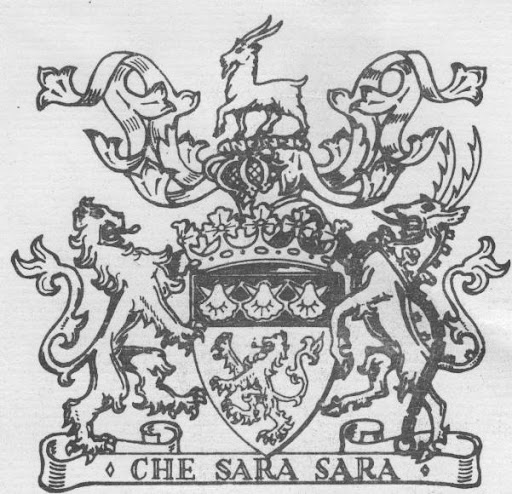
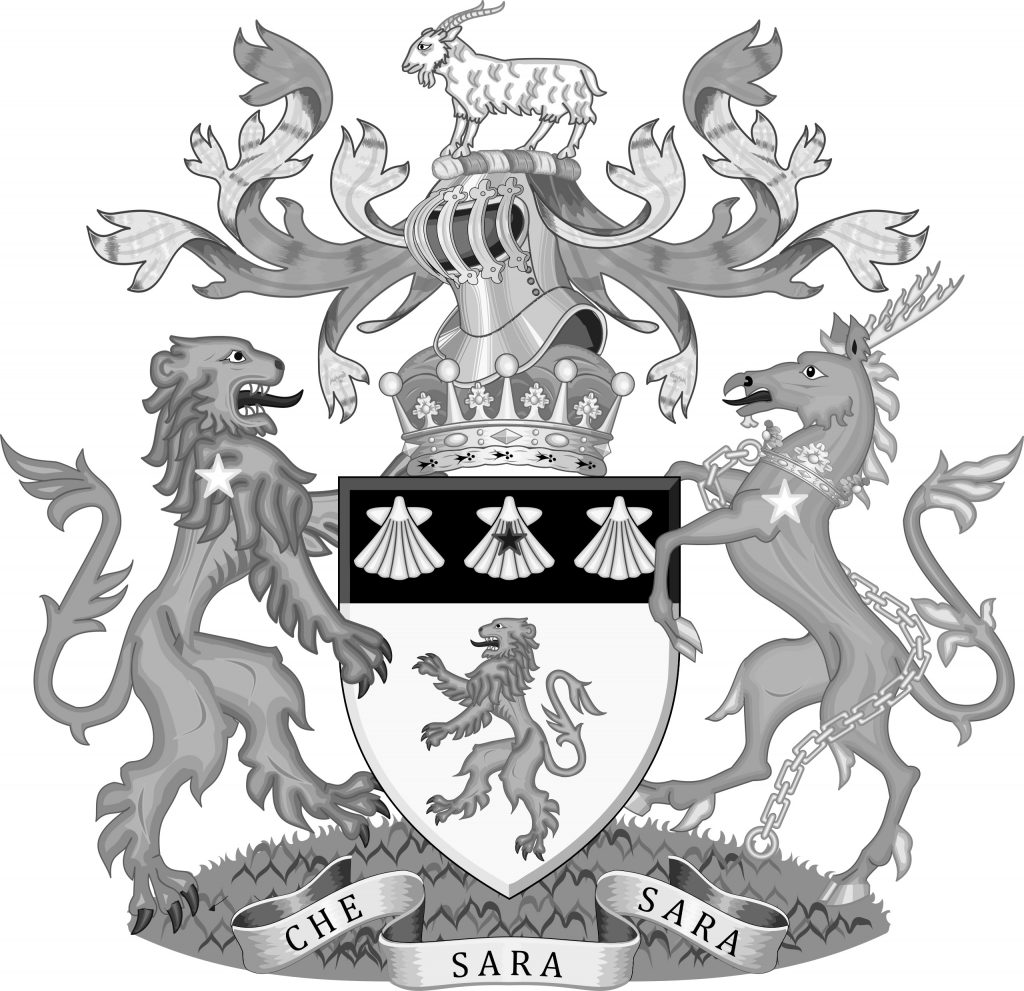
The Russell Coat of Arms
1539-1550
Chenies Manor is mentioned in Sir John Leland’s itinerary. Leland’s visit to the house probably dates to 1544, and he describes the house at Chenies as follows:
“The old house of Cheynies is so translated by my Lord Russell that little or nothing of it in a manner remaineth untranslated: and a great deal of the house has been newly set up made of brick and timber: and fair lodgings be new erected in the garden. The house is within diverse places richly painted with antique works of white and black”
1544
John Knox paid a visit to Chenies, preaching his non-conformist views to the village which already strongly belonged to Lollardy. He very likely stayed in the Manor House.
1553
John Russell was succeeded as Earl of Bedford by his son Francis in 1555. Unlike his father, he supported the reformers, as a result of which he was imprisoned during the early years of Mary’s reign, and then spent time in exile in Italy. The accession of Elizabeth to the throne saw him returning to court life.
1555
The Bedford Chapel was built by Anne Countess of Bedford, Sir John Russell’s widow, in accordance with the provisions of her late husband’s will.
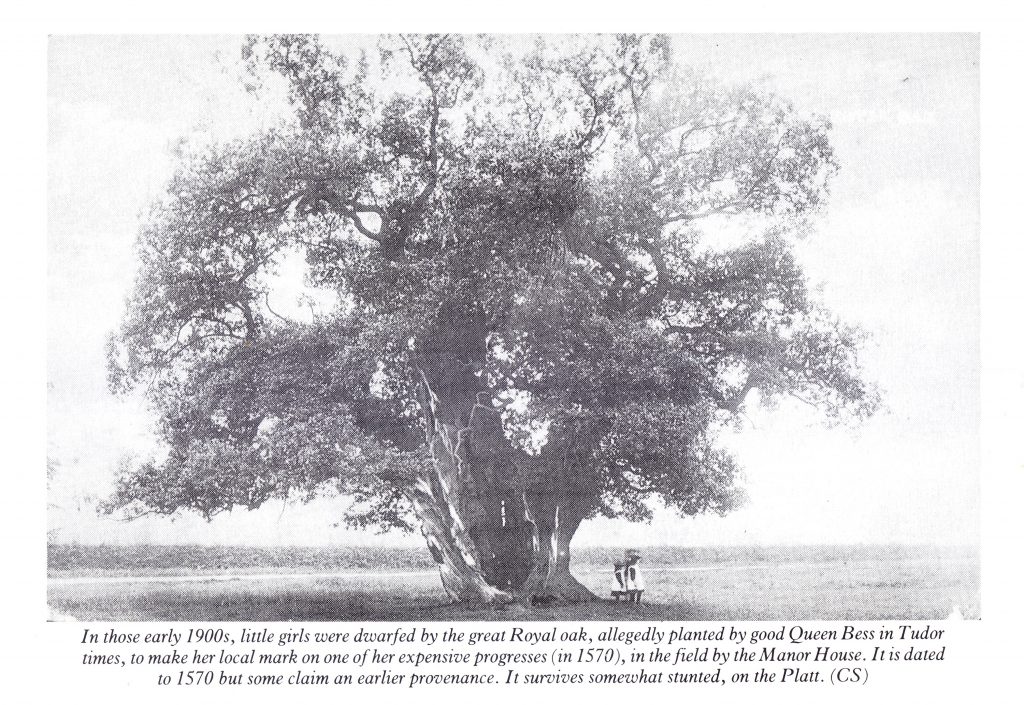
Elizabeth I spent four weeks at Chenies in July and August of 1570. Records suggest that a surveyor visited to establish what work was required to bring it up to a suitable standard. This included the construction of new cupboards, repairs to doors, stairs and the woodwork, possibly including floorboards. It may have been during this time that Elizabeth lost some jewellery beneath the shade of an oak tree in the grounds of the house (now named the Elizabeth Oak).
The Royal Oak, c.1900s. Photo from the collection of Colin Seabright.
At this time the manor was at its peak. The new south range would have been completed, and there was accommodation facing the gardens to the north, an inner and outer courtyard, extensive gardens containing a separate accommodation block and state apartments fit for Royalty.
1570
Francis died of gangrene in 1585 and was succeeded as 3rd Earl of Bedford by his grandson, Edward Russell. Francis’ debts at the time of his death exceeded all of the money available and as a result much was sold to pay them. An inventory was drawn up listing 9 bedrooms of consequence, 3 kitchens, a buttery, a ewery, a bolting house and woodsheds. The armoury contained sufficient weaponry to equip 50 men. There were also numerous outbuildings. After this the house went into the gradual decline.
1585
The 3rd Earl of Bedford, Edward Russell, was involved in the Essex rebellion against Elizabeth. As a result of this he was fined £10,000 and placed under house arrest at Chenies. His wife joined him and amongst her visitors was the poet and author John Donne.
1601
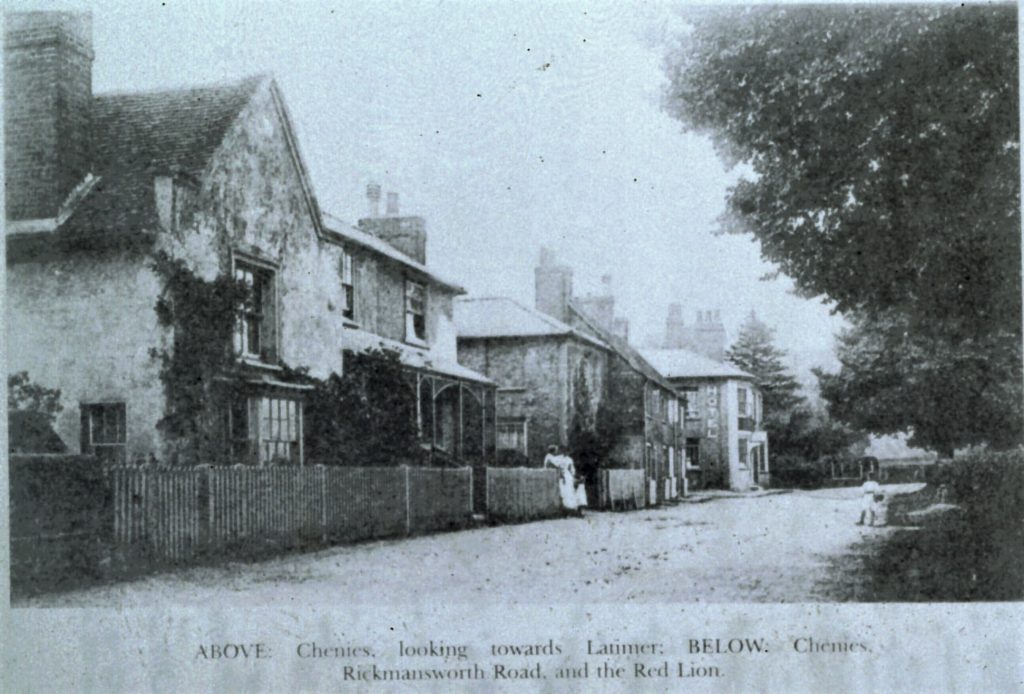
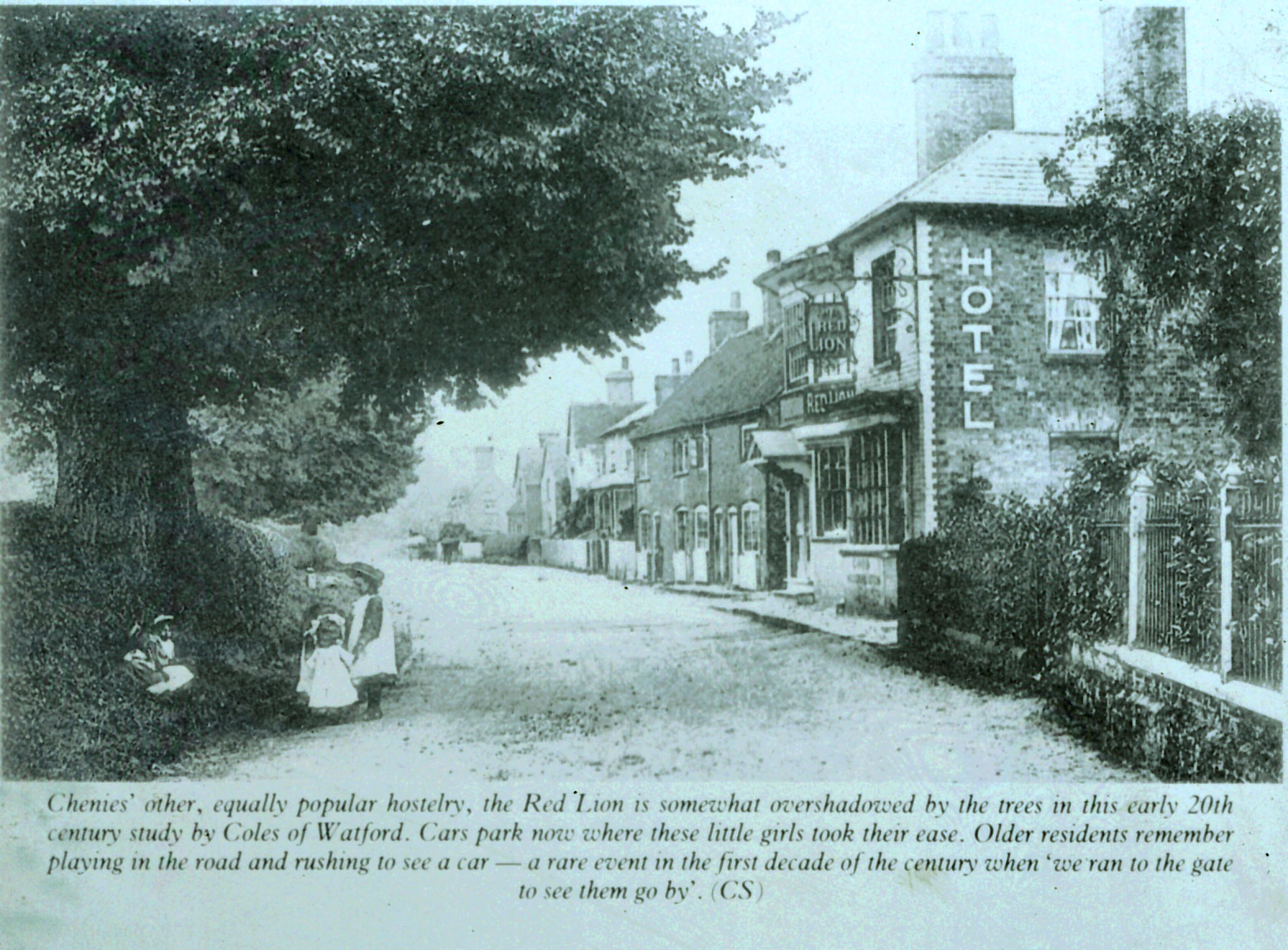
The plague visited Chenies in the summer of 1603, and fourteen people died. It is believed a traveller from the Goat Inn was the carrier of the disease. Three of John Barfoots family (the landlord of the Goat Inn) died as well as Edward Lodesman (the landlord of the Red Lion ale house) and two of his children.
The Old Goat
1603
With the accession of James I to the throne the Countess of Bedford was made Lady of the Bedchamber for Queen Anne, and had to leave for Edinburgh. This marked a change in the Russell’s fortunes and Chenies was once more occupied.
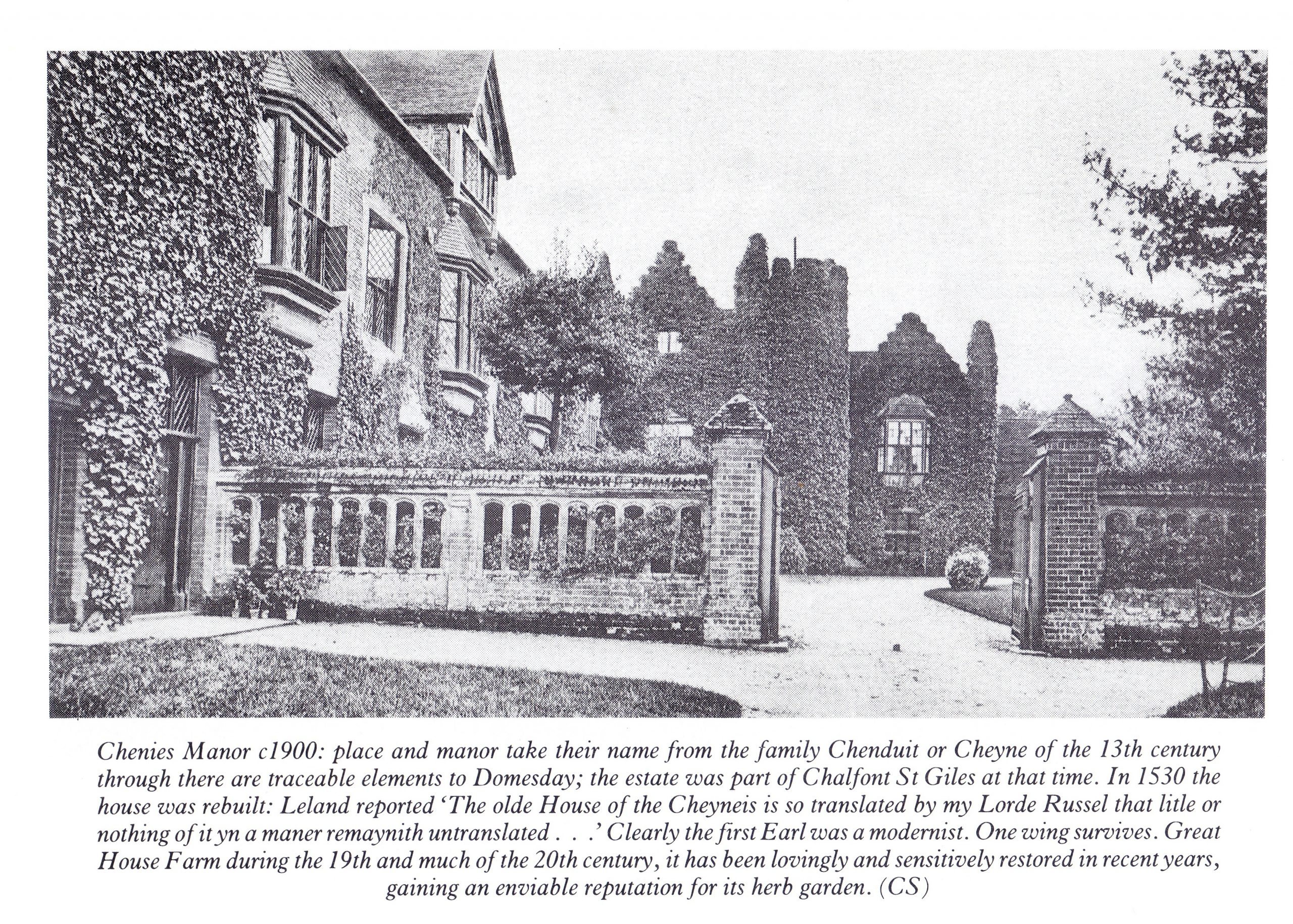
Chenies Manor c1900. From the collection of Colin Seabright.
1603
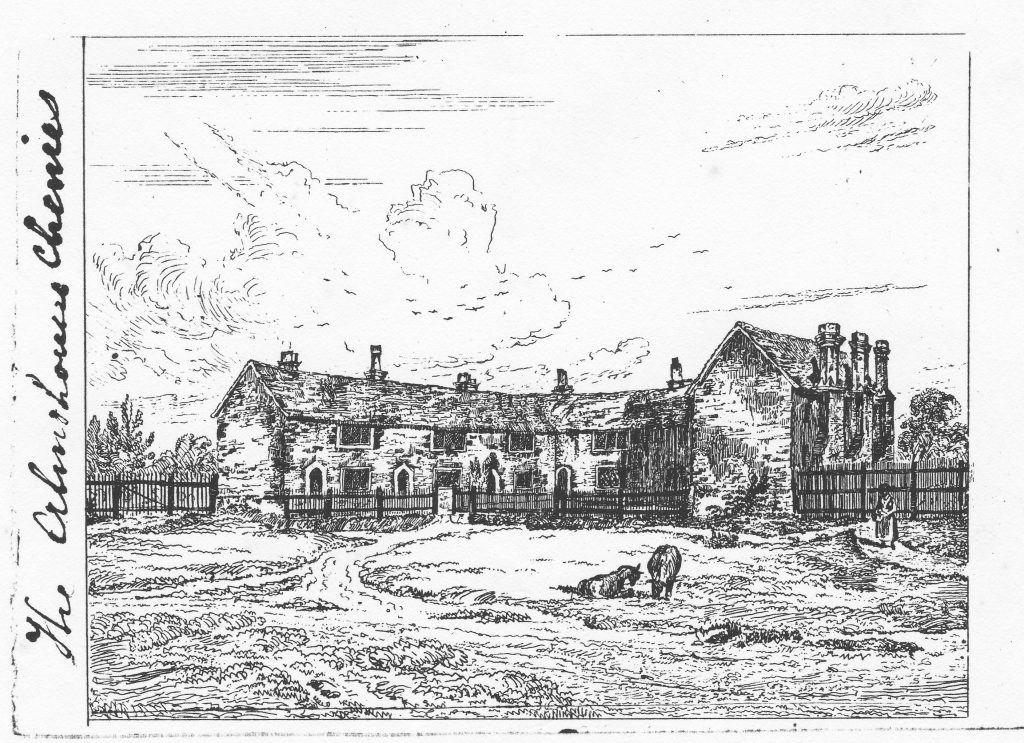
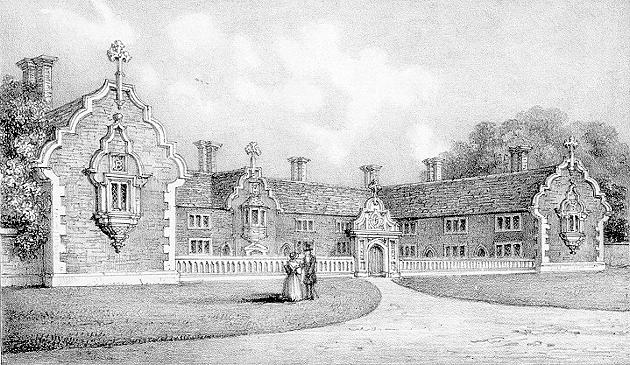
The Countess of Warwick founded the Almshousesin 1605 to house older members of the surrounding area, including from Chenies.
The “Magna Britannia”, written in 1806 states:
“Anne Countess of Warwick, founded an alms-house at Cheyneys, in 1605, and endowed it with 50 l. per annum, for the support of ten poor persons, six of whom are to be of Cheyneys, two of Northall, and two of Wotton-Under-edge, in Gloucestershire.”
It eventually grew to house seventy two!
Postcard reproduced with permission of the Bucks Archive
1605
The family quit Chenies for good in 1608. The house was occupied by a Mr Vernon, who had been an employee of the estate for some time, until his death in 1622. A female housekeeper was employed, and allowed to make money from the gardens and orchards.
1608
The 3rd Earl died in 1627, leaving no children, and the title passed to his cousin Francis Russell, the 4th Earl of Bedford who was heavily involved in the growing conflict between King and Parliament. Arrested in 1629, he was also one of the main opponents to the King at the Short Parliament held in April 1640. He died of smallpox on the 9th of May 1641.
1627
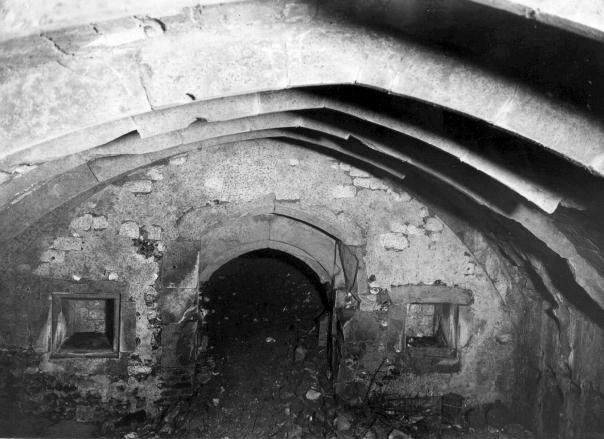
William, the 5th Earl of Bedford, and later the 1st Duke of Bedford (see 1694) fought first on the side of the parliament and then on that of the king during the Civil War between 1642-1646. Chenies Manor was garrisoned by the Parliamentarian forces during which time the Medieval undercroft may have served as a prison, as some of the graffiti inscribed on its walls is thought likely to relate to this period.
The undercroft at the manor. Photograph reproduced with permission of the Bucks Archive
1642-1646
The Presbyterian rector Benjamin Agar at Chenies was among the 2000 ministers ejected from the Church of England under the Act of Uniformity in 1662, aimed at restablishing the authority of the church after the tumultuous Civil War and rise of non-conformity. His name can be read in the internet archives here.
1662
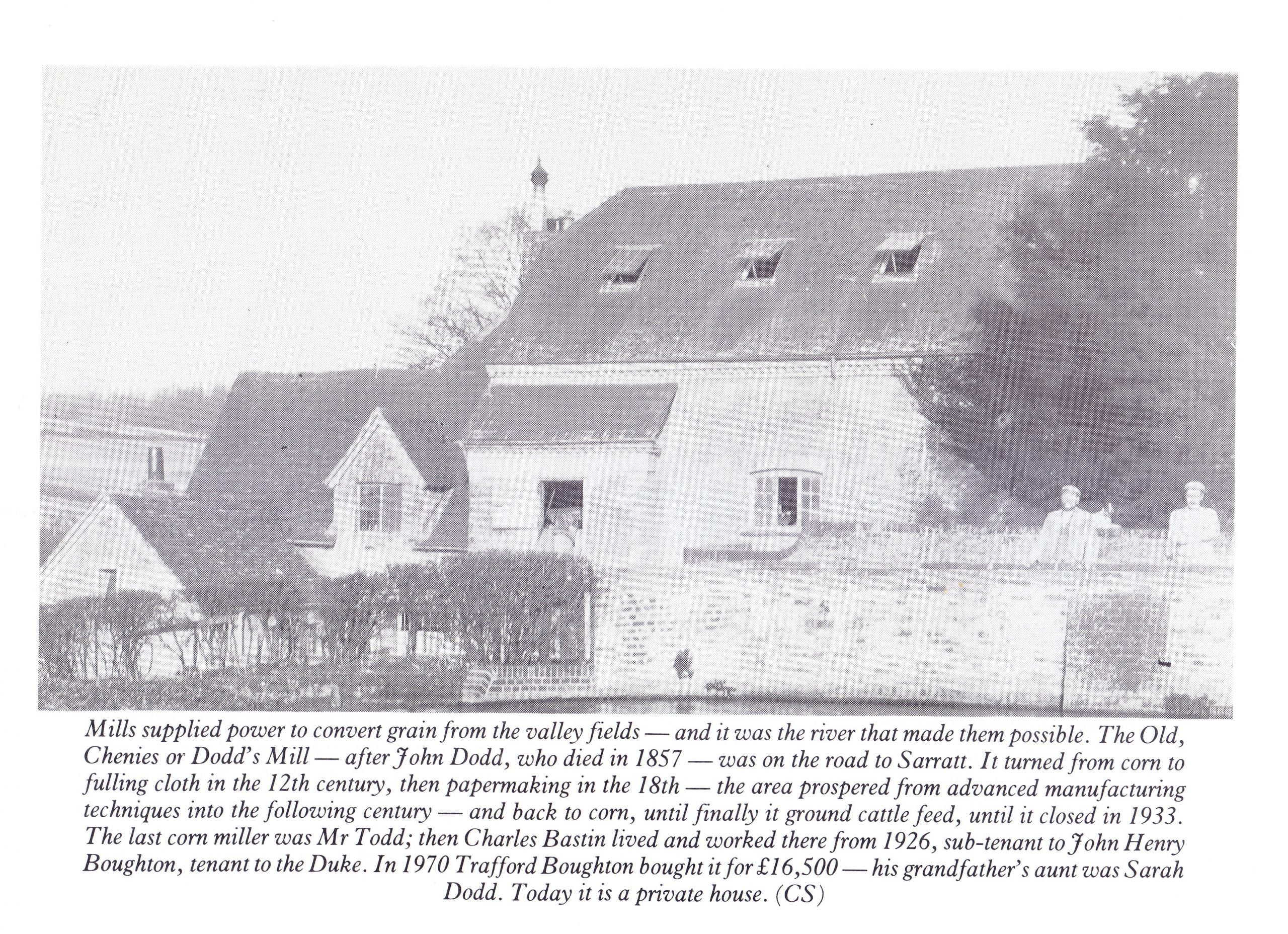
“The Mills”, as they were then known, were rented in 1665 by the widow Farrow for £25.4.0d per annum.
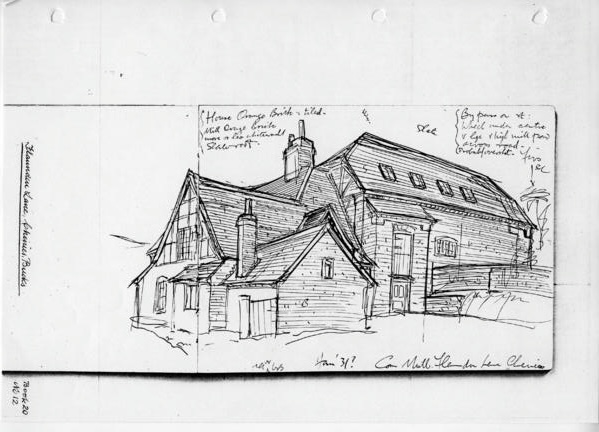
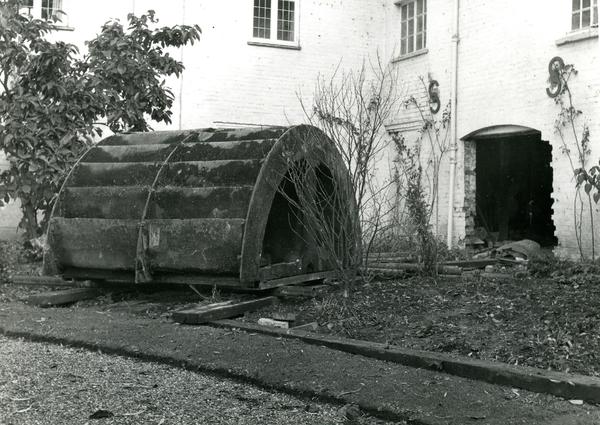
Sketch of Dodd’s Mill probably made in January 1931, from the Mill Archive
1665
William, the 5th Earl of Bedford‘s son, Lord William Russell, became a martyr for the Protestant cause after he was executed for his alleged involvement with the Rye House plot of 1683, a conspiracy to assassinate King Charles II and his brother the Duke of York to prevent a Catholic succession. William subsequently retired from politics.
1683
William, the 5th Earl of Bedford rose to prominence once again under King William and Queen Mary and was awarded the Dukedom in 1694 as compensation for the loss of his son, becoming the 1st Duke of Bedford.
1694
The 1st Duke of Bedford died in 1700, and was succeeded by his grandson Wriothesley. He was succeeded in turn by his eldest son, another Wriothesley, in 1711. The 3rd Duke died in 1732, with no direct heirs, and the title passed to his brother, John. At this time the Church was in a poor state. The chancel roof had collapsed and the chancel was closed off.
1700
James Newton became a Licensed Dissenting Minister and two cottages in Green Street, outside the Bedford holding, were licensed as meeting houses. James Cannon also became a Licensed Dissenting Minister at Cheynes Lodge in 1708.
1705
In 1728 the west wing of the current manor house was let as a farmhouse to Mr Henry Blythe, at a rent of £23 per annum. The south wing remained largely empty and suffered from weather damage. In 1735 the family steward at Chenies reported:
“Chenies Place is a very large old house, brick built with some very large and lofty rooms, but the apartments are not very regular and of no more value than to be pulled down. There is a great deal of lead and other materials that would be very useful to repair a small box. It joins to the churchyard ”
The Dodd family took on a 21 year lease on the mill from the Duke of Bedford in 1739.They continued making paper there until 1851 and it became known as Dodd’s Mill.
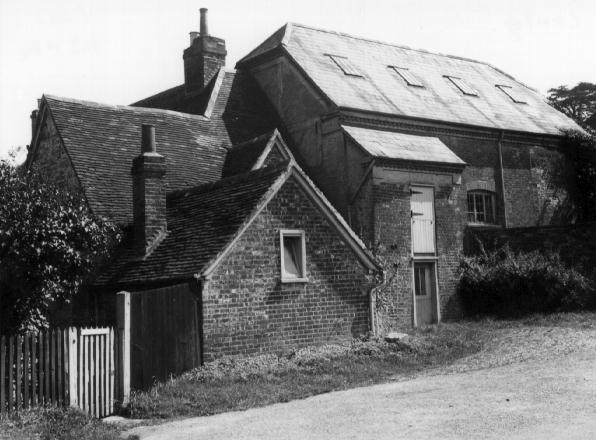
Dodd’s Mill. Photo reproduced with permission of the Bucks Archive
1739
A letter surviving in the archives owned by Elizabeth MacLeod Matthews dated to 1746 describes the difficulty caused by the window tax. The iniquity of the window tax may have played a significant part in the decision to dismantle or abandon some of the buildings within the complex.
1746
Horace Walpole visited the house at Chenies on the 28th of September 1749. By this time much of the complex was in a sorry state of repair. He talks of the house being built around three sides of a court, falling down in places and with some of the roofs missing, although he does comment favourably on some of the stained-glass.
1749
In 1760 the south range was divided into five tenements for farm labourers, with new doors inserted and an extra staircase added. The steward in residence, Mr John Davis, advised that the building be pulled down, a request refused by the Duke who instead embarked upon a restoration programme.
At this time the group of non-conformists meeting in Green Street had grown to twenty one and Mr John Davis, had identified himself with it.
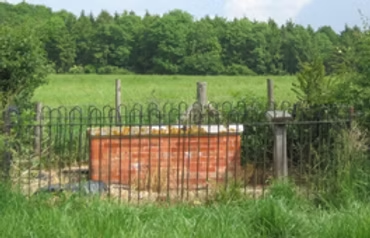
William Liberty, a relative of the family of Liberty’s of Regent Street, London, was buried in a tomb on his estate of which nothing remains. His tomb can be seen adjacent to the Chess Valley footpath (Mill Farm to Latimer).
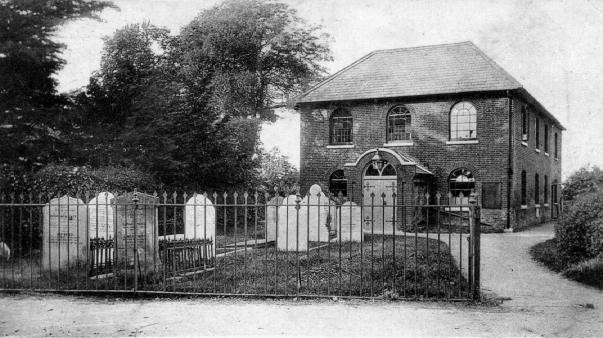
On 8 October 1778 the new Baptist Chapel built on John Davis’s land was certified to the court of Quarter Sessions as a Place for Religious Worship for Protestant Dissenters. The formal vesting of the property was delayed until May 1779 when it was transferred by John to 20 trustees. ‘Kingscote’ was included in the deed, but the adjacent cottage, the present manse, remained the property of Davis whose tenant George Cooper was still living there.
In 1798 the Posse Comitatus listed 93 men between the ages of 16 and 60 in Chenies. By 1801, there were 423 inhabitants in 105 families living in 88 houses recorded in Chenies.
1798
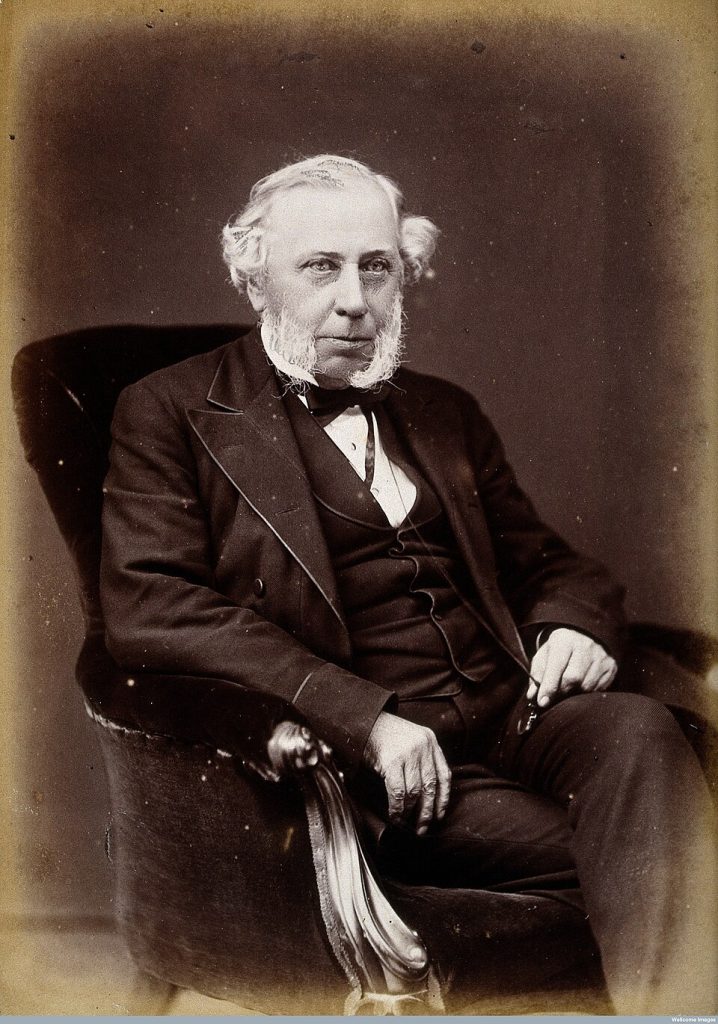
Ebenezer West, the then minister at the Baptist Church started a school “for 4 or 5 young gentlemen under 12 years of age”, together with his two sons, one of whom, Charles, (later Dr Charles West), was the founder of the Great Ormond Street Hospital for Children.
Charles West. Photograph by G. Jerrard. Credit: Wellcome Library, London. Wellcome ImagesCC BY 4.0
1821
In 1829 the new Rector, Lord Wriothesley Russell, set about repairing the Church. During 1835-36 it was closed for major restoration, reopening on 23rd June 1836. Substantial repairs were also carried out to the surviving elements of the manor house in c. 1830, following occupation of an unreliable tenant. These were undertaken by the architect Edward Blore (who also worked on St James’ Palace and Buckingham Palace) for Lord Wriothesey Russell.
1829-36
The Beer House Act of 1830 provoked a number of houses in Chenies to sell (and brew) ale, including numbers 50, 51 and 52. According to the 1735 survey Grafton Cottage (50), the turner’s shop with stables and yard was been the site of the Swan Inn, and number 51 is thought to have been the Ship Inn. It is likely that these ceased to be beer houses when The Plough opened at number 52 in 1860 up until a short while after the Second World War.
The Plough
1830
In 1831 the first iteration of the current Chenies Schoolwas first held in Lord Wriothesley Russell’s kitchen in the Rectory from 1831 to 1846. Lord Wriothesley also started an orphanage for boys in what are now the Platt Cottages and opened the new burial ground opposite the Church overcoming some opposition by promising that was where he and his wife would be buried when the time came.
1831
In 1840 an old Tudor building attached to the west wing of the manor was taken down and replaced with a new structure. Two bay windows were added to the west of the house in 1860 and the brewhouse was demolished.
1840
In 1845 The Duke of Bedford instructed an Infant School to be built, this was what is now known as No 49 Chenies (Field Cottage), it carries a Bedford crown and the date 1845.
Field Cottage, left
1845
1846 The oldest part of the present school building was built on the instruction of Anna Maria, the wife of the 7th Duke of Bedford and there is a plan of this building in the minute book when formal records began with the formation of the School Board in 1887. It was built to educate the children on the estate.
After George Dodd’s death his widow Sarah continued to work the mill as a flour mill, and at her death the lease passed to her nephew John Boughton, a farm tenant at Chenies Manor.
1851
In the period 1861–87 the flint facing on the Church was reworked, the porch to south door, the battlements, turret and flagstaff were all added. In 1886-87 the roof was raised and the present handsome hammer beam roof was installed.
1861-87
The first mention of Cricket in Chenies was in 1878, with regular games and records kept. Chenies later joined with Latimer in 1909 thus establishing the Chenies and Latimer Cricket Club which continues on til this day. Initially playing in a field alongside Chenies Church (the Pightle), it later moved to it’s present location after the second world war.
1878
A very special event celebrated in the school one Sunday afternoon was the presentation of a special frame made with wood from St. George’s Chapel, Windsor, with paintings of local scenes and the signatures of all the residents, to Lord Wriothesley Russell, on his Jubilee as pastor. Of the school it was written:
“Chenies has been called a model village, and certainly this was a model school. In these days of education, when every parish is trying to hold its own in learning, and aiming to perfect its machinery, how apt we are to forget the efforts of those who began this good work!“
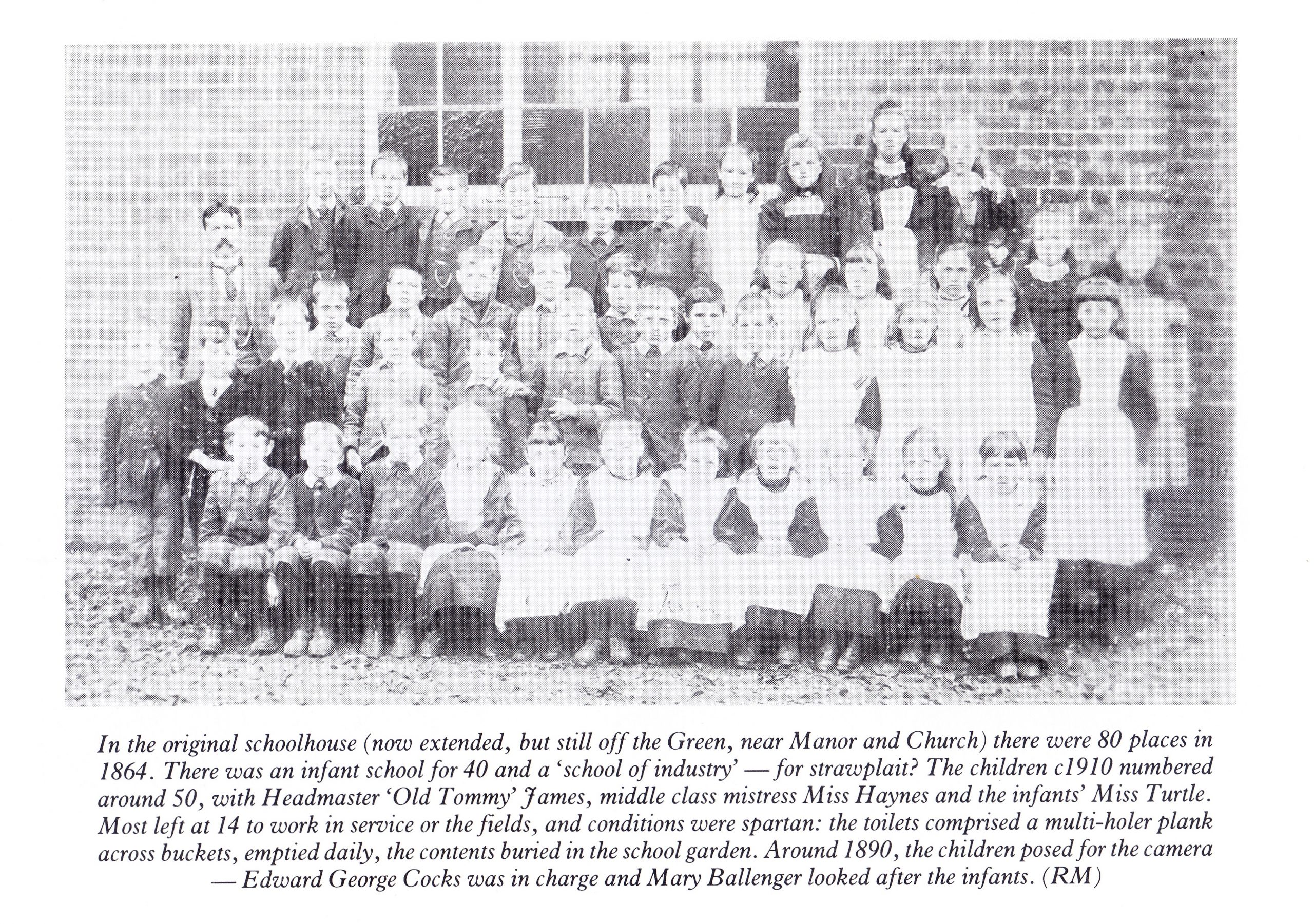
Around 1890, Chenies School Children. Photo credit: Rose Maling
At this time the village was practically self supporting and had a Post Office, a drapery store, a General Store at Banner Rest, a Butchers, a Bakery and two Public Houses (the Bedford and the Red Lion). There was a Blacksmiths Shop in Back Lane and a Wheelwrights (now no. 18), and a Carrier who made weekly journeys to London. In addition there was a grocers, an oilman, a man with straw hats, a basket maker and the Muffin Man, who came around with a tray of muffins on his head ringing the bell. At one time we had a resident District Nurse and a Policeman.
c.1900
During 1914 a swimming bath was built in meadow near the Chess and was greatly enjoyed by the residents of Chenies. The water was drawn from the river, and it eventually had to be closed as it was thought that the water was not sufficiently clean. This photograph is sourced from Historic England.
1914
Flour milling at Dodd’s Mill ceased in 1915, but the mill continued to grind animal foodstuffs until 1933. Rose Maling remembers:
“In 1926 my parents and family moved to the Mill House … By now it was used only for grinding corn for animal feeding. The house and the garden were very dirty and neglected … It was like stepping back in time as we had to use oil lamps once more and all cooking on a kitchen range (no gas). There was however a tap indoors and a drain from the sink. Also the wash house was outside with the copper”
During the 1930s, the school roll had dropped to just 10 pupils, making Chenies the smallest in Buckinghamshire and placing it under threat of closure. Chenies acquired 24 new children from Latimer, which subsequently rose to 50 by the outbreak of war in 1939, allowing the school to take on a second teacher to look after the class of infants.
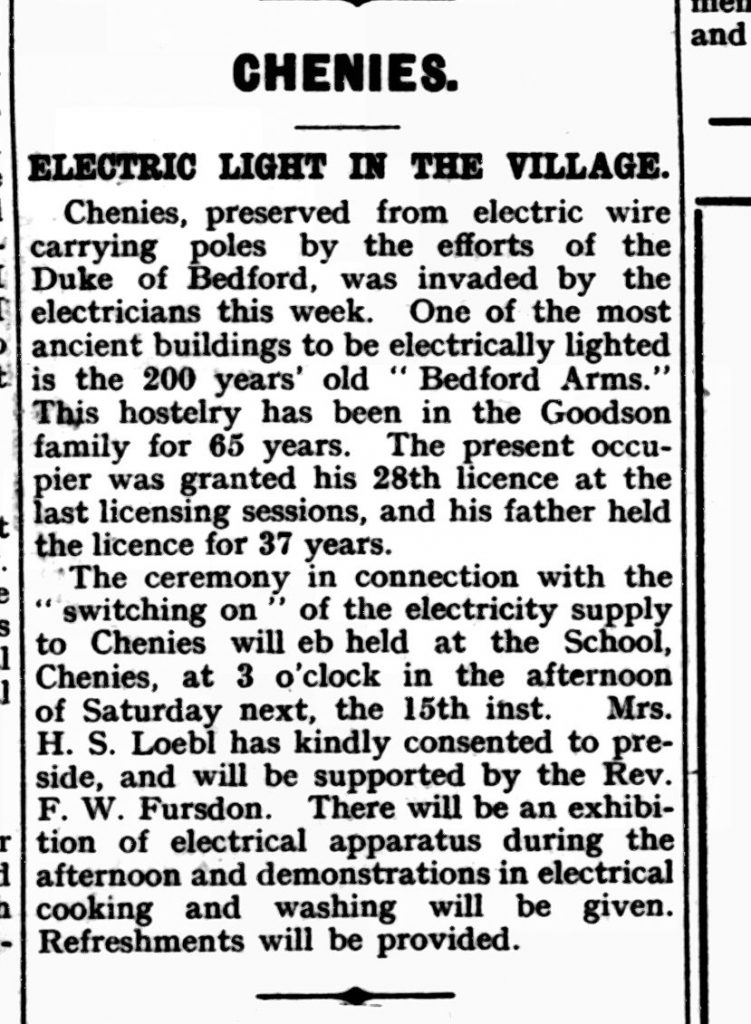
Electric Light in the Village. Buckinghamshire Examiner, 14 October 1932
1932
World War II brought challenges to the village school, with the evacuation of children from London to the safer environment of Buckinghamshire. Emilie remembers:
‘Then came the war and evacuees and London (LCC) teachers. In one week, our numbers rose to 175 and the staff to six. In a room for 40 we packed 120 children, three in a desk, with two of us to instruct same. From September till May we struggled under those conditions. Perforce we had to take many combined lessons. Heretofore, the singing of my children had been rather weak and colourless. What a change when the LCC children joined in! Believe me everyone in Bucks could have known what we did to the drunken sailor!! No longer did any mistake in my accompaniment sound to high heaven….’Emilie Life – retirement speech (edited transcript)
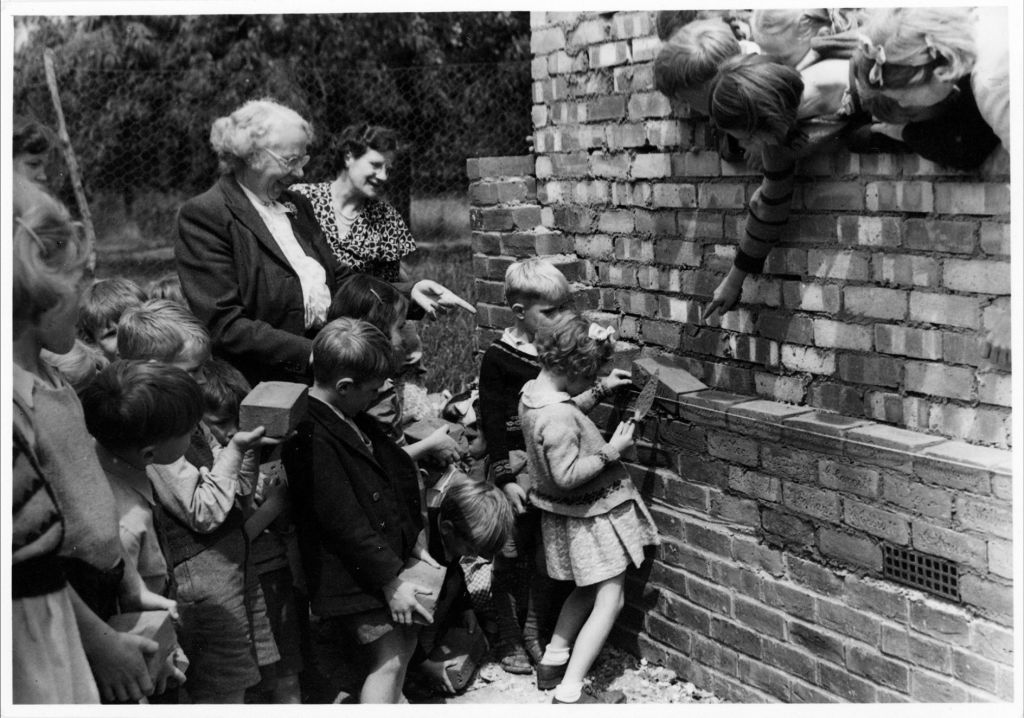
Mrs Emilie Life retired as Headteacher of Chenies School, moving out of the schoolhouse and building a new home – The Pightle – which was christened with bricks signed by pupils and staff.
Pupils of Chenies School laying bricks personalised to themselves in the wall of The Pightle in 1951
1951
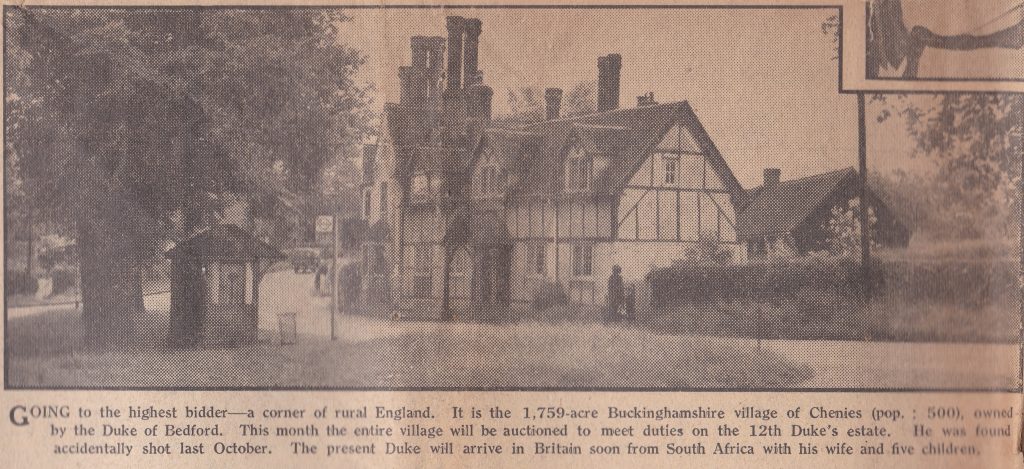
When the 12th Duke of Bedford’s estate was split up and sold for auction in 1954 after he was accidentally shot in a hunting accident in October 1953, much of it was purchased by a property developer who hoped to be allowed to build more housing. However this was not allowed, and many of the properties were then resold to those who rented them. In this way some of the farms continued as they had been previously run.
There has been however a gradual ‘Gentrification’ of the farms, with many of the large farmhouses being converted to private residences, and old farm workers cottages and outhouses changed to housing. In this way the character of the village and its farms has changed dramatically.
From the Daily Mail 12-Jun-1954
1954
Chenies Village Society formed in 1956, following the auction sale of the village by the Bedford Estate in 1954. The inaugural meeting took place on Tuesday 6th March 1956 in St Michaels Church.
1956
1964 brought the closure of the village shop
1964
The removal of nine elm stumps from village green was necessary due to Dutch Elm disease.