

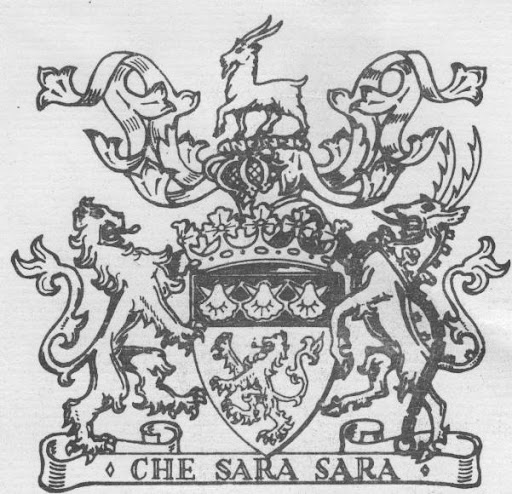
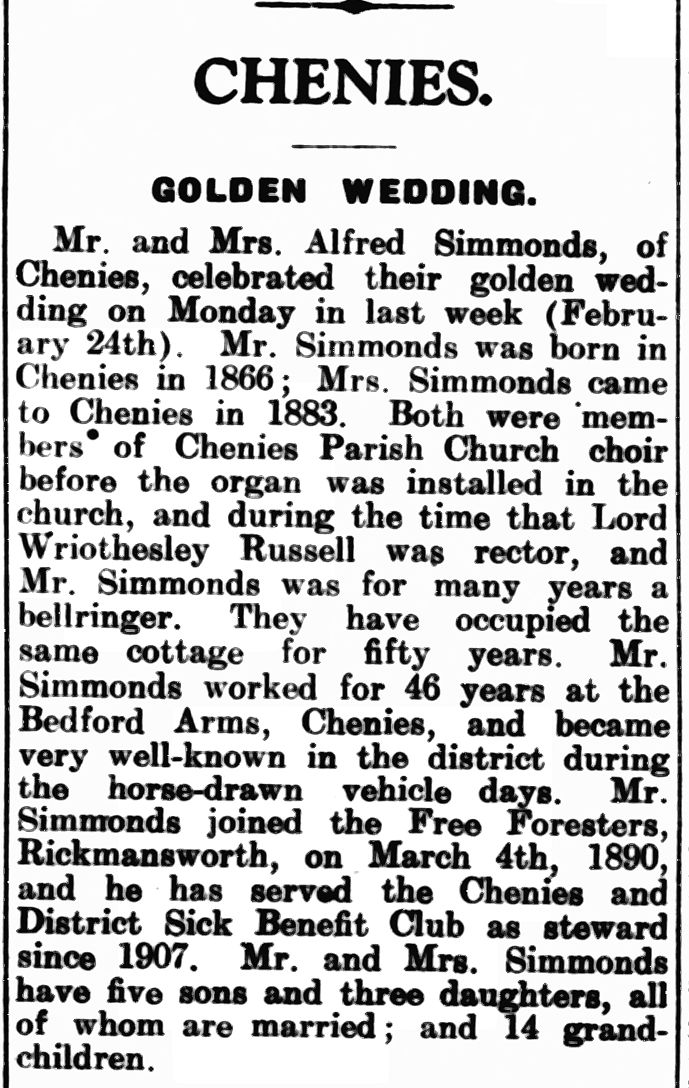
Betty Healing, née Simmonds was born on the 11th November 1923. Although she lived in Sarratt Bottom, she was a regular visitor to Chenies where she went to school and spent time with family members. Her paternal grandfather, Alfred Simmonds, was a coachman at the Bedford Arms and attended Chenies School, and her maternal grandmother, Elizabeth Westell, was licensee of the Red Lion along with the landlord Mr Westell, with whom she had a second marriage. Betty also had a great grandmother who lived on the Green. Her father, Alfred Thomas Simmonds, also attended Chenies School, and at one time worked as an assistant to the Baker (located at No. 58, Chesscroft) in Chenies, and one of her siblings also worked at the Bedford Arms. Betty died in 2001.
We have two written versions of her memoirs which can be downloaded at the bottom of this page, the full memoir and a shortened/rewritten version. Below is the transcribed text of her memoirs which does its best to honour both.
A Thing of Beauty is a Joy Forever.
Memories of a Child in the Valley of the Chess, by Betty Healing 1990
I was brought up in a beautiful but remote part of the Chess Valley in the early 20s. On the one side was Saratt, on the other the ‘Ducal’ estate of Chenies owned by the Duke of Bedford. The river running through the valley was the boundary between Hertfordshire and Buckinghamshire.
In this part of the valley lies the hamlet called “Sarratt Vale” where I lived on a small farm with my parents. This was worked by Auntie and Uncle Smith who were as second parents to my brother and me.
Altogether they were eight houses and two farms, the larger one being ‘Valley Farm’ at the top of the moor farmed by Mr Saunders.
Known locally as the ‘Bottom’ there were two lanes leading up to Sarratt which we called the top, one was Dawes Lane the other Moor Lane, and there were a few shops on the Green as well as two pubs and a Chapel. There was no vehicle access to Chenies unless you were lucky enough to own a pony trap like uncle Smith, going through the river at the ‘Splash’, or by bicyle over the only foot bridge. This was the most shallow part of the river at the top of the moor – motor vehicles had to go via Sarratt and North Hills onto the Chorleywood Road, a distance of about eight miles.
I come from a very old Chenies family. At that time there were four generations living in the village, and so it was natural for me to spend most of my time on that side of the valley. Although living on the Herts side of the valley, I really had the best of both worlds.
My mother was an only child and moved to Chenies from Chorleywood where she went to school when Grandma became Licensee of the Red Lion Hotel with a Mr Westell (having recently remarried). Probably “Proprietor” rather than “Licensee” would be more accurate, as at the time they were still used as tea rooms. I can’t be sure when they became fully licensed. Long before my time, Grandma had retired and moved to the cottage next door to the Red Lion where she was to spend the rest of her days. Mr Westell was a very tall gentleman with a long grey beard, he always wore a black cloak and carried a walking stick. I never took kindly to him or his beard.
I was often told how mother had to get up in the morning to scrub the floors and blacklead the grates before going to her work as a civil servant in London. One of those rooms is still the same today. My father was one of eight children and they lived on the edge of the village green (no 48). He was an interior decorator, but some of his brothers and sisters worked on the estate or in the larger houses for the gentry in the village.
Grandfather was Coachman at the Bedford Arms Hotel. He also helped with the cattle and horses belonging to the Hotel. His job was to take people to Chorleywood Station for one and sixpence, or to Rickmansworth for shopping and of course to Church on Sundays, but his main priority was always to take the Lady Blandford for her two hourly afternoon ride.
His coach was drawn by one horse. It had a door on each side and curtains at the windows. A special treat was to sit up on top with Grandfather on the box snuggled under his black cloak. His reins in one hand and his whip beside him, my older cousins had this privilege more often than I did.
On one side of the village green was an old well opposite the school. On the other side a row of cottages with diamond pane windows, one of which was where Great Grandma lived with her two daughters (no 21). The ‘Court’, a long drive, went up to the Church and the Manor House. The Russell family vault is in Chenies Church. The Duke stayed at the Manor for a short time, this a very long time ago, as did other members of the Russell family of which the Lady Blandford was one.
The Manor House, a beautiful old rambling building with many chimneys, each one a different design, looks out over the “Plait” an area of trees and cottages where some of the estate workers lived. One tree, an oak, had a hollow in it large enough for two people to hide in. I once heard it said that one of the early Kings hid there from his enemies, but I cannot give much credence to that, although there are passages under the house. I only went once to the entrance as a small child. It looked like a very dark hole to me.
I attended Chenies School, as did my father and grandfather and had the privilege of the village amenities, mainly the swimming pool. Living by the river I learned to swim at an early age, this became my favourite pastime.
The pool was an antiquated corrugated iron building set on the river bank by Chenies Mill, it had twelve changing rooms each with a wooden seat and a door that neither reached top or bottom. Fed from the river it was always murky, it came in through pipes and was emptied the same way. We always knew where the bottom was when going in off the boards at the deep end which was only 6 feet deep anyway. The pool was demolished at the time of the second world war probably to help the war effort.
The entrance to the moor was through a five barred gate in front of our house and I earned my pocket money opening the gate for cars to go through to picnic and to paddle in the river, but today it is all fenced in and boasts a concrete road. Mainly grasslands with boggy patches, I knew every step of the way, a delight in summer when the blackberries were ready to gather for jam making. Dandelions for wine, or just to blow the furry tops away to count time, but in the winter the winds blew anything away that was not fastened down. Nevertheless, this was my playground. The woods and fields in the valley were private property, but no one concerned themselves with a little girl roaming around, usually alone. I had been taught to close the gates behind me.
Our cottage, two up and two down with an outside loo, had an old fashioned grate with a boiler on one side an over on the other and in front a trivet which swumng to stand the kettle on. My mother know only too well how to blacklead grates.
There was no electricity in the valley, only gas. For lighting we had an oil lamp, then we progressed to a shiny chrome lamp called an ‘Aladdin’ which burnt pink paraffin.
Aunties house was larger than ours, she had gas and it was more up to date (the gas stove). Aunties house was once a hostelry called ‘The Cart & Horses ‘ situated on the corner of Moor Lane adjoining our house. It still had the tap room with a large open fireplace that you could sit inside, and a black settle large enough to seat five or six people. The door to the public bar was in two halves, like a stable door, the lower half had a shelf for serving. The cellar, down two steps, had a cold stone floor and had a very small window, it had a very different use in my day.
The little farm, or smallholding as it was called, had five cows, one was called “Mollie”, she allowed one to sit on her back when Auntie brought her in for milking. Mother helped with the milking and was very good at the job, not so my father. There were also pigs and chickens. I could feed them and collect the eggs, but the pigs I viewed from afar. Mother loved to have young lambs indoors to feed on a bottle in front of the fire, it was a sad day when they had tails “docked” – a gruesome sight. Eventually my parents had their own smallholding. We always had fresh warm milk straight from the cow for our breakfast cereal, it was called “Force” (porridge in the winter). This was all before the days of pasteurisation and T.T. testing came into being. Then a machine that looked something like a washboard with a hose pipe on the top was used for cooking the milk as it ran through the channels into bowls underneath, all the cream then taken for butter.
Butter making was a long and tedious job. Auntie sat for hours with a churn on her lap turning the handle until the cream was ready for making butter. Using large wooden butter-pats the cream, butter by this time was shaped into slabs and ready for use. There were times when it would not “turn” but all told we had a very healthy living from the farm produce. The slump in the building trade in the early thirties was a very worrying time for my mother, she dreaded the sight of my father coming home with his tool bag on his bicycle. From our bedroom window we could see him coming across the moor sometimes having cycled to the London area looking for a days work. At this time mother and her friend cycled to Loudwater as “Domestics” for ninepence an hour.
Saturday was visiting day for the family. Setting off over the moor to Mount Wood where a path took us out by Grandma’s cottage and “The Red Lion“. I could visit Miss Kentish in her little store tucked away in the corner, buy a sherbert dab with a stick of liquorice for a penny, or wait for the ice cream man to come by on his three wheeled bike, a tub of ices on the front. We had real ice cream, lollies and snowfrutes, calling and ringing his bell as he went “stop me and buy one”.
After dinner with Grandma we walked down the village past the Post Office and the Butchers/Dairy. The milk in the village was brought to the door in big churns and ladled into our own jugs, they were delivered on a little cart drawn by a pony, not like at home where we took the jug out to the cow. Next came the Bedford Arms Hotel, a lovely building right in the middle of the village, here you could go to the back door and buy a quarter of ham for a shilling. Probably Grandfather and my Uncle would be tending the horses or maybe milking the cows. My parents and several other of my aunts and uncles had their wedding receptions here; although fashions have changed the actual building has not altered much.
Finally, to Great Grandmas house after seeing my paternal Grandparents. Great Grandma was always sitting in her rocking chair by the fire wearing a lace cap on her head and a stiffly starched white apron over several black skirts, one of which had a pocket for her money bag. Her two daughters in attendance one to cook and one to clean.
To get to school I had a two mile walk over the moor by Mount Wood, and along the lane after crossing the river to the three step field, so called because it had three steps up to the stile (today there are six steps and an official footpath sign). This was a short cut to Chenies Common avoiding Holloway Hill which is very steep. From the top of the field I could see my Mother waiting on the moor to see me. I usually had Aunties old mongrel “Nort” with me. Sometimes he would be waiting when I came out of school in the afternoon. There were sheep and rabbits and cattle in the field, and once I saw a white rabbit as well.
In this field were mushrooms growing and my father often went early in the morning to pick some for breakfast. On one occasion he found a shilling near the stile that I had lost the day before, a miracle indeed.
Winter months were very tiring for tiny feet when the snow lay deep and crisp and even. We wore wellies and macs and gaiters that had to be done up with a button hook that pinched legs. The winter evenings were happy times sitting round the fire playing cards or making rag mats on an old sack, hessian was not a common commodity in those days. While my brother and I cut up pieces of rag to short lengths, my parents, using a special hook, pulled them through the sacking to make loops, sometimes making patterns.
The long hot summer passed into autumn and leaves carpeted the ground. Acorns to be picked up and fed to the pigs, conkers to play with, chestnuts over, but we did gather some, so did the squirrels. This was the beginning of the winter evenings and the long dark days of winter, the family fireside treats. This was also the time to think of winter warmth, there was always plenty of wood laying around. With an old pram we went to the wood, sometimes takiing a chopper with us, but if we happened to see a friendly woodman he may cut the wood into just the right sizes for us. Pine cones wrapped in twisted newspaper were a good way to kindle a fire, they soon made a good blaze. The violets, primroses and bluebells are over, but the hawthorn and hips and hoars begin to bloom. We used to call it Bread and Cheese. The moor was mostly milkmaids and cowslips in the spring, but on the river bank were huge kingcups and irises mostly yellow but here and there a purple one. A lovely sight standing stiff and tall.
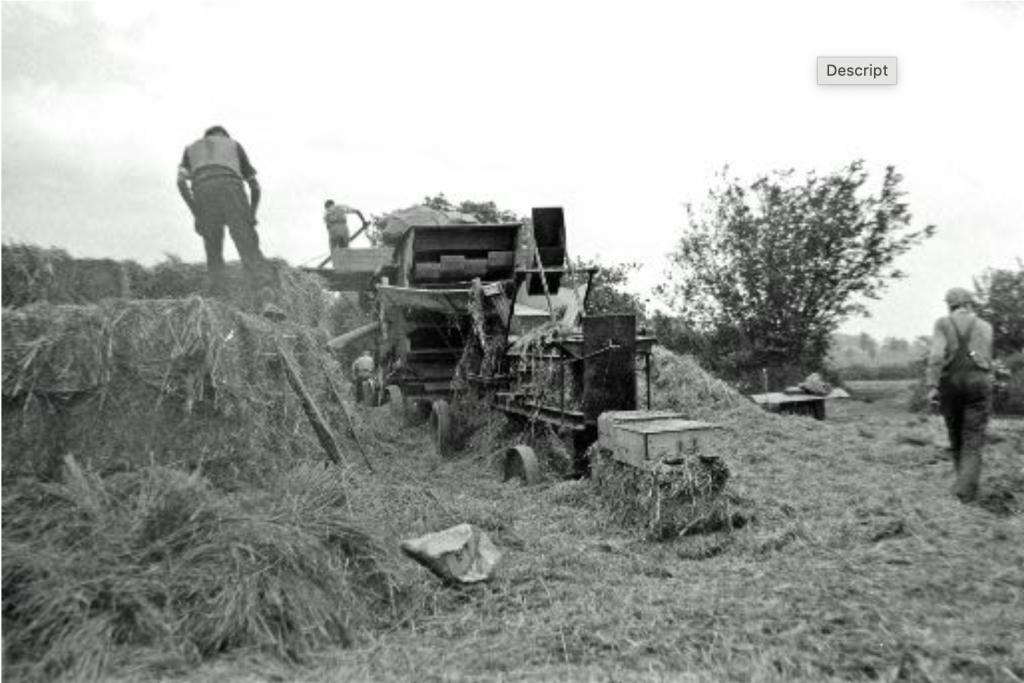
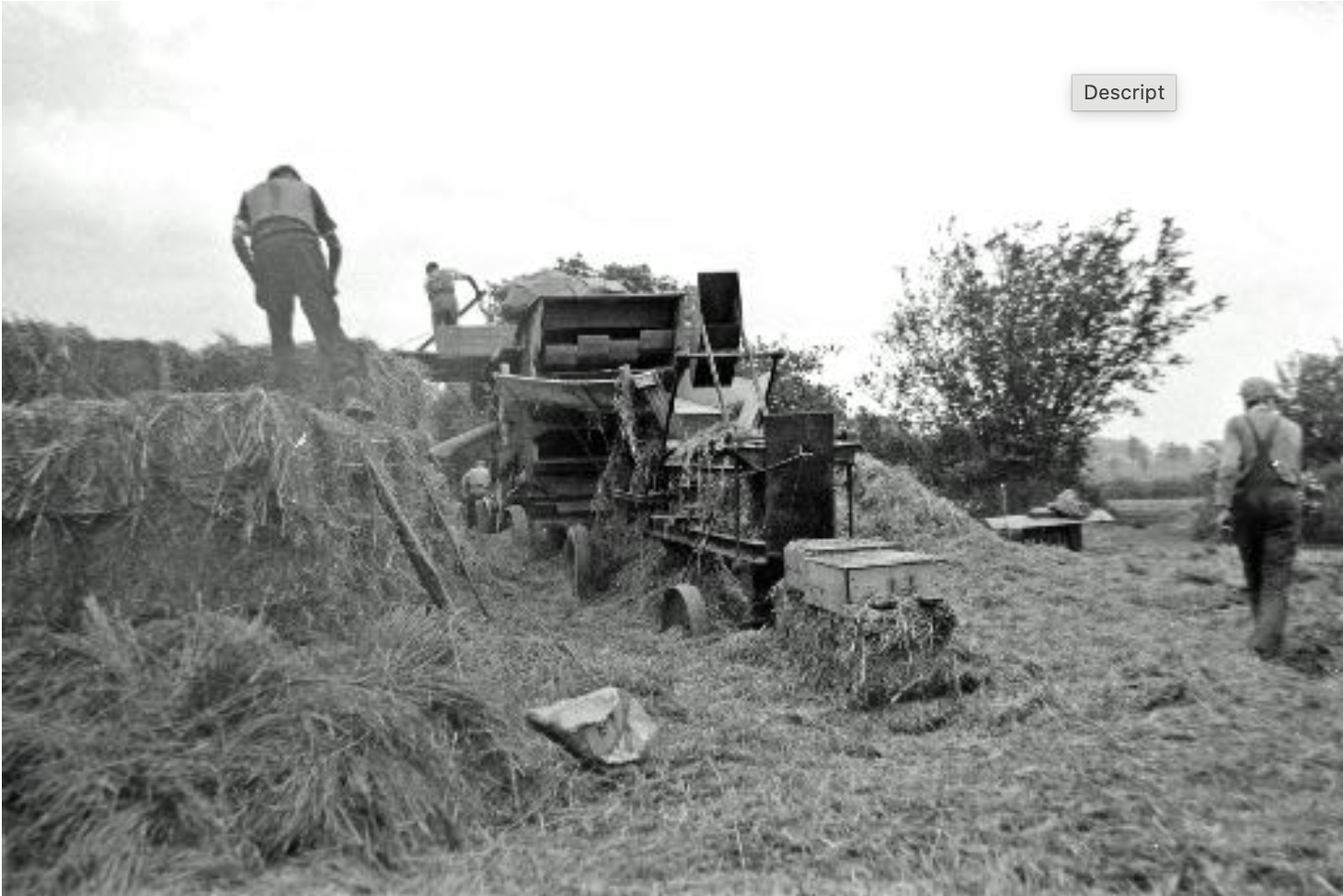
Haymaking time was a busy but enjoyable time of year, any available hands were brought in to help and endless jugs of tea were carried to the rickyard. The first job was to go round the sides of the field with a bagging hook to clear all rough grass and rubbish away, anyone who could wield a scythe helped as well. Mr. Higgs from Rose Hall Farm came with his men and machinery, all the implements were horse drawn. Firstly, cutting with a mechanical scythe and after laying for a given period, it was turned. This often by men with hayforks which only have two tines, unlike a garden fork. After being raked into rows ready for the sweep to come along and pull it into heaps ready to be taken to the rickyard on the cart. This cart had four wheels and extensions on all sides that looked like a five barred gate. Children loved to come to the field hoping for a ride back to the yard. Great fun bumping over the field on top of the hay. Often when horses and machinery were busy on other farms, we had to wait and pray it would not rain until the rick was built, this was done by men tossing fork loads of hay up to the man on top who built the rick ready for the thatcher to finish off with straw preserving it for winter use.
In Chenies there was a lady who kept owls. She was always willing to pay a penny for a mouse and at haymaking time there was always plenty about in the hay (another source of income). There were rabbits, but they usually found their way to the dinner table.
Cage owls apart, the wild life in the valley was an interesting feature. “Birds of Prey, Game Birds and Woodland Birds, a few marshland ones as well. One of my uncles, a gamekeeper, moved on to visit Scotland with his employer during the Grouse season.
It was at this time of year that I saw more of other children in the valley. Eight boys and two girls, they were older than me and went to school at Sarratt. Harvest was not such a busy time for us as for most farmers. Apart from fruit and vegetables for our own use we only grew marigolds for the animals. Apart from the orchard the rest was grazing land.
In Chenies all the social activities were held in the Long Room at the Manor House. The name speaks for itself, on the end was also a cottage where the Church caretaker lived, he also took charge of the swimming pool. One can easily visualise our parents dancing the Lancers, Quadrilles and the Two Step years ago when the gentlemen wore white gloves and the ladies in their lovely sweeping gowns. My father had four brothers and so I heard many stories of those days. For us in the twenties and early thirties it was Roger de Caverly and maybe a Waltz. Upstairs was a billiard room where we had our party teas on tables put up around the billiard table.
Chenies School
Chenies School had three classrooms, we only used one, sometimes there were only 10 pupils, however, when Latimer School closed down they came to our school raising the total to twenty or thirty, far different from Father and Grandfathers day. Teachers name was Mrs. Life, she lived with her husband and son in the house adjoining the school. Affectionately known to everyone as “Guv’ness” she did so many things to make our school days happy. Probably drying wet clothes around the old boiler in the classroom (usually mine) or doing jacket potatoes for lunch, we carved our names on them beforehand.
Mrs. Atkins, the school caretaker, used to bring windfall apples – somehow we baked them as well. As to the wet clothes, Guv’ness always kept a reserve set for temporary use, they didn’t always fit in the right places, but it was all part of our school life.
In the summer our desks were taken into the playground and put in an open fronted shelter for our lessons out of doors. Before the Easter holidays, Guv’ness hard boiled chicken eggs and dyed them pink. Mr. Life then hid them in the hedgerows around our playground for us to find the ones with our own name on, but not to tell if you found someone else’s. There were usually chocolate eggs as well.
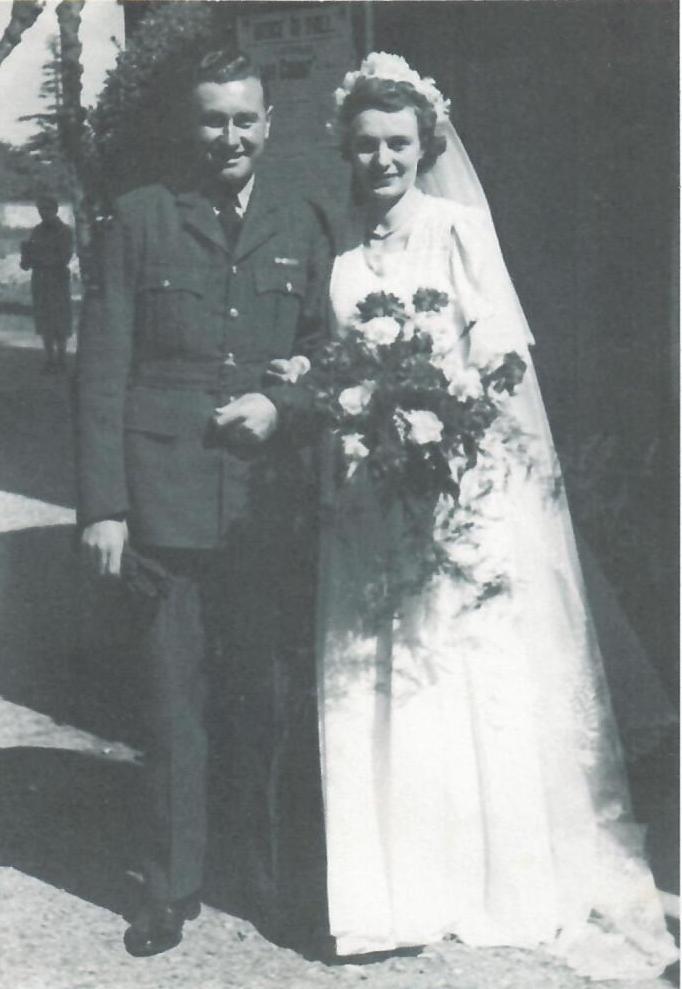
Although I had friends both in Chenies and Sarratt, it always seemed to be separate ways of life. Sarratt was Sunday School at the Baptist Chapel, but Chenies was school and family and so it was not until my late teens that I formed a real friendship, this during the Second World War, by which time I was alrady engaged to be married.
Christmas parties at school, when there were only a few children there and it was very cold, were held in the house. Once we had tea and games in one of the Guv’ness empty bedrooms. Punishment was rare, not because it was not sometimes necessary, even then it was to stay in at playtime or stand in the corner.
When one day during summer term the needlework inspector arrived in her car which was so thick with dust you could write your name in it, I couldn’t resist the temptation! A few days later the school governer who was also the village overseer, paid his usual visit, all the formalities over, I was called to the front of the class, needless to say I ended up in the corner. I was very hesitant to go to his house afterwards which I had to do to get my permit for the swimming pool, happily my misdemeanor was not mentioned. The latter because I lived over the boundary.
In Chenies the “Rectory” had stables where ropes were hung over the rafters, we often played here swinging around the stable. Sometimes if the “Folk” from the Big House came around, we were expected to curtsy (without falling over).
Towards Christmas when the nights drew in fast, Guv’ness allowed me to go home early. It was always cheering to see someone around. Maybe Miss Palmer walking her dog on a lead as long as a clothes line. Mr. Saunders or one of his sons tending the cattle, certainly Mr. Tyler would be at his watercress beds picking and bunching cress ready for market the next day. A bunch the size of a dinner plate was twopence. His men, backs bent over their job, standing in the water wearing rubber boots up to their thighs, caps pulled down on their heads, often a sack round their shoulders to keep out the cold and rain. Sounds echoed through the valley and when wives called their menfolk home for meals you could hear the call come back.
Eventually the time came for Guv’ness to retire. A house was built near the school and the pupils of the day each laid a brick with their name marked on it under one of the windows. My younger cousin was one of them. Guv’ness lived there until her death at the age of ninety one, a unique lady.
In 1929 my brother was born and our routine was changed for a time. Going to Chenies via Holloway Hill instead of the short cut, a rope on the front of the pram for me to pull and mother pushing behind was hard work and I was thankful when he was able to walk and we could use the short cut again. Not that it was shorter in distance, but easier walking. He never knew the near misses he had crossing the bridge on slippery days.
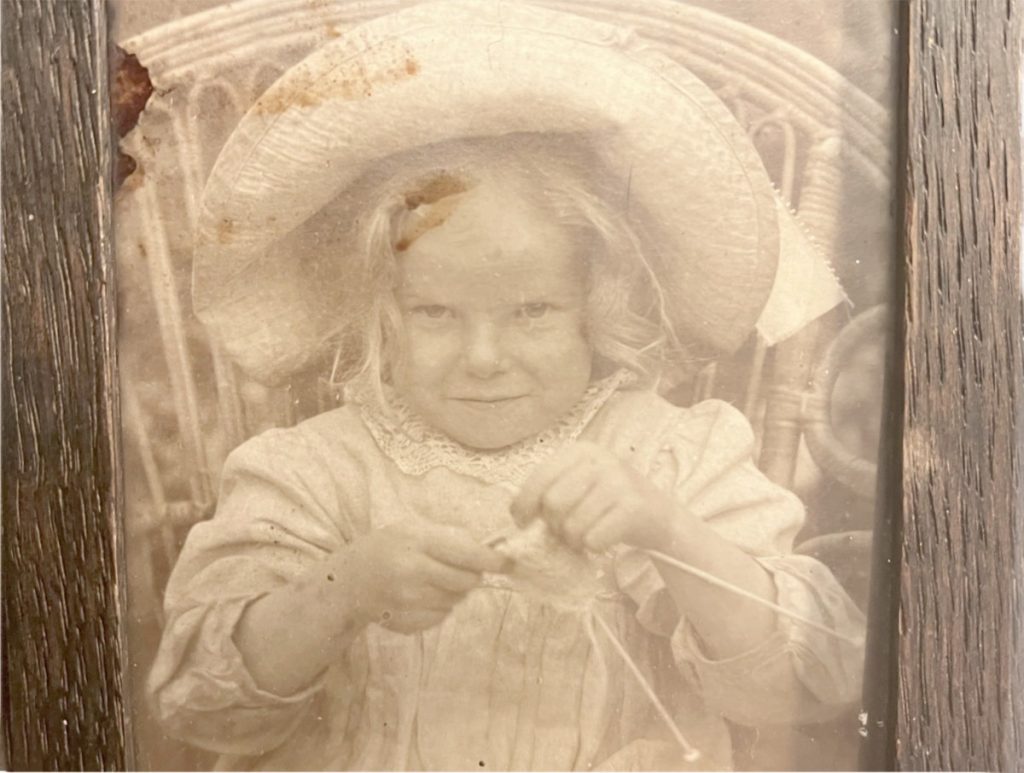
My brothers favourite pastime was to have a block of wood, hammer and nails supplied mostly by uncle, sometimes it was the doorstep as well, but I was happy with a book or knitting needles. The day I acquired a bicycle was a turning point for me, albeit an old black contraption of the ‘sit up and beg’ type with one brake on a front wheel. Nevertheless pushing it up Holloway Hill was compensated by riding it down again.
Sarratt Memories
Monday was washday, the cellar comes alive, it is now the wash house. Mother and Auntie don their hessian aprons tied round the middle with string, a woollie hat on their heads which had a button on each side proudly made by Auntie, they were rarely seen without this headgear. Auntie had been known to go to bed in hers. Buckets of water drawn from the well and heated in a large copper with a roaring fire underneath. Trestles put up for two baths side by side, each with a scrubbing board, a mangle with big wooden rollers stood in the corner, a bath underneath to catch the water. Side by side, washing, scrubbing, rinsing and mangling often stopping to untangle strings from around the rollers, the clothes were finally hung to dry on a line between two apple trees in the orchard. Nothing wasted, the used water was taken to scrub the cellar floor and swill the path outside.
The well where we drew our water was at the bottom of our garden and used by other people in the valley. One day someone left the lid off and Sam, our pet goose, fell down. After a lot of squawking it was pulled out in a bath on ropes by father and Mr. Tyler. Summer was spent mostly by the river catching tadpoles or swimming. In the evenings the grown ups from the ‘Top’ came down to swim. We could see them running down the field behind Sarratt Church to the Willow Tree. This was the deepest part of the river, some had old tyres blown up to use. Bushes were sought for changing or towels fixed up by the hedge, one eye always on the lookout for the water bailliff. The fishing rights belonged to the Duke, but we were seldom turned away, he knew we would be back again.
My parents friends had two nieces who came to stay in the summer holidiays. Being townies they did not like animals very much, if there were any on the moor or swans on the river it had to be hopscotch in the road and running hoops made from old bicycle wheels.
When one day I was walking along the lane past Mount Wood to visit Grandma, I noticed a sheep walking along the inside of the field. It did not concern me as there were often sheep and cattle in the field, but when I got over the stile I saw it standing a few yards back. It came towards me with its head down, I ran to the hedge after getting a bump in the rear. The eggs I was carrying went flying and I managed to scramble through the wire. Sadly, a few days later an elderly lady was not so lucky. That sheep turned out to be a ram and never was seen again.
About the time my brother started school I was going on to senior school .”Whitehill School for Girls” was my venue for the remainder of my education, except for one term at a village school when my parents moved. A coach bringing children from Latimer to school at Chenies took us back to Chesham. I missed it a few times and had to cycle all the way. My brother was more furtunate than I was, he sometimes got a lift to school on fathers crossbar or my carrier.
Whitehill became an entirely new way of life for me. There were more pupils in one class than the whole of Chenies School. Days began with assembly and our school song. Divided into four houses, Shakespeare, Constable, Purcell and Darwin, which provided teams for sports etc. Swimming naturally was my favourite, plus netball and hockey to name a few. I had violin lessons after school which meant travelling home by local transport. The 336 Chesham to Watford passed through Chenies. A double decker bus with three seats in the middle, a gangway each side, it was always a rush for the front seat on top (not the type with open top and a macintosh to cover you in wet weather although occasionally they did use those).
The problem arose when riding home from Grandmas with my violin balanced on the handlebars. Mother carried it in the morning. When the school took part in a music festival at Berkhamsted I was one of the violinists chosen and still have the badge of St. Cecilia – Goddess of Music. School camping holidays were an experience for me. We paid sixpence a week throughout the year. Setting off from Little Chalfont Station for Eype in Dorset, our first task on arrival was to visit a local farm and fill our mattress with straw. It was called a paliasse. We slept six in a tent which was fine until one wet and windy night the ropes were not secured properly and we all had wet beds (not of our own doing). Chores were shared by everyone, the most boring was peeling potates for 40 people. Washing in open air oblutions was done as quickly as possible. Conway in North Wales was another camp I went to, alright, if you did not mind sand in everything. Camp was on the beach, ideal for an early morning swim.
Anything unusual in the valley was a red letter day, not that getting married was unusual but it was cause for excitement. Twice I was a bridesmaid, first to Connie, Auntie and Uncles daughter. I do not remember very much about that, except being dressed in white satin with a lace cap, having lots of photos taken under the apple tree in the orchard after going to Chapel in a big black car with white ribbons on. Soon after this the Chapel Minister married Connie, the Butchers daughter, everyone turned out for that. My second time as a bridesmaid I have cause to remember, wearing a lemon silk dress with pink rosebuds on, it was a pouring wet day, I was carried into Church under a large umbrella. As soon as all the festivities were over the dress had to be taken off and put away for Xmas which was only a few weeks away. Party time arrived, I set off with my father over the moor towards Chenies on a cold and slippery afternoon. When crossing the bridge I slipped and fell in the river, for once fathers walking stick served a good purpose. Taken home soaking wet and bedraggled, I was dried out and went to the party, but ‘alas’ not in the lemon silk.
My father always wore white spats with his Sunday best and a Trilby hat carrying his walking stick, the hat was ‘doffed’ to passers by. On big occasions it was a bowler hat which had to be brushed religiously round and round in circles with a special brush that never had to be used for anything else. I still have that brush today.
When we were invited to stay with Uncle Peck for Christmas, we set off for Chorleywood Station through Goldingtons Park up North Hill to Green Street, a long lane leading down to the station, reaching Baker Street in London and then by cab to 32 Pembury Grove, Hackney. A five storey building with four generations living there, at Christmas there were twenty sometimes more. The kitchen was on the ground floor where Uncle Peck did the cooking himself. One flight up was the dining room with a long table, in the middle of it was a pudding, so we thought, but there were pink and blue steamers hanging from it, with a pull we each had a gift. I had never seen the like before.
Again another flight up and we were in the parlour where friends and neighbours came to play games until teatime and then it was soon bedtime for we young ones. The top two floors were bedrooms and above that an attic. The grown ups played charades and sang songs. One or two of Uncle Pecks relations played some sort of musical instrument. One Aunt played a harp when she was well enough. Mother had a lovely voice and always enjoyed these get togethers, at one time she had been with a local concert party singing songs from the shows. My older cousins sneaked out onto the stairs to listen to the goings on in the parlour. Uncle Pecks daughter would go to bed with her hair all tied up in rags, coming down to breakfast with long ringlets down her back. No amound of persuasion would induce my hair to turn up at all.
At the Bottom of the Park near the White Bridge was a row of five cottages, one of them served cups of tea by an elderly lady. Also there was a shed where a cobbler did shoe regairs- actually he made a pair of white sandals for me when I was married. My Father had an allotment along there and my job was to pick up the small potatoes – nothing wasted in those days. Wasps were a problem when the apples and plums ripened, this was when Reckitts Blue Bag came into its own (other than on Mondays in the Wash-tub). Dampened and rubbed on the affected part to cool it down after (if) the sting could be removed.
At the bottom of Dawes Lane was where the Freeman family lived, I used to play with Noreen in the holidays. There was also an old lady living there who everyone called ‘Aunt Pam’. Noreen left the Valley belore I did and the new residents served afternoon teas. Halfway up Dawes Lane were some pig-styes with several pigs that were farmed by a man called Si who lived in a hut there, he was a friendly person.
The cottages on the common opposite what is now Wards nurseries vere pulled down, and so apart from ‘Si’ there was only a lady in a caravan who was related to Brummy Young. Brummy lived at the bottom of the Park on the riverside, he had a ladder up one side of the fence and down the other. My parents often used to stog and chat on a Sunday evening ii he was leaning over the fence.
Farther on over the Lane the Ships lived at the Waterworks cottage. Betty and Jean went to Sarratt school and were a good bit older than me. We walked by that way to visit relations in Solesbridge Lane.
As I have said I went to Sarratt Chapel Sunday School when I was quite young and so I had to walk up Dawes Lane, although sometimes I would cut across the fields. I was never worried about meeting strangers, so many came down to the river at weekends. If Mr Stockley happened to come along on his motorbike – what better than to ride pillion- the Grandparents had never heard such goings on. In later years my Father often took Mr Stockleys daughter Barbara to Chenies – in a Pony and Trap.
My only surviving uncle loves to recall those days with me and confirm much of what I have said. Transport not being much in evidence people stayed within their own community or used ‘Shanks Pony’.
Goldingtons, a house at the top of the Park, was where the Clutterbuck family lived. Each year, on Boxing Day, Miss Margaret
came to the valley with a gift for everyone. The park was an ideal spot for sledging. On the side of North Hill it was a quiet area very pretty when the frosts made lacy cobwebs on the hedgerows to sparkle in the winter sun. Until I was eleven years old I went to Chapel with Connie. It was here I learned my Scriptures, took part in Sunday School Anniversaries and Nativity Plays – until my parents decided it was time for me to go to Church at Chenies where the family worshipped and had done for many years, most of them in the choir at some time.
Sarratt was also familiar to me through by Sunday School activities, it was from here we went to catch rhe bus to Watford on market days. Mr. Biggerstaffs coach ran several times a day and was always full on market days. The cattle market was held in the High Street and a big open market where Charter Place is today. Woolworths was better for me, within my price range, nothing
over sixpence. Mother would buy our clothes from Marks and Spencers usually their prices were under five shillings. The day then finished off with tea in Bucks Restaurant.
The major event in Sarratt was the fair on May Ist. Every year, for two days. the green was a hive of activity. Water squirts and confetti for a penny, we used to squirt and run. The music echoed across the valley and could sometimes be heard in Chenies. Friends always liked to come and stay for this event. In Chipperfield a clinic for children was held once a month. Mr. Hosier ran a taxi back and forth from Sarratt. A kindly man, when one day one of Mrs. Downhams children lost a sock, someone saw it by the roadside and he waited while they went back to get it.
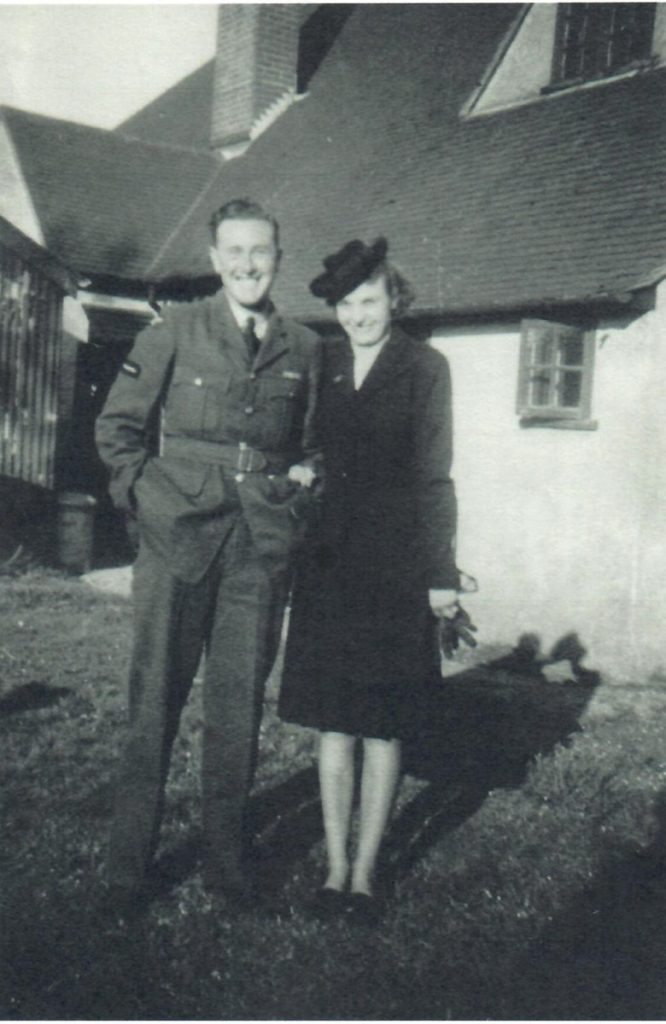
It was here that “Nurse Maggie” reigned supreme. she toured the villages around on her bicycle and from her black bag always seemed to produce the necessary, whatevery the case maybe. A very Scottish lady, but a heart of gold beneath her stern figure. Little did I know then that Chipperfield was to become my home, but it was then that I met again with the Downham family, as in the same way I saw Hilda Hopkins again. So many friends come to mind one wonders “where are they now”. Although many return for Sarratt Fair or to visit relations and to “Holy Cross” for festive occasions.
In Chenies being a smaller community. Guv’ness son still lives in the village and many keep in touch with him. Some meet up at
“Whitehill” old Girls Reunions. Incidentally, the School celebrates it centenary this year, although now it is a Community Centre 1890 – 1990. However, when in 1937 my father and Mr. Stockley decided to buy a plot of land in Chipperfield and each start their own smallholding. Two bungalows were built and we were ready to go. Mr. Stockley already had chickens and so the henhouses had to be taken down. I was volunteered to help with his wife who was given to fits of laughter. Suddenly seeing the funny side, she dropped the part she was holding and it wasn’t the sound of cackling hens that came from inside the henhouse.
Farewells had to be said to the valley folk. I was to leave my childhood playground, no more games on the moor or sitting at the bedroom window to watch the men fetching water from the well. One I remember always had a yoke on his shoulders, a chain on each side with a bucket hooked on the bottom. The chickens were crated and transported in a motor bike and sidecar. I make that last journey on my old bike proudly wearing the silver necklace Auntie and Uncle gave me.
And so to a new life, all mod cons, water on tap and a bus at the end of the road. Today my Husband and I still walk the valley woods and fields. I live again those childhood memories and realise how the passage of time changes our lives as we tread a new path.
But thats another story.
PDF Downloads: