

Woodside House: A School
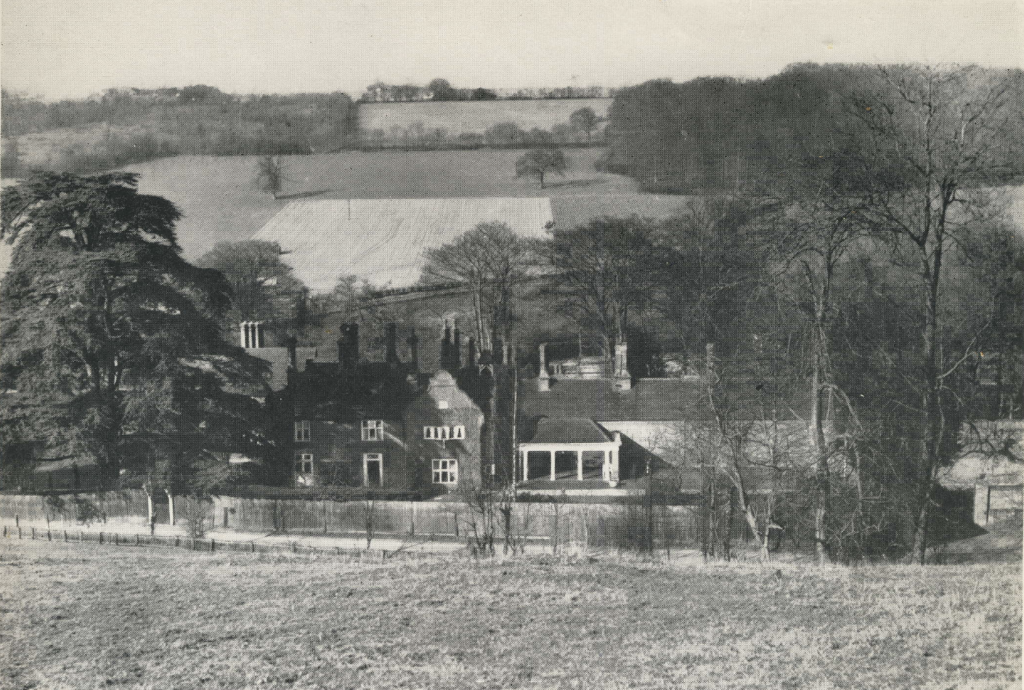
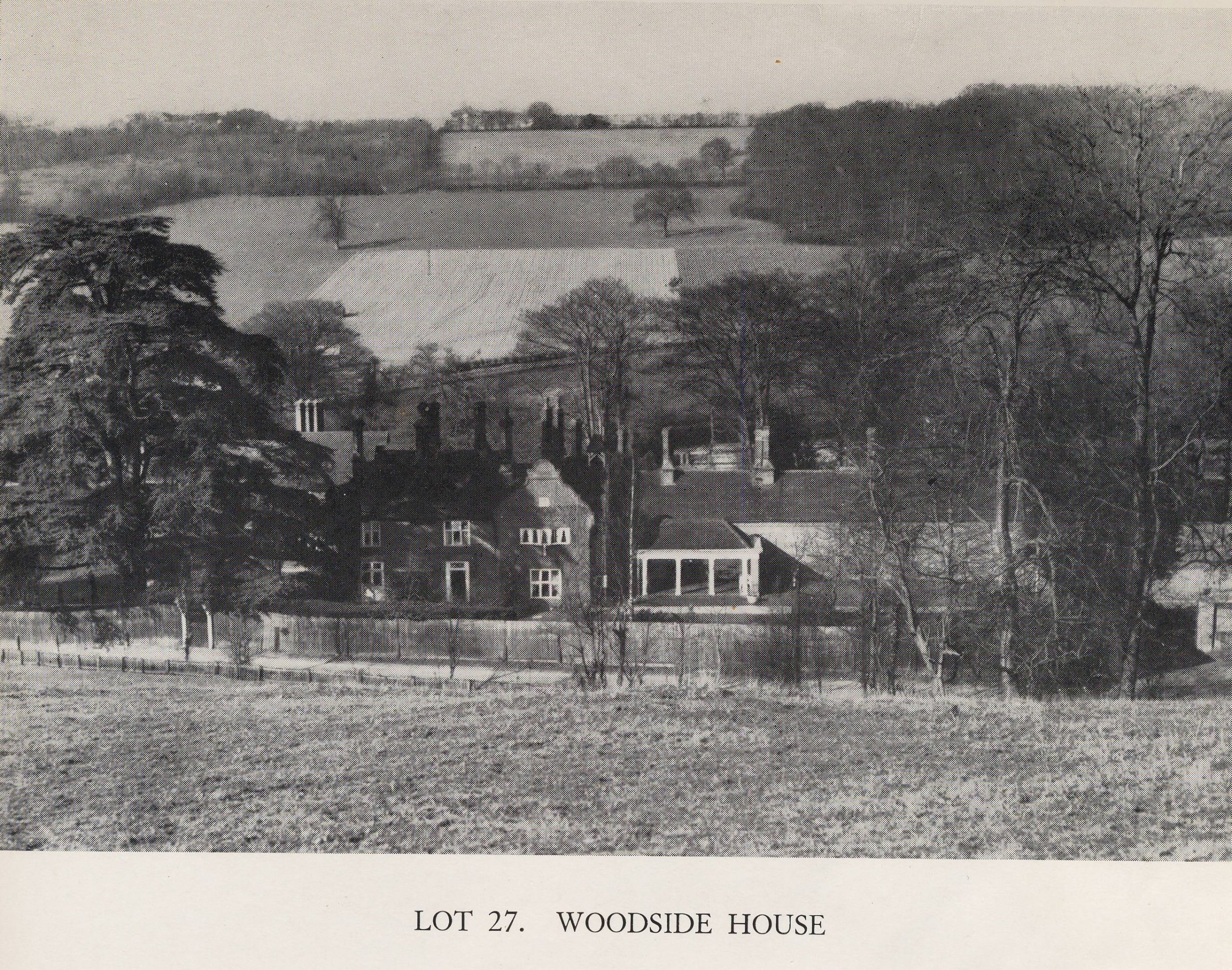
Woodside House started life as a boarding school for ‘young ladies’, where between 1860 – 1887 it educated the daughters of the nobility. The Misses Forbes, sisters Louisa and Evaline, worked there as schoolmistresses along with a language teacher, cook and a variety of domestic servants from the surrounding area. In 1871 there were 12 scholars listed as present for the census, and in 1881 there were 10. Louisa and Evaline were both born at the Russell’s Woburn seat, where their father worked as a gardener and lived in an estate cottage owned by the Duke of Bedford.
Woodside House: The Duchess
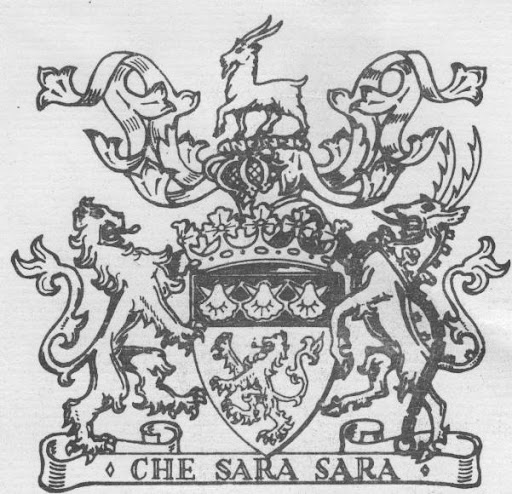
In 1893, on the death of the 10th Duke of Bedford, his widow the Dowager Duchess Adeline Russell moved from Woburn, bought Woodside and turned it into a residence. The Duchess used the cottage as kitchens, built an extension as a chapel (now the dining-room and main bedroom of Chenies Place) and in 1894 she built a stable block and carriage house (now the Court House). Woodside Cottage was built to house the butler. Rose remembers that ‘The Dowager Duchess Adeline of Bedford lived at Woodside House and each year she presented the children of the village with something at Christmas. One year it was a red riding hood cloak for the girls and a red jersey for the boys. Another year it was boots for each child. One year I had a doll but I cannot recall if every girl had one’.
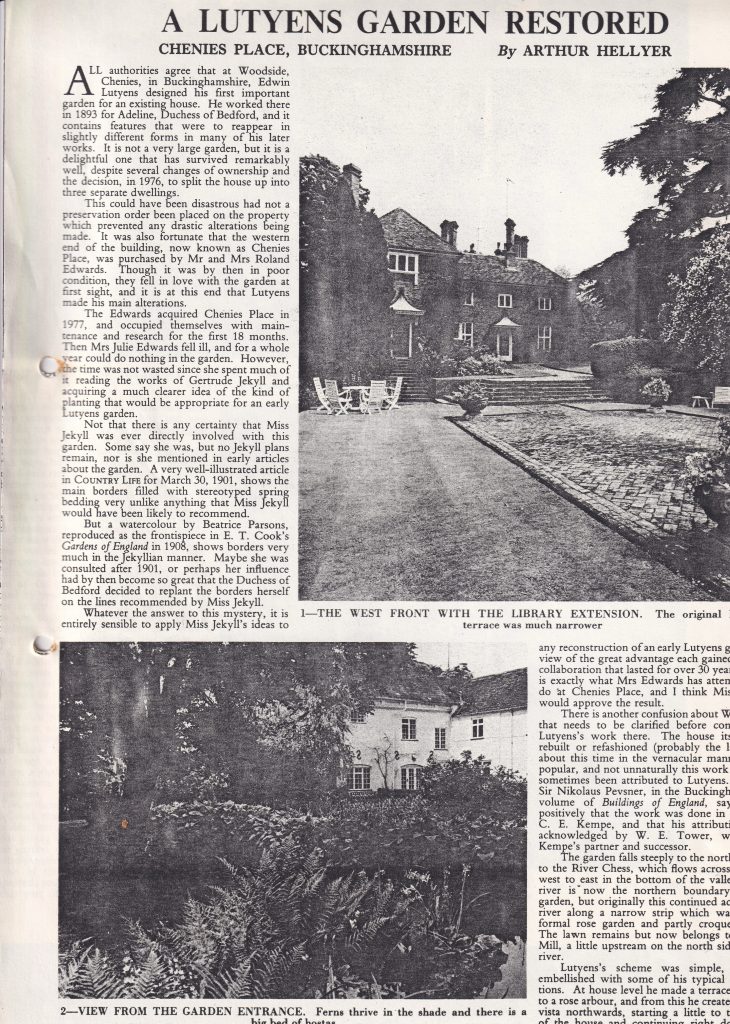
One of the most significant improvements made to the house by the Duchess are the gardens, which were created by Edwin Lutyens, his ‘first important garden for an existing house‘. This 23 year old, unknown and unqualified architect had a sister, Mary Constance Elphinstone Lutyens (1868-1951) who was a scholar at Woodside House between 1884-1885, so Woodside House may have been a personal project for him. Lutyens has since been desribed as the greatest English architect since Wren, and with him he brought his much older friend, Gertrude Jekyll to arrange the planting, who went on to establish herself as the leading plantswoman of her era, who changed the face of English gardening during her lifetime.
The original garden as designed in 1893 measured 12 acres and took in a wide section across the River Chess, with two bridges. Fourteen gardeners were employed for the upkeep, the herbaceous borders being replanted two or three times a year.
Woodside House: Later Years
Mr & Mrs R Stafford Charles lived here sometime after the Duchess died in 1920. They had previously lost their son Captain Leslie Stafford Charles during World War 1. Mrs R Stafford Charles started the WI with Miss Wishart at No. 19 in the 20s.
Woodside was leased in 1946 to Air Commodore C E Benson, who had access to the Westonbirt Arboretum through his grandfather, Sir George Holford. He bought the property in 1954 after the 12th Duke of Bedford died and his estate sold to pay the death duties.
In 1976, a decision was made to split the property and gardens of Woodside House into six separate dwellings, Chenies Place, Woodside House, The Cottage, Gardeners Cottage, The Court House and Woodside Cottage.
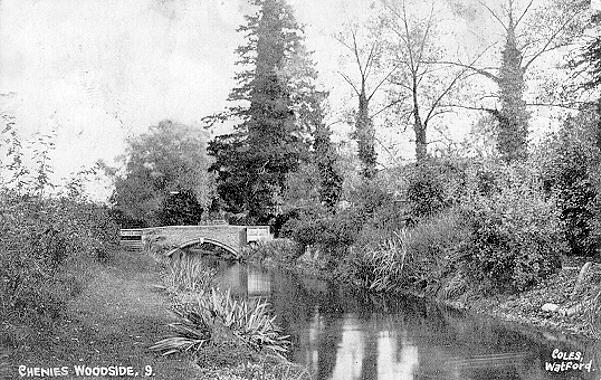
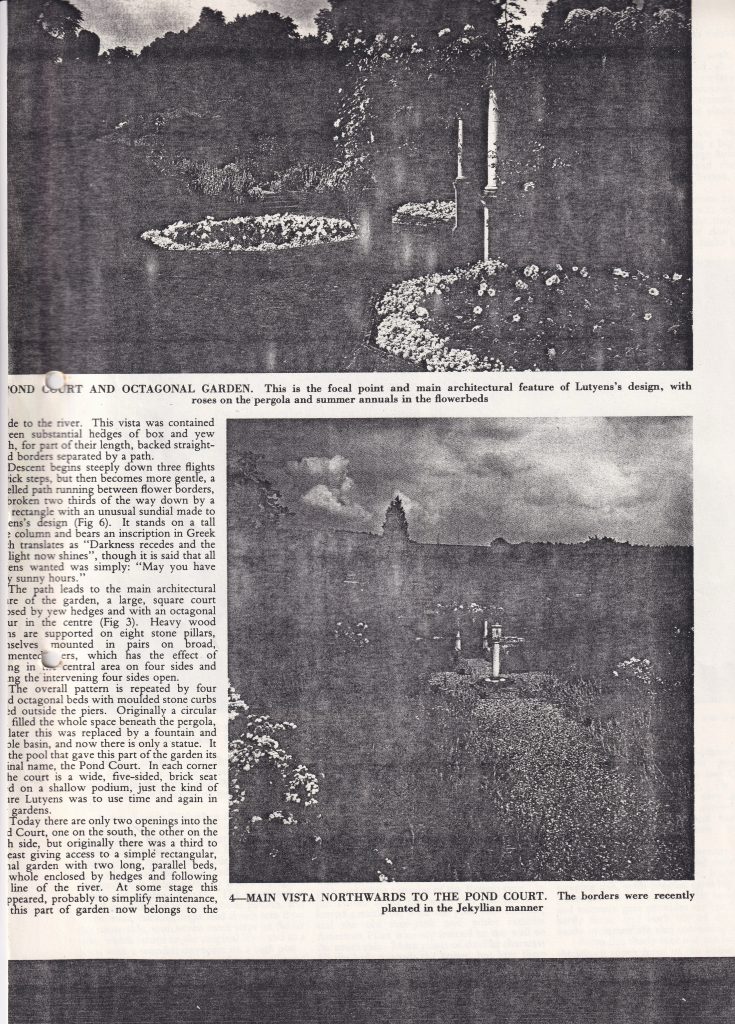
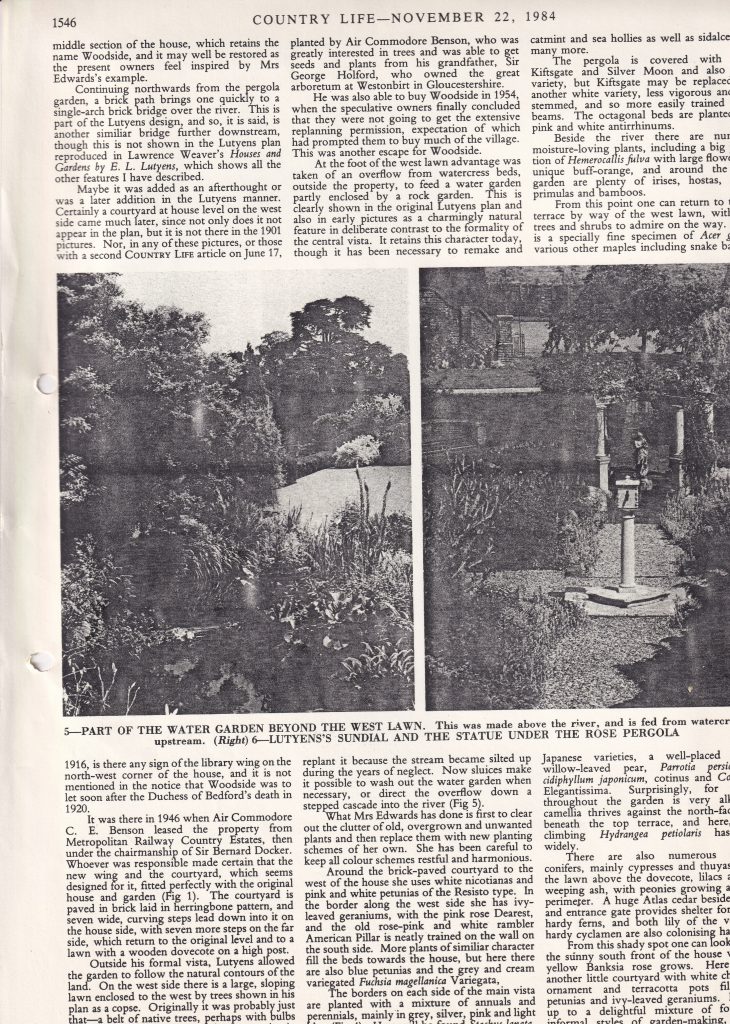
Chenies Place, bought by Mr & Mrs Roland Edwards, still maintains the major features of the garden as designed by Lutyens, including brick steps and a gravel path that lead down from a huge Atlas cedar, over 200 years old, to a Lutyens sundial set between yew hedges, and then on through the courtyard with full Lutyens Seats to a bridge over the River Chess. Between the sundial and the bridge is a pergola covered with roses; Kiftsgate and Silver Moon. On either side of the pergola are octagonal beds planted with pink and white antirrhinums.
The water garden fed from a small tributary of the Chess is a particularly attractive feature, and there are some unusual trees, planted by Air Commodore C. E. Benson.
The garden is listed which prevents alteration to the architectural features without the consent of English Heritage. Planting is at the discretion of the owner, whose efforts to continue the Jekyll tradition are restricted by the lack of fourteen gardeners!
sources:
Chorleywood, Chenies, Loudwater and Heronsgate, a Social History by Ian Foster
Country Life, November 1984 (see above)
contributors: Rachel Bishop, Sandy Homewood
date published: 18/04/26