

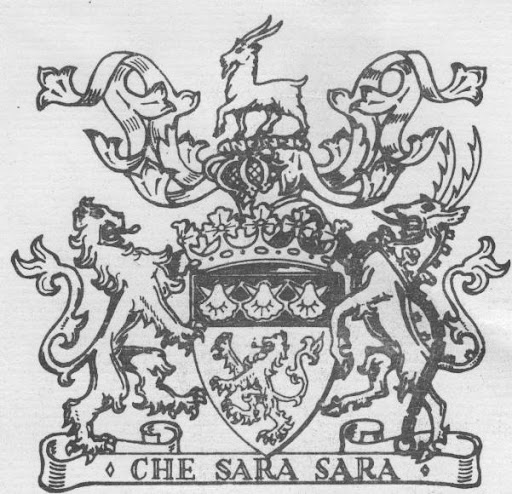
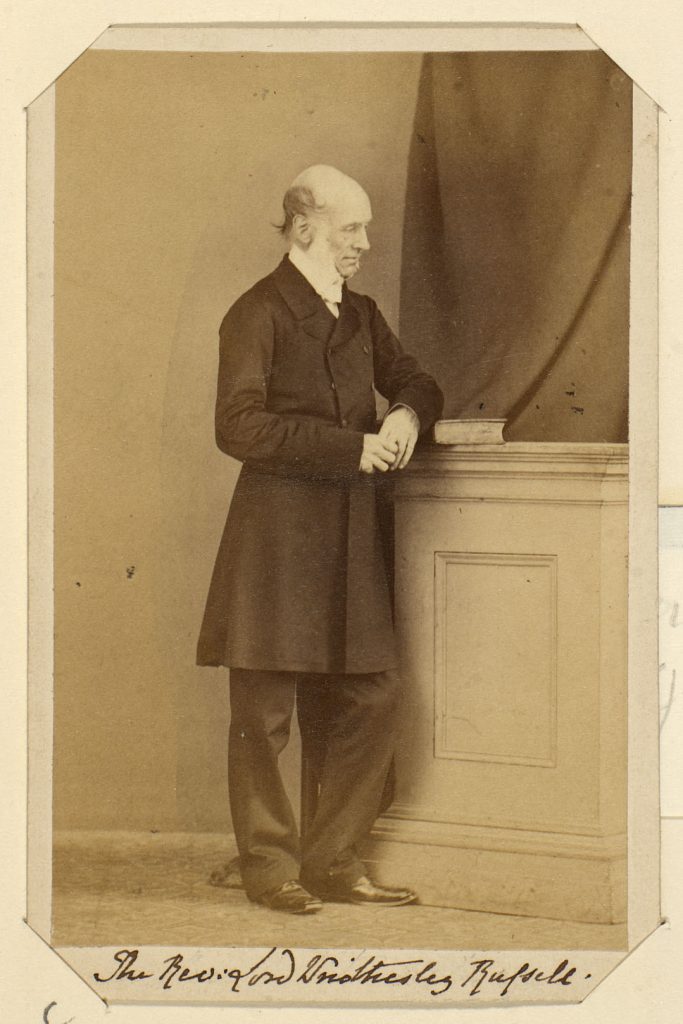
used with permission
11 May 1804 – 6 April 1886
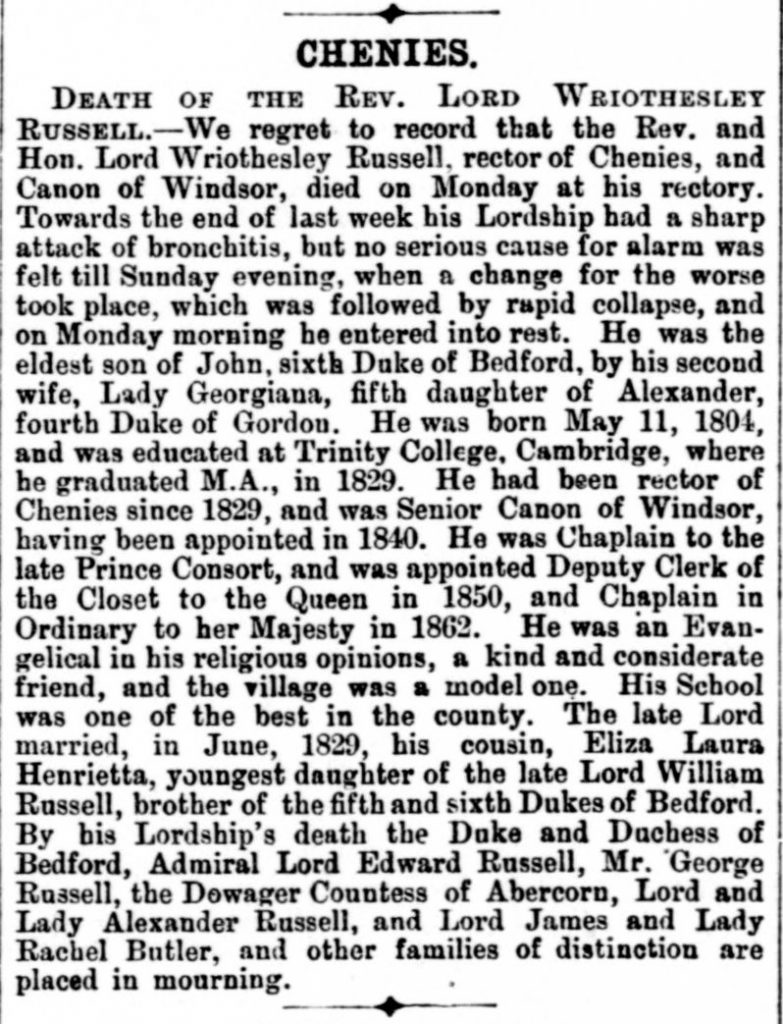
The Reverend Lord Wriothesley Russell was born in 1804 to John Russell, the 6th Duke of Bedford, and his second wife, Lady Georgiana Gordon. Educated at Trinity College, he was awarded an MA in 1829 and arrived in Chenies that same year aged 25 where he became the much loved Rector of St Michael’s Church. His memory is still treasured in the village.
In his recollections of Russell, Dunne writes:
“To surrender all these prospects, for a few hundred souls, and a benefice worth £400 a year! It is true he held at first, as well as Chenies, the rich and important living of Streatham, but it was not for long, as he resigned the latter, and determined to devote his labours to his little Buckinghamshire village, from which place nothing could induce him to depart; not even the offer, twice, of a bishopric …He loved his poor people and they loved him. He read for them, he worked for them, he prayed for them, and it was no wonder that ‘his lordship’s’ wish was the only law they knew.”
The same year he arrived in Chenies, Lord Wriothesley set about repairing the Church. During 1835-36 it was closed for major restoration, reopening on 23rd June 1836. Lord Wriothesley also arranged for substantial repairs to be carried out to the surviving elements of the manor house in c.1830, following occupation of an unreliable tenant.
In 1831 the first iteration of the current Chenies School was held in Lord Wriothesley Russell’s kitchen at the Rectory (now called Chenies House) where he continued to teach up until the new school was built in 1846. Lord Wriothesley also started an orphanage for boys in what are now the Platt Cottages, and opened the new burial ground opposite the Church, this by overcoming some opposition by promising that was where he and his wife would be buried when the time came. It is said that Lord Wriothesley refused to have a new carpet in his study as the men would not like to walk on it in their boots.
The affection in which he was held is attested to by the lovely illuminated address presented to the Rector in 1879 to mark his 50th anniversary as priest. This special frame made with wood from St. George’s Chapel, Windsor, where he had been made Canon in 1840, with charming watercolour paintings of local scenes still hangs in the church, and on each side may be seen the signatures of all the residents of the village. It is interesting that some of these names are still to be found either in the village or the surrounding area. On this Jubillee occasion, Miss Forbes on behalf of Woodside House, (then a school for young ladies) presented him with a gold watch.
Lord Wriothesley Russell was made Deputy Clerk of the Closet to Queen Victoria in 1850, and had three children with his wife Elizabeth Russell, including Alfred John Russell (13 Aug 1833 – 11 Feb 1857), Algernon Wriothesley Russell (30 Aug 1835 – 19 Feb 1908) and Evelyn Mary Eliza Russell (5 May 1837 – 5 Dec 1913). Algernon and Evelyn (‘Miss Russell’) continued to live at Chenies House after his death in 1886, and are remembered in the memoirs of the school children and villagers at the turn of the century.
Rev. Russell and his wife are buried in the churchyard of St Michael’s, Chenies, together with other members of the Russell family.
content sources:
Article written by members of the Buckinghamshire Federation of Women’s Institutes for the publication “The Buckinghamshire Village Book” (1987) and reproduced here with their permission
Personal Recollections of Lord Wriothesley Russell and Chenies, by F.W.B Dunne. Published by Elliot Stock, London, 1888
Further edits sourced from Wessex archaeology (January 2005). “Chenies Manor, Chenies, buckinghamshire: An archaeological excavation of a tudor manor house and an assessment of the results” (PDF). Archived from the original (PDF) on 16 January 2016. Retrieved 2 Dec 2025.
contributor: Andy Homewood, Rachel Bishop date published: 09/06/26