

Research conducted by Mrs A.M. Thomas, August 1984
Families with a dissenting background certainly give the family historian a hard life, being mostly outside the standard parish registers. However, useful clues can sometimes be found in a other quarters and this is true to some extent of the Clarkes of Chenies.
The earliest reference I have come across is in a 1783 mortgage deed and, by following the trail through a network of deeds, one comes to the conclusion that the premises concerned were on the site of the present block of houses which includes No. 10 Chenies. The deed refers to two pairs of dwellings on the site, one pair being originally a thatched barn. In one of the non-barn pair lived a Samuel Clarke.
He was probably not a very young man at the time for, a few years later, in 1798, when a French invasion was thought likely, a return was drawn up of men aged from 16 to 60. In this Samuel Clarke senior and Samuel Clarke junior are both listed as wheelwrights. It was presumably Samuel junior who, in 1795, had married Mary Abbee at Rickmansworth. He was described as ‘of Chenies’ and she is likely to have belonged to the family which leased brick-making premises somewhere in the modern Chorleywood Station area, i.e. just over the border in what was then Rickmansworth but part of the Duke of Bedford’s estate. The name has links with the Chenies Baptists. The date would allow an eldest child of the couple to figure as the Samuel Clarke of the 1841 and 1851 Census Returns.
As a matter of fact there appears to have been a definite concentration of Baptists in the area around the Chapel in Chenies (called in the 1861 Census ‘the Upper End’) and clues to a whole network of business transactions and marriage alliances are plentiful. Not that the little Chapel register for 1783 to 1812 deposited in the Registrar General’s Department is very helpful for the Clarke clan for it appears to heve been rather erratically kept; there is only one Clarke entry, that of the burial of an 8 months-old child of Samuel and Mary Clarke in 1802.
In 1793 both the Samuels had appeared among the supporters of the declaration of loyalty to the Crown, drawn up at a meeting of inhabitants of Chenies and some neighbouring parishes and now preserved among the parish records.
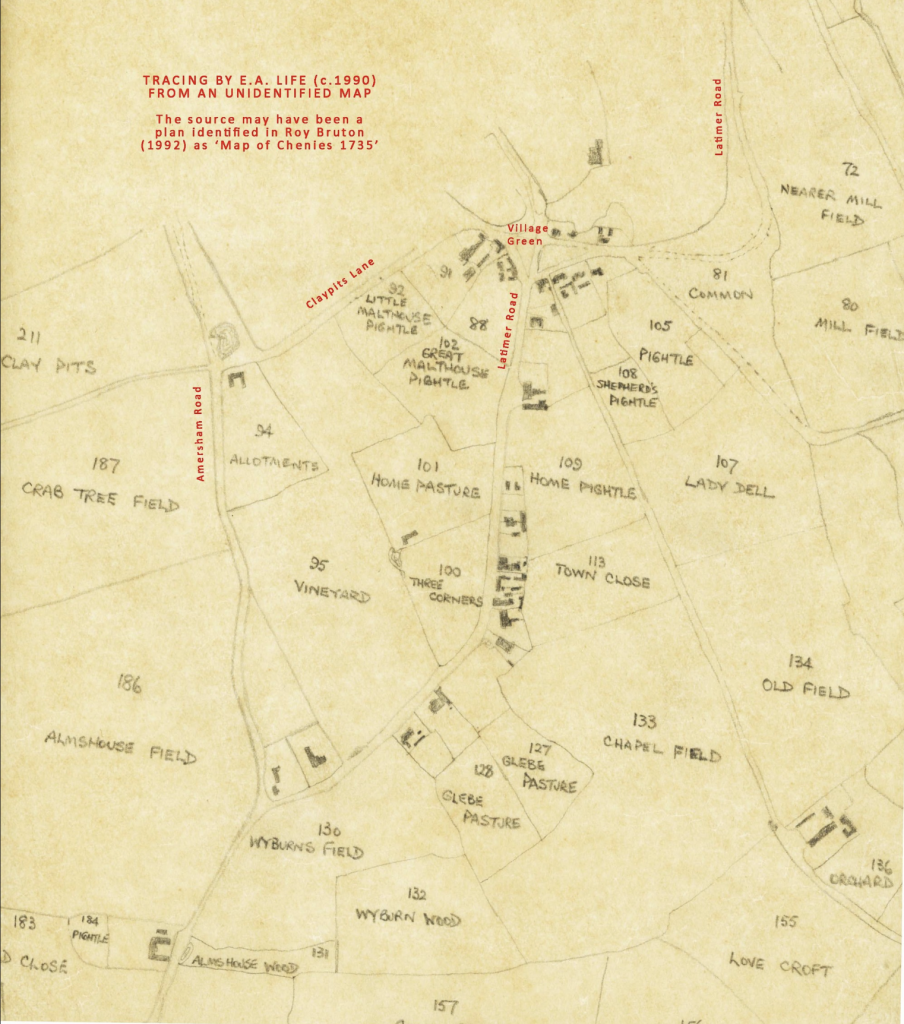
At this time Samuel senior, and possibly his son also, appears to have been living on the above-mentioned premises at the end of the village, and to have had a wheelwright’s workshop there. An 1802 Survey of the Bedford estate refers to the inconvenience caused by the quantities of their timber lying by the highway and advises that a piece of land from the adjoining field, Wyburn’s, should be let to the wheelwright so as to remove this nuisance.
This field was part of Grace’s Farm (the farmhouse stood on the site of the modern house next to the Cricket Club) and the Survey recommended breaking up this unit and offering the tenant one of the Green Street Farms instead. This tenant was William Simpson, the owner of the property occupied by the Clarke’s. A few years later find that the advice has, to some extent, been acted upon; an Estate map shows Samuel Clarke as tenant of all Wyburn’s Field as well as Cooks field on the other side of Wyburn’s Wood. In an 1809 Land Tax return Samuel Clarke is still a tenant under Simpson; he also appears among the list of those passing the parish accounts (Poor Relief etc) until 1810. After that, for a number of years, the name becomes just plain Samuel Clarke, as if there were no longer two of them to distinguish by senior and junior, so possibly Samuel I died about this time. After all, his grandson, Samuel III was about fourteen so the old man is likely to have been well past middle age.
At any rate Samuel III’s name (presumably) continues to appear in parish records, several times as an Overseer of the Poor until 1835. He is also appointed executor, with two other identifiable Dissenters from Chenies, of the will of George Clarke of Watford, carpenter, who died in 1817, It was they who conveyed cottages at Water Lane, Watford, to William Davis, another of the Dissenting colony, who had been a tenant of the Manor House Farm and came from a family which had served the Dukes as agents and surveyors.
One had hoped to look at this will but it was withdrawn for filming and is only lately back in circulation. Some information from the Inland Revenue Estate Duty records states that his properties were to be sold for the benefit of his two daughters, Sarah and Elizabeth, and value was sworn at under £600. The will may possibly yield further family details. Two of the executors, James Cannon and James Body, were Chenies Farmers; Samuel Clarke, presumably Samuel II, was called a wheelwright. I have an idea there were marriage links with Clarkes in the case of Body and Cannon.
By the time of the 1825 Land Tax, and possibly earlier, Samuel II is shown among the farmer tenants of the Duke of Bedford, and so he is in the 1825 Poor Rate return. By 1828, when he was a trustee in the documents concerning a property purchase by his son, Samuel III, he was called a farmer.
The farm was one which was listed in an 1836 Rental, and was known as Port’s Farm, its house today represented by No. 18/19, Hillside. In 1802 it had been described as a brick and timber building, tiled, of old construction but in good repair. It had two barns, one thatched and one tiled. A cowhouse, carthouse and pigsties were of timber and thatch. It was not a large farm and many of its fields were, before long, to be merged in the lands of the new-built Mount Farm.
I have not, so far, looked at any evidence for the precise dating of Samuel II at Port’s Farm so cannot say definitely whether he had got there when the 1821 Census was made, but it seems likely. Like other early returns this was a matter of numbers only, without personal details and the records have not been preserved. However, in Chenies, the parish officials made a rough pencil draft and, for their own convenience, identified each household by its head’s name before setting out the numbers of males and females in each age group.
The little packet of Papers has survived among the parish records and we find the household of Samuel Clarke enumerated as follows:-
| 5-10 years | 15-20 years | 20-30 years | 40-50yrs | |
| Males | 2 | 1 | 1 | 1 |
| Females | 1 | 1 | 1 |
Of course one cannot tell whether all the eight were one family or whether a servant, apprentice or even lodger might have been included. Samuel III’s marriage date must have been a very few years later, judging from the ages of his family in the 1841 Census.
Samuel II still figures as a farm tenant in Poor Rate and Land Tax returns of 1831 but, by the time of an Estate Rental in 1831, some Mount Farm land is described as ‘late part of Clarke’s farm’ and an item among the Estate Correspondence refers to the question of a new tenant for Clarke’s farm. Presumably Samuel II had either resigned his tenancy or died. He was likely to have been approaching seventy years.
To turn now to what can be discovered of the life story of Samuel III, who also turned out to be a wheelwright and seems to have remained one in spite of other interests.
He is likely to have been the young man in the 20-30 age group in 1821 and must have been in the lower part of it. By the ages of his family in the 1841 Census he must have married in the early 1820s, but when and where is not discovered so far, or the origins of the bride.
For well over a century a family named Reed had owned a small property now represented by Nos. 50 (Grafton Cottage) and 52 (The Plough) and successive generations, mostly woodworkers or dealers, had occupied the two dwellings there. In August 1790 Richard Reed, the last of the name to be owner, had married one Sarah Clarke. It was not a first marriage for his eventual heiress, Mary, was old enough to be a bride in 1806. Richard died in 1811, leaving some of the property to the widow Sarah for life and then to Mary, his daugnter.
The cottages had been sub-divided as time went on and even further accomodation built on the gardens and some of these premises were bequeathed outright to Mary and her husband, Thomas Gristwood. The widow Sarah died in 1827 and the next yearThomas and Mary began to dispose of the inheritance.
The No. 52 portion was acquired by Samuel Clarke, junior, wheelwright, with his father, Samuel, senior, as his trustee. In due course a wheelwright’s shop was put up in the yard and the front cottage turned into a beershop, The Plough. In 1838 a deed concerning No. 50 refers to Samuel junior as ‘dwelling’ next door, though in 1833 a document concerning the Simpson property at the end of the village had described him as occupier there, but replaced by another tenant before 1839. It was in 1833 also that Samuel junior was negotiating for a mortgage from the Duke of Bedford. He still seens to have been living at the No.52 premises at the 1841 Census (though no inns or beerhouses are actually given their names therein). The family consisted of:
| Samuel Clarke | 45 years | Wheelwright |
| Elizabeth Clarke | 45 years | |
| James Clarke | 16 years | Apprentice Wheelwright |
| Samuel Clarke | 14 years | |
| William Clarke | 10 years | |
| Rebecca Clarke | 7 years |
Two years later, in 1843, the Tithe Survey took place in Chenies, part of a nation-wide measure to put the charges on a standard basis. The schedule of owners and occupiers shows Samuel Clarke now the occupier at the Red Lion and also the owner of the house, workshop, yard and cottage on the 52 Chenies site, stated to be occupied by himself and others. His own occupation presumably refers to the workshop.
It is interesting to notice that in 1844/45 a letter concerned with encroachment on the highway is mentioned as being delivered through Mr. Samuel Clark of the Red Lion.
By the time of the 1851 census Samuel and his remaining family were back at Wheelers Yard (as the 52 Chenies site had come to be called), though one is not entirely sure whether they were living at The Plough or in the buildings, shop and yard owned by Samuel himself for The Plough had been conveyed to a Watford brewer in 1849. Samuel could have been their tenant.
| Samuel Clarke | 55 yrs | Wheelwright | Born Chenies |
| Elizabeth Clarke | 54yrs | Beer seller | Born Chenies |
| Samuel Clarke | 23yrs | Butcher | Born Chenies |
| William Clarke | 19yrs | Wheelwright | Born Chenies |
| Mary Ann Derry, (granddaughter) | 5yrs | Scholar | Born Chelsea |
Samuel had been succeeded at The Lion by John M. Hughes and Fanny, his wife, who had been tenants of one of the Plough cottages in 1841. I have an impression that somewhere i have come across a relationship link between this couple and the Clarke family but I do not remember where, so I may be mistaken. Fanny was born in Sarratt. There certainly was a noticeable tendency in this ‘Dissenters quarter’ for kinsfolk (and/or other Dissenters) to be the occupiers of dwellings belonging to the little handful of property-owners of ‘the Household of Faith’.
August 1856 found Samuel Clarke, late of Chenies, now of Sarratt, taking out a mortgage on the two cottages at the rear of The Plough. Then there is silence for fifteen years until, in May 1871, Samuel Clarke the elder, wheelwright, conveys the two cottages to Samuel Clarke the younger, butcher, (i.e. Samuel IV) of Chandlers Cross near Watford. Samuel IV promptly mortgaged the property to a Building Society. A further mortgage followed in 1877 by Samuel the younger. Yet another, in 1882, was to plain Samuel Clarke, no elder or younger, so possibly Samuel III had died between 1877 and 1882, but perhaps more detailed information on this point is already in hand. To finish the tale, the two cottages were acquired from the Building Society in 1892 for the Duke of Bedford, which is why the series of deeds has been preserved among the Bedford Archives.
And so ends the story of the Clarke family in Chenies, its successive generations, its occupations, its property transactions, and its dwellings as far as the sources so far available to me record it. I have it in mind to visit the Hertfordshire Record Office before long and I may pick up something further there.
If there are any questions I might be able to answer directlyplease do not hesitate to contact me and I will do my best.
Mrs. A.M. Thomas.
SOME FURTHER FACTS
As one rather expected, the complete version of George Clark’s will of 1817 produced further family details. When naming Samuel Clark of Chenies, wheelwright, as one executor George describes him as his brother. Likewise, James Body, another executor, is called a brother-in-law, Presumably this was the James Body who married an Elizabeth Clarke by licence at Chenies on 5th November 1801. George: mentions two wives, the first, Mary, and the second ‘lately deceased’, but without a name. Mary was the mother of the two girls provided for by the will, both apparently still under age. By the second wife there were two sons, Samuel and Joseph, also under age of course. The cottages in Water Lane, Watford, were to be sold for the benefit of the daughters and to pay off a £300 mortgage. Another set of cottages in Watford (in one of which George appears to have dwelt): were to go to the sons. Another batch of recently-purchased, newly-erected cottages nearby were left to the daughters. The will was made less than two months before George’s death.
A visit to Hertford raised a few assorted scraps. A film at the Reference library of the 1851 Census covering Sarratt included the following: –
| James Clark | 26yrs | Wheelwright | Born Chenies |
| Bethiah Clark | 29yrs | Born Sarratt | |
| William James Mill (wife’s son) | 5yrs | Born Sarratt |
At the Record Office in a rapid scanning of a difficult film of Sarratt Parish Registers I noticed:-
| Frances Clark | 67yrs | 27 March 1830 | of Watford, buried |
| Elizabeth Clark | 70yrs | 30 Dec 1839 | of Chipperfield in Kings Langley parish, buried |
| James Clark | 85yrs | 5 Jan 1840 | of Watford, buried |
It would seem that Watford and the parishes between there and the Chess valley might be the best locations for the particular Clarke line being traced.
The card-index for Herts marriages carried a large wad for the name throughout the county, including a long list of Samuels, but a top-speed run-through did not note any parishes outstandingly likely to have links with the Chenies line.